Showing posts with label probability. Show all posts

Tuesday, May 24, 2022

Keys: An Empirical Study

(Click on the comic if you can't see the full image.)
(C)Copyright 2022, C. Burke. "AnthroNumerics" is a trademark of Christopher J. Burke and (x, why?).

The probabilty of successfully unlocking the door on the first time is very low.

In actuality, the incorrect key fits into the cylinder but doesn't turn. However, the correct key, at times, does not turn on the first attempt leading the user (i.e., me) to believe that it is, in fact, the incorrect of the two keys.

However, this wasn't as easy to illustrate, so I went with non-entry, which doesn't actually happen with similar keys. The bathroom key, for example, is a completely different key and wouldn't fit into the cylinder at all. However, there is no circumstance under which I'd mistake the bathroom key for the classroom key.

I will add in these notes that I believe I saw a similar image years ago about orienting a thumb drive correctly. I will defend this comic by saying first, these involves the selection of one out of two separate keys, as opposed to lining up a USB or picking up the correct end of a paper clip. Second, this actually happens to me on a daily basis. I'm living this comic, making this autobiographical.


I also write Fiction!


You can now preorder Devilish And Divine, edited by John L. French and Danielle Ackley-McPhail, which contains (among many, many others) three stories by me, Christopher J. Burke about those above us and from down below.
Preorder the softcover or ebook at Amazon.

Also, check out In A Flash 2020, by Christopher J. Burke for 20 great flash fiction stories, perfectly sized for your train rides.
Available in softcover or ebook at Amazon.

If you enjoy it, please consider leaving a rating or review on Amazon or on Good Reads.


Come back often for more funny math and geeky comics.


Thursday, June 17, 2021

How Many Launches?

(Click on the comic if you can't see the full image.)
(C)Copyright 2021, C. Burke. "AnthroNumerics" is a trademark of Christopher J. Burke and (x, why?).

Assume a giant space amoeba doesn't swallow up the entire system first.

Solutions are left as an exercise for the reader.

Nah, that's not a copout. I'm just trying to get more comments.


I also write Fiction!


Check out In A Flash 2020, by Christopher J. Burke for 20 great flash fiction stories, perfectly sized for your train rides.
Available in softcover or ebook at Amazon.

If you enjoy it, please consider leaving a rating or review on Amazon or on Good Reads.

Thank you.


Come back often for more funny math and geeky comics.


Tuesday, May 04, 2021

P(C3PO)

(Click on the comic if you can't see the full image.)
(C)Copyright 2021, C. Burke. "AnthroNumerics" is a trademark of Christopher J. Burke and (x, why?).

There's no replacing them!

While I'm pretty much over the joke of "May the Fourth", I will continue to acknowledge it. It's odd that I didn't hear it at all for the first 25 years or so, and then couldn't get away from it. Also, I think "Revenge of the Si(x)th" makes more sense than "Revenge of the Fifth", with the side benefit of leaving Cinco de Mayo alone.

As for the problem above there is a 1 in 5 chance of selecting the correct protocol droid and a 1 in 4 chance of selected the correct astromech, meaning that there is only a 1 in 20 chance of selecting the pair of droids you're looking for.


I also write Fiction!


Check out In A Flash 2020, by Christopher J. Burke for 20 great flash fiction stories, perfectly sized for your train rides.
Available in softcover or ebook at Amazon.

If you enjoy it, please consider leaving a rating or review on Amazon or on Good Reads.

Thank you.


Come back often for more funny math and geeky comics.


Tuesday, March 03, 2020

Simple Probabilities

(Click on the comic if you can't see the full image.)

(C)Copyright 2020, C. Burke. "AnthroNumerics" is a trademark of Christopher J. Burke and (x, why?).

Die! Die, Misconceptions, Die!!

And it would have been easier, but less accurate, to write "die" instead of "number cube", which is used by textbooks and state exams. This is for the simple reason that dice do not necessarily have 6 sides. But if I go into the whole "six-sided die", I might as well say "number cube" because it's more mathematical.

This comic is semi-autobiographical.


Come back often for more funny math and geeky comics.


Tuesday, July 16, 2019

Store Cards

(Click on the comic if you can't see the full image.)

(C)Copyright 2019, C. Burke.

Art imitates Life, more often than I'd care to admit.

More updates this week. I hope.


Come back often for more funny math and geeky comics.


Wednesday, November 23, 2016

Thanksgiving Probability Problem

(Click on the comic if you can't see the full image.)

(C)Copyright 2016, C. Burke.

It approaches 1 as more people approach the buffet.

Unlike a previous Thanksgiving with the Family comic, I didn't try to squeeze everyone into this "extended" family gathering. However, Thanksgivings are big affairs. Now that the torch has passed from mother to daughter (who is married, so nee Keegan), there are more guests with nieces and nephews and assorted relatives who are alone for the holiday because their immediate families no longer live around here.

Yeah, there are a lot of complaints, and sometimes it gets a little heated -- the oven has been on all day, after all -- it's still family. They're the only ones you have. And when they're gone, they're gone.


Come back often for more funny math and geeky comics.


Saturday, July 18, 2015

Miss Probability Question

Today's Probability Question is a Real Beauty

1. If all outcomes are equally likely, what is the probability that Mr. Burke has his arm around Miss America 2015?

2. In your opinion, do you think Mr. Burke cares about the answer? Er, I mean ... explain why question 1 is not a reasonable question.

Obviously, in the real world, not all outcomes are equally likely to win the pageant, but if you were to, say, pull a photo of one contestant from a pile, or were to pick a sash at random, you could calculate the probability that the picture or sash belonged to Miss New York.

Also, in the real world, before this past Thursday, Mr. Burke would never believe he'd ever had a photo of himself with his arm around Miss New York (Miss Jamie Lynn Macchia). However, in the real world, if Mr. Burke should ever get such a picture, there is a 100% certainty that he's going to post it!!!

Monday, November 17, 2014

Falling Leaves, Part 2

(Click on the comic if you can't see the full image.)
(C)Copyright 2014, C. Burke.

Reality doesn't work that way. Ninety percent of the leaves accumulate in the gaps between cans. And that's assuming someone move the birdbath in the middle of the garden, which doesn't jibe with a plan born out of laziness.

By the way, the mat is actually written in English. It has not been translated from, say, Klingon for the benefit of the viewer.


Monday, August 04, 2014

Hear Yourself Talk

(Click on the comic if you can't see the full image.)
(C)Copyright 2014, C. Burke.

Is ''Hear Yourself Talk'' = ''Talking To Yourself'' ?

"Speak up more?" Isn't it enough that they're awake and in class? (Or, at least, in class?)

Reviewing that exam, I could have used an actual negative correlation question, but they were too wordy to fit in a panel.
And, to be honest, I never would have copied it onto the board with chalk. (Maybe with a projector, but not chalk.)


Saturday, May 03, 2014

Day 8: One for the Roses

This is Day 8, for those keeping track, and if you are keeping track, is that track Churchill Downs? This afternoon will be the 140th running of the Kentucky Derby, the first leg of horse racing's Triple Crown.

The "Sport of Kings", as it once was known, is accessible to all, young and old. And to math teachers. Seriously, there are nineteen horses in the race, numbered 1 to 20 (skipping number 11, which was scratched), and people place bets not only on which horse will come in first, but on which will come in second and third as well!

Sounds like a permutation problem to me!

Disclaimer: Gambling has its risks. There are no sure bets. Winners of horse races are not random numbers of equal probability. Bet with your head, not over it. Four score and seven years ago, yabba dabba doo, m-o-u-s-e.

When you place a bet on a horse to win, you put down your $2.00. Let's say that you want to "Dance With Fate" and you bet on the horse of the same name. (This is not unusual. People bet on horses because of names without any regard to the background and track record of the horse in question. Fools and their money?) As of this writing, Dance With Fate has odds of 14-1. That means that should he win, you'll be paid $28 plus your original $2.00, give or take. (Betting is parimutuel, meaning it depends on all the money bet in the race, and the odds shown are rounded.)

So your $2 bet gets you $30, which is nice, but it will barely buy you dinner, or, for that matter, pay for the snacks and beverages you probably consumed while waiting for the race. (Granted, you would've had to pay for them anyway.) If you want a bigger payout, you have to risk a larger amount, or take a riskier bet.

The next bet is to pick the exacta where you pick the horses which will finish first and second, in that order. You want to have it both ways? Sure, you can: just make two bets! That's allowed. But, first, let's look at this one bet. How many possible exacta bets are there? There are 19 horses which could theoretically win the race (despite what the experts will say about some of them). That means that there are 18 remaining who can place (i.e., come in second). Applying the Counting Principle, we find that there are 19 X 18 = 342 possible outcomes for first and second.

As previously stated, you can make multiple bets, put at $2 per shot, it'll get a little pricey. No one's planning on $2 x 342 = $684 on betting slips (I hope). However, there is one thing you can do to improve your payout: "wheel" your bet. If you are planning on putting money on one particular horse to win, you can play the exacta with each of the other 18 horses. At $2 apiece, you'll bet $36, but the combination of payouts (and I won't even pretend to be able to explain how its calculated) will likely (but not definitely) be higher than if you bet the entire $36 on your horse to win. But, again, if your "winning" horse fails to win, you get nothing.

Trifecta, Anyone?

Finally, there's the trifecta: picking horses to win, place and show (i.e., third place, obviously). How many possible permutations are there? Glad you asked!

It's 19 X 18 X 17 = 5,814 for all of them, or 1 X 18 X 17 = 306, of you're sure that your horse is a winner. Hint: that's not a good bet to make, even if you're playing for buttons or jellybeans with your friends.

Let's narrow it down. Suppose you pick any four of the nineteen horses. How many bets do you have to make to cover every permutation of horses coming in first, second and third?

It's 4! = 4 X 3 X 2 X 1, which the odd horse finishing out of the money. That's $48 for a $2 bet. Remember: I'm not commenting about the viability of the bets; I'm just talking about the math.

Handicapping Today's Derby Race

Okay, so you read the sports pages, saw what the experts had to say, checked all the stats for the past year, and looked into the parentage of each of the participants. (No, you didn't, but let's say you did.)

Which horses do we bet on? That's easy!

Pick your kids' ages or birthdays and your lucky number. Wheel them and make a bet. Enjoy the race and a cool drink as you kiss your money good-bye.

That's what I'd do, but I won't because they closed the OTBs around here.

Saturday, August 17, 2013

Integrated Algebra Regents Exam (August 2013) Discussion, Part II, III and IV


EDIT: Welcome to my website. If you like the information in this blog entry or find it useful, please, feel free to leave a comment. Thank you for visiting.

Part II

31. A jogger ran at a rate of 5.4 miles per hour. Find the jogger's exact rate, in feet per minute. Note: “1 mile = 5280 feet” was given.

To convert from miles per hour to feet per minute, you need to multiply by 5280 feet/minute and 1 hour/60 min. Why is the 60 in the bottom? Look at this

The hour units cancel as do the mile units, leaving only feet per minute. Evaluate the expression and you get 475.2 feet per minute.

Partial credit for doing one step, or miscalculating or for rounding to the nearest foot.

32. Simplify twice the square root of 108, which I’ll write as 2(108)^.5
A reminder: “^.5” means “raised to the one-half power”, which means to take the square root. You can use this form in spreadsheets.

The largest perfect square that is a factor of 108 is 36. So you have (2)(36*3)^.5, which is (2)(6)(3)^.5, which is 12(3)^.5, or 12 times the square root of 3.

Partial credit if you didn't simplify completely, or if you gave the decimal equivalent (which in my opinion shouldn't be worth anything, but, as it has been noted, I don't write the exams).

33. Adrianne invested $2000 in an account at a 3.5% interest rate compounded annually. She made no deposits or withdrawals on the account for 4 years. Determine, to the nearest dollar, the balance in the account after the 4 years.

Compounded interest. (2000)(1.035)4 = 2295.046, which is $2295 to the nearest dollar.

I don't know if there's credit for calculating simple interest. A point is lost for not rounding correctly, which on a two-point question hurts a lot!

Part III

34. Miller's Department Store is having a sale with a 25% discount on mattresses. If the sales tax rate is 8%, how much change will Frank receive from $800 if he purchases a mattress regularly priced at $895 during this sale?

In one line (but don't do this in one line), it's:

800 - (895 * .75)(1.08) = 800 - 724.95 = 75.05

Find 75% of $895 (or find 25% of it and then subtract that amount from 895) and multiply by 1.08 (or find 8% of the subtotal and then ADD that to the subtotal) to get the total amount spent. Subtract that from $800 to find out how much change he'll get.

Partial credit if you stopped along the way or made a calculation error.

35. The difference between two numbers is 28. The larger number is 8 less than twice the smaller number. Find both numbers. Let x be the smaller number and y be the bigger number. Then the two equations that you need are

y - x = 28
y = 2x - 8
Now, this is a good case for substitution (unlike question 15).
2x - 8 - x = 28
x - 8 = 28
x = 36 (the smaller number)
so y = 36 + 28 = 64 or y = 2(36) - 8 = 72 - 8 = 64. (check!)

Partial credit for only finding x and forgetting about y. Checking isn't required, but it's a good idea. If you got the wrong x, but evaluated y using that x, that's consistency, so it's partial credit.

36. Janis measures the dimensions of the floor in her rectangular classroom for a rug. Her measurements are 10.50 by 12.25 feet. The actual measurements of the floor are 10.75 feet by 12.50 feet. Determine the relative error in calculating the area, to the nearest thousandth.

Hey, tutoring class! We did a similar problem, only with Volume. This one is an easier example of this type of question compared to what they usually ask. Make sure you round correctly.

Find the two areas. Then calculate (the difference of the areas)/(the actual area).

(134.375 - 128.625)
134.375
= 0.042790..., which is 0.043 to the thousandth place.

The two areas together are worth a single point. The calculations give you the next point. The final answer, rounded correctly, give you the third point.

37. A graph. Absolutely no reason that you should lose any points if you plot the graph correctly, label the lines and state the solutions (the points of intersection).

And if you realize that y + 1 = -2x is the same as y = -2x - 1, you can put both equations into your graphing calculator, graph it and look at the Table of Values. All you would need to do is copy the points onto your paper and draw the lines. They meet at (-2, 3), which must be labeled.

If you graphed a parabola with an error or an incorrect line (ex, y = -2x + 1), the lines should still intersect and you can state (approximately, if necessary) the point or points of intersection. If your graph is so far off that there are no points of intersection, then you would have written "No solution.", although that should have tipped you off that there's a mistake.

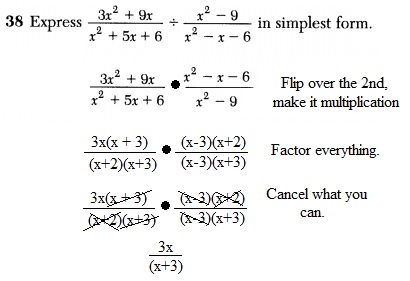
38. It's easier to use a picture than to explain:

No points if you canceled out all the x2's.

39. A bottle contains 12 red marbles and 8 blue marbles. A marble is chosen at random and not replaced. Then, a second marble is chosen at random.
a. Determine the probability that the two marbles are not the same color.

You need to find P(red then blue) and P(blue then red), and add them. (They'll be the same.)
so (12/20 * 8/19) + (8/20 * 12/19) = 192/380

b. Determine the probability that at least one of the marbles is red. You can find P(Red then blue) and P(blue then red) -- which we just did -- and P(two reds) and add them.
So (192/380) + (12/20 * 11/19) = (192/380) + (132/380) = 324/380

Alternatively, you could find the probability that both are blue and then subtract that from 1:
1 - (8/20 * 7/19) = 1 - (56/380) = (380/380) - (56/380) = 324/380.

Tuesday, June 18, 2013

More on the Algebra Regents

It's been almost a week, and the tests are graded, so I don't suppose anyone still cares about this, but I'll go ahead anyway.

First off, if you weren't familiar with the word bivariate, you could have broken it down into bi-, meaning "two", and -variate, which looks like "variable", right? So bivariate: two variables. Which of the tables is measuring two variables and will give a scatter plot, as opposed to a bar graph. The answers, unfortunately, doesn't matter because the question was thrown out. A "lack of specificity" was the reason.

Likewise, if you took the test in Chinese, two answers were accepted to question number 1 because of a translation error. That happens a lot.

As for the Factorial question, a.k.a. "the question with the exclamation point", I was able to guess that answer without doing any work for one simple reason: the last step was to subtract 10, but only one answer was 10 less than another. That answer was the correct one. (I checked my guess afterward, of course.) For the record: 6! + 5!(3!)/(4!) - 10 can be done with the scientific calculator, if you know where to look, but it isn't necessary.
6! = 720, 3! = 6, 5!/4! = 5, so 720 + 5 * 6 - 10 = 720 + 30 - 10 = 740

I wanted to review some of the open-ended questions.

Question 31. An inequality with a negative multiplier. The trick was to remember to reverse the direction of the inequality symbol.

That is, -5(x - 7) < 15, when divided by -5 becomes (x - 7) > -3.
The final answer is x > 4.

Question 32. A volume question on the Algebra test. Silly. If they at least gave the Volume and asked to find, say, the height, you could argue it was an Algebra task, but, as is, it's a middle-school problem.

The formula for volume of a cylinder was in the back of the booklet: V = (pi)r^2*h.
The trick here is that the gave the diameter instead of the radius, so you had to divide 13 by 2 to get 6.5. If you didn't, your answer was four times larger than it should've been, but you most likely got 1 out of 2 points.

The final answer is 1,014*pi. Note: The question said "in terms of [pi]", so if you multiplied by 3.14 or used the pi key on your calculator (i.e., you did extra work!), you lost a point for not answering the question that they asked.

Question 33. A distance question with big numbers, with a conversion added on. Two questions on the test involved converting between hours and days and weeks. This was one of them.

The distance from Earth to Mars is 136,000,000 miles. A spaceship travels at 31,000 miles per hour. Determine, to the nearest day, how long it will take the spaceship to reach Mars.

Divided 136,000,000 by 31,000 to get the number of hours (4387.096774...) and then divide by 24 to get the number of days (182.795698...).
The final answer is 183 days.

Question 34. The Counting Principle. How many options are on the menu? They've given this question many times before, but this is the largest number of items that they've ever used. The Principle remains the same.

There are five main courses, three vegetables, five desserts, and three beverages. To find the number of possible means, multiple the four of them: 5 * 3 * 5 * 3 = 225.
How many have chicken tenders? That's 1 * 3 * 5 * 3 = 45, which is one-fifth of the total.
How many have pizza (1), corn or carrots (2), a dessert (5) and a beverage (3): 1 * 2 * 5 * 3 = 30

If you showed your work, you likely got one point for each correct answer.

Question 35. Trigonometry. Find the angle of elevation.
You have a right triangle with a height of 350 feet and a base of 1000 feet, and you want to find the angle on the ground. You have the opposite (350) and the adjacent (1000), but you don't know the hypotenuse, so that means that you need to use tangent to solve the problem.

So tan(x) = (350)/(1000) and, therefore x = tan-1(350/1000), which is approximate 19.29.
The final answers is 19 degrees
Partial credit likely for using sine or cosine, or if you answer is expressed in radians or if rounded incorrectly.

Question 36. Summation of radicals. I cover this in Geometry. I have simplified them when dealing with Pythagorean Theorem but I don't usually cover this as it requires an extra day or so that I don't have.

Bear with me as I try to type this without any graphics:

(25)^.5 - 2(3)^.5 + (27)^.5 + 2(9)^.5
"^" means raise to a power, "^.5" means raise to 1/2 power, which means square root.
Calculators and spreadsheets understand this.

The square root of 25 is 5 and twice the square root of 9 is 2*3 = 6. That leaves the root 3 term, which is in simplest form, and root 27, which simplifies to (9*3)^.5 = 3(3)^.5. So 5 + 6 = 11 and -2(3)^.5 + 3(3)^.5 = 1(3)^.5.
The final answers is 11 + (3)^.5. In other words, 11 + the square root of 3.

Question 37. Algebraic fractions.

This is the one time where your teacher may have given you bad advice. Actually, it was good advice, if you know when to use it, but this isn't the time.
I have colleagues who will tell students (the ones who hate fractions or just "can't do" them) to multiply by the denominators to get rid of them. In this case, that would make a big mess. Don't do that.
This is one approach you could take:

2 / 3x + 4 / x = 7 / (x + 1)
2 / 3x + 12 / 3x = 7 / (x + 1)
14/ 3x = 7 / (x + 1)

At this point, cross-multiplying will yield the equation 14(x + 1) = 21x
The final answers is x = 2.

Question 38.Probability. I was expecting more of a twist for a four-point problem. This one isn't too bad if you know what you're doing.
Five red marbles and three green marbles make eight marbles total
These are dependent events, and their probabilities will be multiplied.
P(red then green) = 5/8 * 3/7 = 15 / 56
P(both red) = 5/8 * 4/7 = 20 / 56 = 5 / 14
P(both red or both green) = P(both red) + P(both green) = (20 / 56) from above plus 3/8 * 2/7 = 6 / 56. The total is 26/56, which reduces to 13/28.
I recommend to my students to reduce fractions, but I can't say if it's required for full credit in this problem.

Question 39. An Area problem, which I have never covered in Algebra.
You needed to find the area of the rectangle, then the area of the semicircle, and then subtract the latter from the former.
The tricky part here was understanding the frickin' question! Seriously, they went out of the way to be obtuse about it, making this more of a reading comprehension problem than an actual math problem.
In the diagram, AB = 5, and AB = BC = DE = FE, but CD = 6, which means the radius, which can't be named because they didn't name the point at the center of the circle, is 3.

The rectangle is 5 X 16, so the area is 80.
The semicircle is 1/2(pi)(3)^2 = 4.5(pi), which is approximately, 14.13716694.
The shaded area is 80 - 14.13716694 = 65.86283306, which rounds to 65.86.
The final answers is 65.86 square inches.

STUPID QUESTION ALERT! The folks who write these tests know very well that students have been taught for years to approximate pi as 3.14, whether or not they have a calculator which has a "pi" key on it. Using 3.14, the numbers will change in this problem. The semicircle will become 14.13, and the final answer 65.87. Whether or not a student loses a point on this may very well depend upon the teacher scoring it.

Wednesday, May 02, 2012

The Short Straw

(Click on the cartoon to see the full image.)

(C)Copyright 2012, C. Burke. All rights reserved.

If each contestant has a fair chance at drawing the short straw, then there's also a fair chance that this wouldn't be the worst game show on TV.

The small comic size is due to the fact that I was zoomed in when I was drawing it without realizing. No wonder I was having some difficulties.


Friday, January 20, 2012

Drive-Thru

(Click on the cartoon to see the full image.)

(C)Copyright 2011, C. Burke. All rights reserved.

That is, 100%, without fail, metaphysical certitude.


Monday, November 07, 2011

Probability Question: Monday

(Click on the cartoon to see the full image.)

(C)Copyright 2011, C. Burke. All rights reserved.

The only good thing about Mondays is that many students hate them more than I do. I still show up.

For the decimal expansion of this answer, please recall the Remainder of 7 wheel.


Thursday, July 22, 2010

Review: Zombie Dice (Steve Jackson Games)

Zombie Dice is a fun, quick game of odds and probabilities and generally pushing your luck from Steve Jackson Games. It's a somewhat reminiscent of FOR*GET*IT, but with streamlined rules and a better scoring system that avoids one of that game's biggest flaws. (*)

Each player is a zombie searching for brains while trying to avoid shotgun blasts as represented on the sides of the nicely crafted green, yellow and red dice. The colors are important because your probability of success is higher with green than with red, but the dice you roll are chosen randomly, so look out. (Note: if playing a zombie bothers you for some reason, you could easily flip this game around and be humans looking to shotgun the zombies before your brains are eaten, but that would be more challenging with these dice. The zombies numbers are overwhelming.)

The rules literally take seconds to learn, and their simplicity might fool you into believing that the game is too simple. Start believing that and you'll pay everything (to paraphrase the song) when you roll the dice just one more time. You risk all the points for the round on every roll, and you can only dodge the shotguns for so long. Under the best circumstances, there's better than a 40% chance of seeing the business end of those barrels.

There were a few drawbacks discovered from our first sessions. First, going last is a major advantage, so we have a House Rule that the first player from the previous round goes last in the following round so that this position rotates.

Second, there's no interaction between the players other than goading them into taking another dangerous roll or convincing them to play it safe. Psychological manipulation aside, maybe an expansion could address this with some kind of challenge dice or interference cards or some other twist.

Third, after a few games, the nifty Zombie Dice cup start to show signs of wear around the rim, caused by players shoving their fingers down into the narrow can to draw their dice randomly. (It's called "gravity", people. Tip the cup upwards and the dice will come to you!) Quick Fix for next time: put the dice in a spare dice bag and use the cup to roll only the three you select.

Summary: Great, quick game. Perfect between longer games, for the one-last-game-before-we-go game, or a we're-still-waiting-for-you-know-you game. (And then tell them about all the fun they missed for coming late.) And if you like zombie games, you probably have bags of little plastic zombies. use them to keep score.

(*) In FOR*GET*IT, if, for example, all the "IT" dice are out of play, you're free to continue rolling until you max out of points without any chance of losing. There's always the possibility of Bad Stuff on every die in Zombie Dice