Showing posts with label circles. Show all posts

Thursday, June 13, 2024

(x, why?) Mini: Radian

(Click on the comic if you can't see the full image.)
(C)Copyright 2024, C. Burke. "AnthroNumerics" is a trademark of Christopher J. Burke and (x, why?).

Not the same thing at all.

They should invite her out for pie.

So I'm back. For how long? I don't know. I do't have any reasons for being away. This post has been a "draft" since May 31, and the comic is based on a joke told in class nearly a month ago.

Obviously, I needed to get back to the eclipse story becasue I had a two-part follow-up, but that's the kind of thing that takes time to work on. This comic, on the other hand, can be knocked out and posted within an hour. So why'd it take over a month? Again, I don't know.

This just hasn't been a great year scholastically even as things are going pretty well on the writing front. I'd been counting down to 2,000 comics for so long, and then I just came to a halt.

There probably are actual reasons, but not that I can (or will) identify right now.

Enjoy the ride. I hope to have more updates.


I also write Fiction!


You can now order my newest book Burke's Lore, Briefs: Portrait of a Lady Vampire & Other Vampiric Cravings, written by Christopher J. Burke, which contains the aforementioned story and three other stories.
Order the softcover or ebook at Amazon.

And don't forget that Burke's Lore, Briefs:A Heavenly Date / My Damned Best Friend is still available!


Also, check out Devilish & Divine, an anthology filled with stories of angels and devils by 13 different authors, and In A Flash 2020, by Christopher J. Burke for 20 great flash fiction stories, perfectly sized for your train rides.
Available in softcover or ebook at Amazon.

If you enjoy it, please consider leaving a rating or review on Amazon or on Good Reads.


Come back often for more funny math and geeky comics.


Friday, April 14, 2023

(x, why?) Mini: Cut!

(Click on the comic if you can't see the full image.)
(C)Copyright 2023, C. Burke. "AnthroNumerics" is a trademark of Christopher J. Burke and (x, why?).

I've circled back to this unit again.

There will be a lot of vocabulary and a lot of rules and theorems.

And bad jokes, of course.


I also write Fiction!


You can now order Devilish And Divine, edited by John L. French and Danielle Ackley-McPhail, which contains (among many, many others) three stories by me, Christopher J. Burke about those above us and from down below.
Order the softcover or ebook at Amazon.

Also, check out In A Flash 2020, by Christopher J. Burke for 20 great flash fiction stories, perfectly sized for your train rides.
Available in softcover or ebook at Amazon.

If you enjoy it, please consider leaving a rating or review on Amazon or on Good Reads.


Come back often for more funny math and geeky comics.


Tuesday, February 28, 2023

Crop Circle

(Click on the comic if you can't see the full image.)
(C)Copyright 2023, C. Burke. "AnthroNumerics" is a trademark of Christopher J. Burke and (x, why?).

No cardboard or string.

The truth is out there.


I also write Fiction!


You can now order Devilish And Divine, edited by John L. French and Danielle Ackley-McPhail, which contains (among many, many others) three stories by me, Christopher J. Burke about those above us and from down below.
Order the softcover or ebook at Amazon.

Also, check out In A Flash 2020, by Christopher J. Burke for 20 great flash fiction stories, perfectly sized for your train rides.
Available in softcover or ebook at Amazon.

If you enjoy it, please consider leaving a rating or review on Amazon or on Good Reads.


Come back often for more funny math and geeky comics.


Friday, August 05, 2022

Major and Minor

(Click on the comic if you can't see the full image.)
(C)Copyright 2022, C. Burke. "AnthroNumerics" is a trademark of Christopher J. Burke and (x, why?).

The orcs would be led by a major. They'd probably have a minor do all the scut work. Unless orcs enjoyed scut work.

I warned you earlier this week that there'd be more.


I also write Fiction!


You can now preorder Devilish And Divine, edited by John L. French and Danielle Ackley-McPhail, which contains (among many, many others) three stories by me, Christopher J. Burke about those above us and from down below.
Preorder the softcover or ebook at Amazon.

Also, check out In A Flash 2020, by Christopher J. Burke for 20 great flash fiction stories, perfectly sized for your train rides.
Available in softcover or ebook at Amazon.

If you enjoy it, please consider leaving a rating or review on Amazon or on Good Reads.


Come back often for more funny math and geeky comics.


Thursday, January 07, 2021

Inscribed Angles

(Click on the comic if you can't see the full image.)
(C)Copyright 2020, C. Burke. "AnthroNumerics" is a trademark of Christopher J. Burke and (x, why?).

Central vs. Inscribed. If you get it straight, you'll be all right!

I could do a column, maybe not a comic, on answering all sorts of question Geometry students might encounter with circles that can be explained using the numbers 90, 180, and 360 along with "half" and "double". (I'm using "half" as an adjective as much as a number there.)

Toss in "similar triangles" and "Pythagorean Theorem" and you can explain most of the rules and theorems you need to solve the Algebra-type problems that get tossed around.

Actually, it might be possible to be sparse with words (to hold the readers' attention) and still have enough background where a proof could be formulated.

Maybe when the break in the semesters comes toward the end of the month.


Come back often for more funny math and geeky comics.


Monday, November 16, 2020

BAD BED BID

(Click on the comic if you can't see the full image.)

(C)Copyright 2020, C. Burke. "AnthroNumerics" is a trademark of Christopher J. Burke and (x, why?).

As long as we need random letters anyway, why not pick words. Easier to say and remember!

Coming up with five words was the easy part, apparently. I had intended for BAD to be 85o, not 95. Then I looked at the picture was I was done. It was easier to change the number.

Ken could've asked Bibi about minor arc BI and major arc BI, I guess.

The original idea was that BOD would be double the size of BAD, BED, and BID, which are all congruent because they are all inscribed angles that intercept the same arc. Instead, it is double the size of angle BUD. It just doesn't flow as nicely.


Come back often for more funny math and geeky comics.


Wednesday, June 10, 2020

(x, why?) Mini: Sewing Circle

(Click on the comic if you can't see the full image.)

(C)Copyright 2020, C. Burke. "AnthroNumerics" is a trademark of Christopher J. Burke and (x, why?).

S is obviously the North-South axis, and W is obviously the East-West axis. Now, if e and i are the actual constants, it gets interesting.

Believe it or not, I actually debated whether or not to put parentheses around ng. On the one hand, if I didn't I might get comments or complaints. On the other side, nobody leaves comments any way, so maybe I should do that. On the gripping hand, I'd like to get a third mechanical arm, but that's neither here nor there.


Come back often for more funny math and geeky comics.


Sunday, April 12, 2020

Happy Easter 2020!

(Click on the comic if you can't see the full image.)

(C)Copyright 2020, C. Burke. "AnthroNumerics" is a trademark of Christopher J. Burke and (x, why?).

My wife has made this cake a few times. Uncooked spaghetti whiskers can replace the icing, just for fun.

Given that mathematical nature of this cake, I'm surprised I hadn't used it before for a comic.

Happy Easter!


Come back often for more funny math and geeky comics.


Wednesday, April 08, 2020

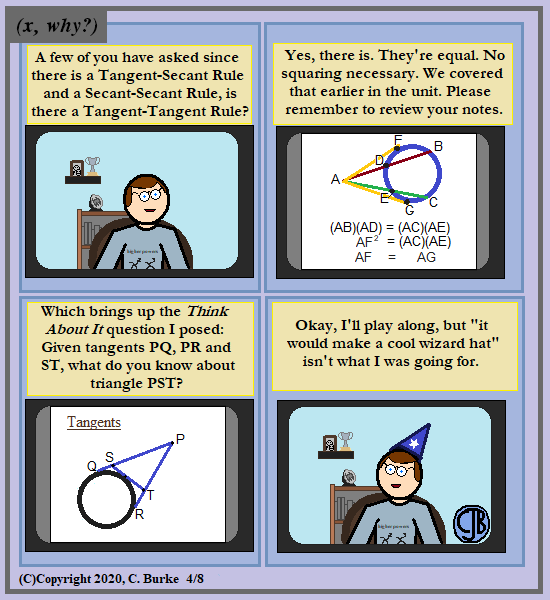
Remote Learning IV: Tangent-Tangent

(Click on the comic if you can't see the full image.)

(C)Copyright 2020, C. Burke. "AnthroNumerics" is a trademark of Christopher J. Burke and (x, why?).

I'm not saying that he already owned that hat. He could've constructed it from paper. But I'm not saying he didn't either.

What can we say about triangle PST?

Look at line ST. It's a tangent line, so it intersects the circle at one point. Call that point U. We don't know the length of SU or TU. We don't know if they are congruent to each other or not. But we do know one thing.

SU and SQ are two tangents to the circle from the same point, and they have the same length. Likewise, TU and TR have the same length. This is enough information to tell us something about the perimeter of the triangle:

PS + SU + UT + TP = PS + SQ + RT + TP = (PS + SQ) + (RT + TP) = PQ + PR = 2 PQ = 2 PR

The perimeter of the triangle is equal to the sum of the lengths of the two larger tangent lines. And because those tangents are equal to each other, we know that the perimeter equals twice the length of one of the tangents.

Also, the triangle could like a clown hat.


Come back often for more funny math and geeky comics.


Friday, May 04, 2018

Secant and Tangent, with Examples

(Click on the comic if you can't see the full image.)

(C)Copyright 2018, C. Burke.

The ''in one ear and out the other'' comes up fairly often.


Come back often for more funny math and geeky comics.


Wednesday, May 17, 2017

Center, Pt. 3

(Click on the comic if you can't see the full image.)

(C)Copyright 2017, C. Burke.

It was almost the satyr of the centaur circle, which would have been a lot of work to throw out at the last minute!

I think I'm done beating this dead ... well, you know.

See also, Center, Pt. 1 and Center, Pt. 2.


Come back often for more funny math and geeky comics.


Thursday, May 04, 2017

Center, Pt. 2

(Click on the comic if you can't see the full image.)

(C)Copyright 2017, C. Burke.

Yes, I've said this in class. As any fun teacher would. Amirite?

And for the geeks out there: May the Fourth be with you. I didn't forget, but I didn't have time to make a special comic. I do Star Wars stuff throughout the year when the mood strikes.


Come back often for more funny math and geeky comics.


Tuesday, May 02, 2017

Center, Pt. 1

(Click on the comic if you can't see the full image.)

(C)Copyright 2017, C. Burke.

Nice to know things are fine.

Warning you now, that there's a part two because I couldn't decide on which joke to use, so I'm using them both.
And I won't even try to hide it by doing the other one two or three weeks from now.


Come back often for more funny math and geeky comics.


Saturday, June 11, 2016

Daily Regents: Area of a Sector of a Circle (June 2015) Geometry

I'll be reviewing a New York State Regents Exam Question every day from now until the Regents exams next week. At least, that is the plan.

Common Core Geometry, June 2015, Questions 29

29. In the diagram below of circle O, the area of the shaded sector AOC is 12*pi in2and the length of OA is 6 inches. Determine and state m<AOC.

As shown in the illustration below, the ratio of the area of the sector of a circle to the whole circle is proportional to the measure of the central angle to 360 degrees.

In other words, whatever fraction of the area is shaded in, multiply that same fraction times 360 degrees to get the measure of the central angle of the sector.

Since area is pi*r2, the area of the circle is (6)2pi or 36pi. The sector is 12pi. (12 pi) / (36 pi) = 1/3. The shaded sector is 1/3 of the circle.
Multiply 1/3 times 360, and the central angle is 120 degrees.


Any questions?


If anyone in Brooklyn is looking for an Algebra or Geometry Regents Prep tutor, send me a note. I have a couple of weekly spots available between now and June.


Tuesday, July 14, 2015

Problem: Pythagorean Theorem and Tangent-Secant

There are multiple ways to solve problems with circles, but some will be more straightforward than others, based on the information given.

If a circle has a tangent drawn to it, then that tangent is perpendicular to the radius it intersects. In other words, a right angle is created. Generally speaking, that right angle will probably signal the need to use the Pythagorean Theorem at some point in the problem.

On the other hand, if the tangent is accompanied by a secant line, then a second theorem can be plucked from our toolkit: the Tangent-Secant Theorem. If the tangent and secant intersect at a point outside the circle, then the square of the length of the tangent from the external point to the circle will be equal to the product of the portion of the secant outside the circle times the length of the entire segment.

Consider the problem below:

Which of the two theorems do we need to use?

The answer is: either one of them.

The circle has three radii drawn, but only one is labeled. Write the "6" next to the other two segments.

You can now solve for x using the right triangle with legs 6 and x, and with hypotenuse 10. Or you can solve for tangent with length x using the secant with a length of 16 and an external length of 4.

If you choose to work both of them out, you'll find the same answer.

Keeping that in mind, look at this next problem:

Now you will see that you can make a diameter from the given radius, and create a secant. This gives you a second option for some for x.

Monday, May 18, 2015

The Distance Around

(Click on the comic if you can't see the full image.)
(C)Copyright 2015, C. Burke.

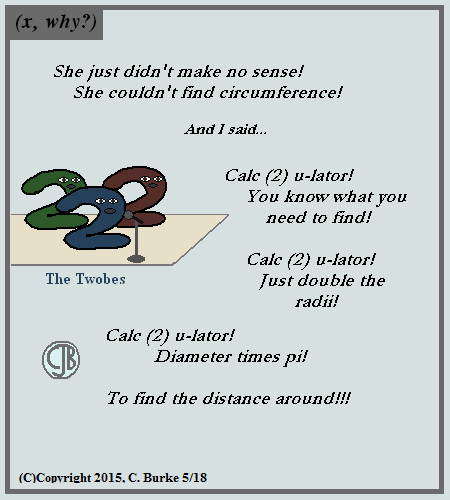
If you quiz them, then you'll test Twobes ...

A little music trivia: this is the kind of song that I enjoy on the radio, but never bought the entire album (which is what they had back then). It's because of this that even though I've heard the song Talk to You Later many, many times over the (multiple periods of ten) years, it wasn't until about a week ago that I actually knew who sung the song. I might've had a couple of guesses, but they would've been wrong because I don't remember ever hearing the name The Tubes before.

The Tubes, and this song, have an interesting place in music history. A long time ago, in the early days of MTV -- you know, back when they played Music -- the network didn't air in places like NY or LA. It did, however, air on cable TV in places like Tulsa, OK. By co-incidence, Talk to You Later sold out in Tulsa despite not getting any airplay at all on the radio. MTV took full credit for this and went to music studios and told them that they needed to produce videos to advertise their records ... and give them to MTV.

The rest is History. As in thing that happened in the past because no one makes albums any more, MTV doesn't play music, and videos go straight to YouTube these days. (Or whatever the next thing after that is.)


Come back often for more funny math and geeky comics.


Thursday, March 05, 2015

Off On a Tangent

(Click on the comic if you can't see the full image.)
(C)Copyright 2015, C. Burke.

Some teachers really go off on tangents.

This is another one that's been sitting in the joke idea box for longer than I can remember, but I never get around to doing. (Or maybe I just don't check that joke idea box often enough ... and there are several places where I write these things down, unfortunately.)


Tuesday, December 16, 2014

(blog): 360, 180, 90, 2 and 1/2: I'm Talking Arcs and Inscribed Angles

Assisting today in a Geometry class. It was Day 2 of Arcs of a Circle. Yesterday, the teacher covered central angles with the class, which meant that today's lesson moved to the inscribed angles. She carefully and diligently explained what makes an inscribed angle, and how the line segments intercept an arc in a similar way that they saw in the previous lesson. And then we got into the relationship between the arcs and the two types of angles.

The measure of an arc of a circle is equal to the size of the central angle which intercepts it. The measure of the inscribed angle is half the size of the arc it intercepts. Pause. What does this make the relationship between the central and the inscribed angle. Pause. Wait. Rephrase? Response? Good -- but try again in a full sentence...

"It's half the size." sounds good. No, really, it does -- it means someone's paying attention and either getting it, or somewhat getting it. Following up: "What is half of what?" The inscribed angle is half of the central angle.

Okay. So if the inscribed angle is 60 degrees, how big is the central angle? Let them think about it. Did they come up with 120 degrees? Or 30 degrees? If the smaller angle is half the bigger angle, then the bigger angle is ... ? (Okay, it's a leading question, and I hate leading questions, but sometimes you do need to just pull that one number out of them so you can move on.)

They moved along with the notes and did a couple of practice problems before moving on to the next step. What if two inscribed angles intercepted the same arc? What could we conclude about the two angles? The teacher waited to see if they could reach the statement before she gave it. It took a moment to realize that A was half the arc and B was half the same arc, so angles A and B had to be congruent even if we didn't know how big the arc was. We didn't need to know. But if we did, we could work things out.

Then things started getting complicated because when you start putting in two many line segments and too many inscribed angles, triangles start forming. Wait! What are we supposed to do with those?! Treat them like three inscribed angles, of course, but don't forgot those properties of triangles, either. Particularly, the one about the sum of the angles!

So if we had a problem that looked like this:

... we have enough information to fill in both angles BAC and BCA as well as arcs AC and BC. We just might not know that we know yet. Not unless we remember some other facts about circles and triangles. The total measure of the central angles in a circle is 360 degrees, so the total of the arcs of the circle is also 360 degrees. The sum of the angles of a triangle is 180 degrees. Notice that if each angle of the triangle is inscribed that make each part of the circle twice the size of inscribed angle -- and 360 degrees is twice as big as 180!

Excellent discovery, if they can make it on there own. One student was hovering about it while he was talking. If he made the connection, he didn't share it with me, but he was close to it.

Finally, why is 90 so important that I included it in the title?

Because many of these problems use diameters as one of the line segments. A diameter cuts the circle in half, into two semicircles, each 180 degrees. The central angle formed by the two radii joining into a diameter is a straight angle, measuring 180 degrees. Any inscribed triangle using the diameter as one of its sides would, by necessity, have an angle that measures half of 180 degrees, which is 90 degrees.

Wait a minute!

So any inscribed triangle using the diameter of a circle is a right triangle? And any inscribed right triangle has to include the diameter?

It's almost as if someone planned it that way. Maybe not, but that's how we planned the lesson.

Tuesday, June 24, 2014

June 2014 Geometry Regents, Parts 2

If you find this page helpful, please Like or Share or Leave a Comment. Thank you!

I really can't do Parts 3 and 4 until I take the time to create the necessary illustrations. Sorry. So here's Part 2. If you missed Part 1, it's here.

Part 2

29. The coordinates of the endpoints of BC are B(5, 1) and C(-3, -2). Under the transformation R90, the image of BC is B'C'. State the coordinates of points B' and C'.

Remember, if they don't state which direction you are rotating, the default is counterclockwise. That might seem counter-intuitive, but you are moving from quadrant I to II, from II to III, etc.

Under R90, a point P(x, y) becomes P'(-y, x). So these points will become B'(-1, 5) and C'(2, -3). Interestingly enough, according to the key, you didn't need to say which was which, but you did need to include the parentheses.

30. As shown in the diagram below [COMING SOON], AS is a diagonal of trapezoid STAR, RA || ST, m<ATS = 48, m<RSA = 47, and m<ARS = 68.
Determine and state the longest side of triangle SAT.

You needed to calculate that m<AST = 65 degrees. You can get this using triangle RAS or knowing that the same-side interior angles are supplementary.
Once you know that, you can use 65 + 48 + x = 180 to find m<SAT, which is 67.

Side ST is the longest side because it is opposite the largest angle. You needed to give the side AND show some kind of work that indicates that you didn't go eeny-meeny... Seriously.
ST without any work -- even just angle sizes after you did the subtraction in your head or on your calculator -- is worth 0 points.

31. In right triangle ABC shown below [I'LL GET TO IT!], altitude BD is drawn to hypotenuse AC. If AD = 8 and DC = 10, determine and state the length of AB.

There's a short way and a long way to do this. Both are okay for full credit.

First, remember that there are three right triangles in this diagram. Both of the smaller ones are similar (and therefore proportional) to the larger one and to each other.

You could write a proportional comparing ( base / hypotenuse) = ( base / hypotenuse) of triangle BAD and triangle ABC.
You would have ( 8 / x ) = ( x / 18 ). (It's 18 because it is 10+8.)
Cross-multiply: x2 = 144.
x = 12, which is the length of AB.

The longer method: If you forgot about that proportionality, but remembered the Altitude Rule, you would have found that altitude (BD)2 = (AD)(DC), so y2 = (8)(10) or 80. So the altitude is the square root of 80. Okay, that's good for partial credit, but we aren't done.

Now you can use Pythagorean Theorem: 82 + 80 = x2. Remember: (the square root of 80) squared is just 80.
64 + 80 = x2
144 = x2
x = 12, again.

Either method is valid and will get full credit. I saw quite a few of each type. The only problem with the longer method was that some students started estimating an answer in the middle and that introduced an error into the rest of the calculations.

32. Two prisms with equal altitudes have equal volumes. The base of one prism is a square with a side length of 5 inches. The base of the second prism is a rectangle with a side length of 10 inches. Determine and state, in inches, the measure of the width of the rectangle.

I graded a lot of these. Two things: First, I can't believe how many Geometry students can do so well and still not know the Area of a rectangle or the Volume of a rectangular prism.
Second: This is a good case of Less is More. What do I mean by that? A lot of students talked or worked themselves out of a 1 or 2 points. Seriously.

Despite the fact that the word prism is used repeatedly, students draw pyramids, which by themselves, might not have been work and could've been overlooked. But then they used formulas for Volume that included 1/3 in them. That's a conceptual error. What makes this worse is that the (1/3)s cancel out and don't affect the outcome -- just the final score. I had to call over an arbitrator on this one because I didn't want to make that call.

Another error that was made repeatedly was that students assumed that the first prism was a cube even though there is nothing supporting this. They substituted 5 for the height! There is nothing about 5 being the height. This led to a discussion about whether that could be a case of "guess and check" and not an actual "conceptual error". Again, the mistake factors out.

But the worst part of it all is that because the heights were the same, the formula for Volume wasn't even needed! You only needed to compare the Area of the two bases.

This became confusing as well. People did perimeter of one and Area of the other. Or they assume that both bases were squares or other crazy stuff.

If was a very simple problem. How simple?

52 = 10x.

That simple: x = 2.5.

Funniest answer: Someone wrote 2.5in = w, with a little bit of cursive and I thought it said "2 Sin w". Okay, it was funny to me.

33. As shown in the diagram below, BO and tangents BA and BC are drawn from external point B to circle O. Radii OA and OC are drawn. If OA = 7 and DB = 18, determine and state the length of AB.

A very similar question was asked in August 2011, but that was multiple choice.

Again, there are TWO methods to solve this: Pythagorean Theorem, and Tangent-Secant.

First, realize that OD is also a radius, with length 7. That means that OB is 25. OA is perpendicular to the tangent line BA. Therefore, OAB is a right triangle with OB as its hypotenuse and OA, a radius, as one of its legs. So 72 + (AB)2 = 252.
Solving the equation, we find that AB has a length of 24.

The other way: Draw diameter DOE (make point E on the circle opposite from D). BE is now a secant line with a length of 18 + 7 + 7 = 32.
Tangent-secant rule: (BA)2 = (BD)(BE) = 18 X 32 = 576. AB = 24.

Both methods are valid.

34. Triangle RST is similar to triangle XYZ with RS = 3 inches and XY = 2 inches. If the area of triangle RST is 27 inches, determine and state the area of triangle XYZ, in square inches.

Short way: The ratio of the areas of two similar triangles is the square of the ratio of their sides. The scale factor of the sides is 3:2, so the scale factor for the areas is 9:4. If the bigger one has area 27, then ( 9 / 4 ) = ( 27 / x ).
Cross-multiply and 9x = 108, and x = 12.

LONG WAY: If you forgot about that, you could have done the following: if the large triangle has Area 27 and base 3, and A = 1/2 b h, then 27 = (1/2)(3)(h), and h = 18.
Then to find the height of the smaller triangle, ( 3 / 2 ) = ( 18 / h ). Then 3h = 36 and h = 12 inches. But that isn't the answer -- that's just the height.
A = (1/2) b h = (1/2) (2) (12) = 12 sq inches. That's the answer. Even though both numbers are 12, if you didn't complete it, you lost a point.

35.

Monday, June 23, 2014

June 2014 Geometry Regents, Part 1

If you find this page helpful, please Like or Share or Leave a Comment. Thank you!

I just got home from grading the Geometry Regents exams in Staten Island, so I finally had a good look at the exam. Students and teachers alike had both described it as a "fair" exam (sort of like the Algebra test), and I'd have to agree.

Here are the multiple-choice questions from Part I. Keep in mind, that I have to type all of these, so the rest of the test may not show up on my blog as quickly as you may like. Questions are always welcome. Likewise, because I've been asked to hurry with this, there are no diagrams included. They may get added at a later time.

1. Plane P is parallel to plane Q. If plane P is perpendicular to line l, then plane Q...

(3) is perpendicular to line l. Think of a fire pole at a fire station going through the second floor to the first floor.

2. In the diagram below [Diagram Omitted], quadrilateral ABCD has vertices A(-5,1), B(6, -1), C(3, 5) and D(-2, 7). What are the coordinates of the midpoint of diagonal AC?

The midpoint is the average of the two x-values and the average of the two y-values. ( (-5+3)/2, (1+5)/2 ), which is (-1, 3).

3. In the diagram below, transversal TU intersects PQ and RS at V and W, respectively. If m<TVQ = 5x - 22, and m<VWS = 3x + 10, for which value of x is PQ || RS?

You want the value of x that makes 5x - 22 = 3x + 10, because corresponding angles are congruent when parallel lines are cut by a transversal. Solve for x and you get 16.

4. The measures of the angles of a triangle are in the ratio 2:3:4. In degrees, the measure of the largest angle of the triangle is:

Take the ratio and write the following equation: 2x + 3x + 4x = 180. So 9x = 180, and x = 20. The largest angle is 4x, which is 4(20) = 80 degrees.

5. The diamter of the base of a right circular cylinder is 6 cm and the height is 15 cm. In square centimeters, the lateral area of the cylinder is

The lateral area is the circumference of the base times the height, or (pi)(d)(h), which is (pi)(6)(15), which is 90*pi.

6. When the system of equations y + 2x = x2 and y = x is graphed on a set of axes, what is the total number of points of intersection?

Substitute y = x into the other equation and you get x + 2x = x2
This can be rewritten as x2 - 3x = 0.
You don't need to solve it to know that there are two distinct solutions. You could have graphed the equations as well. Note: A parabola and a straight line can have 0, 1 or 2 intersection points. They cannot have three.

7. The vertex angle of an isosceles triangle measures 15 degrees more than one of its base angles. How many degrees are there in a base angle of the triangle?

The sum of the angles is x + x + x + 15 = 180. So 3x + 15 = 180, 3x = 165 and x = 55, which is the measure of one base angle.

8. Circle O is graphed on the set of axes below. [Diagram omitted] Which equation represents circle O?

The correct form is (x - h)2 + (y - k)2 = r2, where (h, k) is the center of the circle and r is the radius.
In the graph, the center is (-1, 3) and the radius is 3.
So the equation is (x + 1)2 + (y - 3)2 = 9.

9. In the diagram of the circle shown below [Diagram omitted], chords AC and BD intersect at Q and chords AE and BD are parallel. Which statement must always be true?

Arcs AB and DE are congruent because the arcs formed by two parallel chords are always congruent.

10. In the diagram below [Diagram omitted], triangle AEC is congruent to triangle BED. Which statement is not always true?

Angle ACE does not correspond to angle DBE, so they will not always be congruent although they could be in an isosceles or equilateral triangle.

11. What is the length of RS with R(-2, 3) and S(4, 5)?

Distance formula, a.k.a. Pythagorean Theorem. The square root of (62 + 22 is the square root of 40, which simplifies to 2 times square root of 10.

12. What are the truth values of the statement "Two is prime" and its negation?

Two is a prime number so the statement is True, which means the negation is False. Choices 2 and 3 are just silly and should have been eliminated immediately.

13. A regular polygon has an exterior angle that measures 45 degrees. How many sides does the polygon have?

If you didn't know just from constant repetition of the problem in class, remember that 360/n = 45, so n = 360/45 = 8 sides.

14. In rhombus ABCD with diagonals AC and DB, AD = 10. if the length of diagonal AC is 12, what is the length of DB?

If one side is 10, all sides are 10. The diagonals are perpendicular bisectors. This means that there are four little right triangles with hypotenuse 10. One leg of each triangle is 6 (12/2). Using Pythagorean Theorem, or just knowing the triple, the other leg of each triangle is 8. That makes the length of the entire diagonal DB 16.

15. If the surface area of a sphere is 144*pi square centimeters, what is the length of the diameter of the sphere, in centimeters?

The surface area of a sphere (given in the back of the booklet) is 4*pi*r2 = 144 * pi. Divide both sides by 4*pi, and r2 = 36, so r = 6.
The radius is half the diameter, which is 12.

16. Which numbers could represent the lengths of a the sides of a triangle?

Not a right triangle, just a triangle. The rule for the sides of a triangle is that the sum of the two smaller sides must be more than the length of the largest side. 5 + 9 = 14, 7 + 7 < 15, 1 + 2 < 4, 3 + 6 > 8.

17. The equation of a line is 3y + 2x = 12. What is the slope of the line perpendicular to the given line?

The slopes of two perpendicular lines are inverse reciprocals. (That is, change the sign, and flip the fraction over.)
First you have to find the slope of the given line. Subtract 2x from both sides and divide everything by 3 (the coefficient of y). The slope of the given line is -2/3.
That makes the perpendicular slope 3 / 2. CORRECTION.

18. In the diagram below, point K is in plane P. How many lines can be drawn through K, perpendicular to plane P?

Similar to the other question, only one line perpendicular to a plane can be drawn at any one point. Think of a pencil through a hole in your loose leaf.

19. In the diagram below, AB and CD are bases of trapezoid ABCD. (Not drawn to scale) If m<B = 123 and m<D = 73, what is the m<C?

Because it isn't an isosceles trapezoid, <C and <D can not be assumed to be congruent. However, <B and <C are supplementary. So the answer is 57.

20. What is the equation of a line passing through the point (4, -1) and parallel to the line whose equation is 2y - x = 8?

Rewrite 2y - x = 8 as y = (1/2) x + 4, slope is 1/2. So the parallel line must have the equation y = (1/2) x + b.
Plug is 4 for x and -1 for y and solve for b. You will find that b = -3, so the answer is y = (1/2) x - 3.

21. The image of rhombus VWXY preserves which properties under the transformation T2, -3?

Translations do not change shape nor orientation, so the correct answer is both parallelism and orientation.

22. The equation of a circle is (x - 3)2 + y2 = 8. The coordinates of its center and the length of its radius are

Using the form given above, the center is (3, 0) and the radius is the square root of 8, which is 2 times the square root of 2.

23. Which statement has the same truth value as the statement, "If a quadrilateral is a square, then it is a rectangle"?

Note that it didn't ask what the truth value of the statement was. That isn't important. What is important is that the statement has the same truth value as its contrapositive, which is "If a quadrilateral is not a rectangle, then it is not a square."

24. The three medians of a triangle intersect at a point. Which measurements could represent the segments of one of the medians?

The centroid occurs 2/3rds the way down the length of the median. In other words, the two segments will have a ratio of 1:2, with each segment being 1/3 or 2/3 the length of the median itself. The correct choice is 3 and 6.

25. In the diagram of triangle PQR shown below {NO, IT ISN'T], PR is extended to S, m<P = 110, m<Q = 4x and m<QRS = x2 + 5x. What is m<Q?

The sum of the measures of angles P and Q is equal to the exterior angle R. The equation to write is x2 + 5x = 4x + 110.
This becomes a quadratic equation, x2 + x - 110 = 0.
This factors in (x + 11)(x - 10) = 0, so x = -11 (discard the negative) or x = 10.
HOWEVER, they want the size of the angle, not of x. The size of the angle is 4x = 4(10) = 40.

26. Triangle PQT with RS || QT is shown below [DONT HOLD YOUR BREATH]. If PR = 12, RQ = 8 and PS = 21, what is the length of PT?

You can set up a proportion (21 / x) = (12 / 8), which will find the length of ST, which is 14. PT = 21 + 14, which is 35.

27. In the diagram of line segment WXYZ below, WY is congruent to XZ. Which reasons can be used to prove VW is congruent to YZ?

The reflexive property (XY is congruent to XY) and subtraction postulate (WY - XY is congruent to XZ - XY).

28. The coordinates of the endpoints of the diamter of a circle are (2, 0) and (2, -8). What is the equation of the circle?

This is the third question about the equation of a circle. The center of the circle is (2, -4). The radius is 4.
The equation of the circle is (x - 2)2 + (y + 4)2 = 16.

* * *

So how did everyone do? More importantly, how did I do? I mean, I did rush this. Mistakes happen.