Showing posts with label Volume. Show all posts

Thursday, May 18, 2023

Sentenced to Prism

(Click on the comic if you can't see the full image.)
(C)Copyright 2023, C. Burke. "AnthroNumerics" is a trademark of Christopher J. Burke and (x, why?).

I deserve a cone!

Prism is one of those words that you don't hear correctly the first time in my class. A prism's just a box. But, ironically, (or is it "coincidentally"?), a prison cell is usually in the shape of a prism.

But why does it have to be?

Probably for stacking reasons. And being able to first more cells into a block.

On the other hand, "Prismatic" usually means "colorful" with many varied and bright colors. Prisons are usually dull and muted in color, except, perhaps, for orange jumpsuits.

Math note: this started as a "Volume" comic even though it never got there.

The final comment will be "period" because it will come at the end of this sentence.


I also write Fiction!


You can now order Devilish And Divine, edited by John L. French and Danielle Ackley-McPhail, which contains (among many, many others) three stories by me, Christopher J. Burke about those above us and from down below.
Order the softcover or ebook at Amazon.

Also, check out In A Flash 2020, by Christopher J. Burke for 20 great flash fiction stories, perfectly sized for your train rides.
Available in softcover or ebook at Amazon.

If you enjoy it, please consider leaving a rating or review on Amazon or on Good Reads.


Come back often for more funny math and geeky comics.


Tuesday, March 17, 2020

Erin Go Bragh!

(Click on the comic if you can't see the full image.)

(C)Copyright 2020, C. Burke. "AnthroNumerics" is a trademark of Christopher J. Burke and (x, why?).

And, of course, 317 is a prime number, so the use of decimals was unavoidable without making it trivial.

Happy St. Paddy's Day!


Come back often for more funny math and geeky comics.


Sunday, November 27, 2016

Volume Displacement

(Click on the comic if you can't see the full image.)

(C)Copyright 2016, C. Burke.

One method: Put the turkey in first. Fill the fryer with oil. Remove turkey. Heat the oil.

This one should've been up the day after Thanksgiving, except a) wasn't ready yet because we were enjoying the holiday, and b) I was a little worried that the newspaper would be filled with tragedy from this happening, despite it being a sitcom staple.

I hope everyone's Thanksgiving was a happy and safe one. I'm having great memories of Leftover Sundays past.


Come back often for more funny math and geeky comics.


Wednesday, July 27, 2016

Daily Regents: Volume and Density (August 2015)

Even though the title says "Daily", I won't be doing them daily any more, until the exams get closer. But they will be frequent.

Geometry, August 2015, Question 25

25. A wooden cube has an edge length of 6 centimeters and a mass of 137.8 grams. Determine the density of the cube, to the nearest thousandth.
State which type of wood the cube is made of, using the density table below.

Density is defined as Mass divided by Volume. (d = m/V). You are given the length of one edge of a cube. The volume of the rectangular prism = length times width times height (V = L * W * H). However, with a cube, all three values are the same, so V = s3.

Density = mass / Volume. Volume of a cube = (edge length)3.
If you substitute the values that we know, we find that Density = mass / (edge)3 = 137.8 / (6)3 = 0.63796..., which rounds to 0.638.

According to the table, the approximate value of Ash wood is 0.638.
The wood is Ash.

Note: Don't forget to identify the wood after finding the density, even if you just circle the correct answer.

Also: If you get "Ash" without showing any work, you will NOT score a point.


Saturday, June 04, 2016

June 2016 Integrated Algebra Regents, Part III

On June 2, 2016, New York State gave a special Integrated Algebra Regents exam, which only seniors and "super seniors" were eligible to take. Those were the students who entered high school prior to the implementation of Common Core. This test follows the older curriculum.

I am currently scoring exams, and while I cannot talk about that specifically, I do have a copy of the questions. The work you see below is mine, written on photocopies of the pages that they gave me for scoring purposes.

A cleaner, fuller (and possibly more clear) explanation of the problems may come at a future date. However, this is likely the last time that this test will be administered. Then again, they have said that before.

Part III

All questions in this section were open-ended and worth 3 points. A computational or rounding error cost 1 point. A conceptual error (e.g., using the wrong formula) cost 2 points. One of each cost all 3 points, and the answer -- despite the amount of work -- is worth 0. (There are exceptions, where the rubric states a point is awarded for finding a specific checkpoint in the middle of the problem and then not having any correct work afterward.)

34. Ryan bought three bags of mixed tulip bulbs at a local garden store. The first bag contained 7 yellow bulbs, 8 red bulbs, and 5 white bulbs. The second bag contained 3 yellow bulbs, 11 red bulbs, and 6 white bulbs. The third bag contained 13 yellow bulbs, 2 red bulbs and 5 white bulbs. Ryan combined the contents of these three bags into a single container. He randomly selected one bulb, planted it, and then randomly selected another and planted that one. Determine if it is more likely that Ryan planted a red bulb and then another red bulb, or planted a yellow bulb and then a white bulb. Justify your answer.

You needed to find the compound probabilities of two dependent event (without replacement) and compare the two.
There was no guideline in the rubric, and it didn't come up in our discussion, if you only found the number of outcomes and compared the two with the proper justification.

When added together, there were 23 yellow, 21 red and 16 white for a total of 60 bulbs. There would only be 59 when drawing the second bulb.

P(R then R) = (21 / 60) * (20 / 59) = 420/3540
P(Y then W) = (23 / 60) * (16 / 59) = 368/3540
Therefore, it is more likely that he would get red then red.

Note: some students did write these numbers are decimals or percents. Their math was checked for accuracy (no rounding needed), and then the comparison.

See image below:

35. A particular jewelry box is in the shape of a rectangular prism. The box is advertised as having an interior length of 20.3 centimeters, an interior width of 12.7 centimeters, and an interior height of 10.2 centimeters. However, when a customer measures the interior of the box, she finds that the interior height is actually 6.3 centimeters. Upon further examination, she discovers that the bottom of the interior of the box lifts up to reveal a hidden compartment. Find the volume of this hidden compartment to the nearest cubic centimeter.

Rounding matters. The right formula matters.

I was ready to go off on a rant (and I did, on Twitter) because so many students lost 2 of the 3 points because they used the formula for Surface Area. This meant that they had to do a lot more work -- and do it perfectly -- to get a single point. A rounding error and it would be zero.

Why did so many students do Surface Area? My guess: the formula is in the back of the book. Volume = Length X Width X Height is not, likely because it's so easy that every student should know it. But for whatever reasons, these students didn't.

The height of the hidden compartment was 10.2 - 6.3 = 3.9. Volume = 12.7 X 20.3 X 3.9 = 1005.459 = 1005 cm3.
Rounding before you multiplied was a 1-point error.

Alternatively, you could have calculated Volume = 12.7 X 20.3 X 10.2 = 2629.662 and Volume = 12.7 X 20.3 X 6.3 = 1624.283 and then subtracted to get the same answer. More work, but not incorrect.

See image below:

36. Solve algebraically for all values of x that satisfy the equation: x / (x + 4) = 3 / (x + 2)

Cross-multiply the numerators and denominators. Use the Distributive Property.
This gives you x2 + 2x = 3x + 12
Subtract everything from the right side to get: x2 - x - 12 = 0. (This was good enough for 1 point.)
Factor: (x - 4)(x + 3) = 0
x - 4 = 0 or x + 3 = 0
x = 4 or x = -3

Note: If you made a computational error, you probably had a problem factoring. However, if you used the Quadratic Formula and followed through to get an answer, however complicated it might have been, it would only be a 1-point error. We had a couple of these.

See image below:


How did you do?

Any questions?


If anyone in Brooklyn is looking for an Algebra or Geometry Regents Prep tutor, send me a note. I have a couple of weekly spots available between now and June.


Friday, August 28, 2015

Volumes

(Click on the comic if you can't see the full image.)
(C)Copyright 2015, C. Burke.

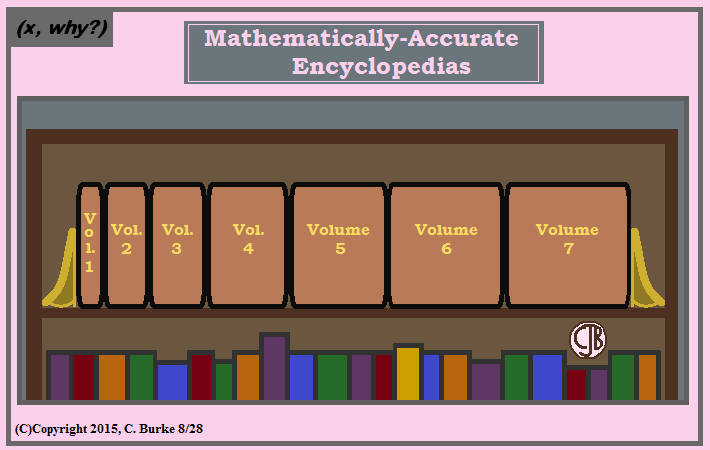
Shouldn't Volume 6 be three times as meaty as Volume 2? Assuming some books aren't denser than others, of course.

Again, there are times I'm surprised that I haven't done jokes like this one before.


Come back often for more funny math and geeky comics.


Tuesday, June 30, 2015

The Water Tower Problem and the Perils of Rounding

Question 34, the first Part IV question of the New York State Geometry (Common Core) Regents exam for June 2015, read as follows:

The water tower in the picture below is modeled by the two-dimensional figure beside it. The water tower is composed of a hemisphere, a cylinder, and a cone. Let C be the center of the hemisphere and let D be the center of the base of the cone.

If AC = 8.5 feet, BF = 25 feet, and m∠EFD = 47°, determine and state, to the nearest cubic foot, the volume of the water tower.

The water tower was constructed to hold a maximum of 400,000 pounds of water. If water weighs 62.4 pounds per cubic foot, can the water tower be filled to 85% of its volume and not exceed the weight limit? Justify your answer.

If you are a regular reader of this blog, you may have seen the discussion generated by this problem between me and a fellow educator when I previously posted the questions in another thread with questions and answers from the exam.

Most of it stemmed from the fact that I made an error in calculating the problem, but I had no way of knowing how significant the error was or what rubric the state would use to grade the mistake. Discussion followed speculating what they would and should do, based on what has happened in the past (recent past, not your parents' past) and what they said they wanted to do now.

Cutting to the chase for those who don't want to read that entire thread, I made a rounding error, and my Volume was off by 1 as a result. Looking at it now, it was likely a one-point deduction. However, before we get there, let's review the problem.

Breaking it into parts

Part of the reason that this question was overwhelming was the irregular nature of the shape. (Another part was that the question was divided into three sections spread across two pages, including the two illustrations above.) This has been done before on exams, but rarely with three sections, and never (to my knowledge) with 3-D objects. It's usually an area or perimeter question.

The water tower consists of a hemisphere (half a sphere), a cylinder and a cone. The radius of the all three parts is the same, and it is given. The height of the hemisphere is its radius. The height of the cylinder is given. The height of the cone needs to be calculated using trigonometric ratios. We have one angle and the adjacent leg of the right triangle, and we want to know the height, which is opposite, so we need to use tangent.

tan(47) = x/8.5, so x = 8.5(tan(47) = 9.11513403521

And here is the problem. Rounding.

One of the biggest problems on Regents exams is rounding. If the answer isn't rounded correctly, to the correct number of places (as specified in the problem), the student will lose 1 point -- which is a hefty price to pay for a two-point problem.

This, however, is only part of the problem, and not a final answer. No number of decimal places for height is specified because it's still the middle of the problem. In the past, a test might have asked for the height (if only to guide the students toward the answer) and then used that height to find the Volume, but this test did not do that, so rounding is NOT appropriate at this point.

I have warned my students in recent years about the dangers of using 3.14 for pi in problems, particularly when large numbers are involved. Current-day exams assume (demand, actually) that the student is using a scientific or graphing calculator and therefore has access to a function key with the value of Pi to 8 or more decimals, and this should be used. This is fine, considering that you can use the pi symbol in your calculations. In the case of this question, you need to carry all those decimals around with you.

All of them? No, not really. But how many? That's the tricky part. The more the better.

The state releases sample answers (not from actual students' exams). For this question, the sample correct answer had rounded to FIVE decimal places. A second response only used FOUR places, but also used 3.14. It lost a point and was faulted for the latter mistake, but not the former one.

So the Volume of the entire water tower needed to be calculated as

V = 1/3(pi)(8.5)2(9.11513) + (pi)(8.5)2(25)+(1/2)(4/3)(pi)(8.5)3

which yields 7650.373... etc., which rounds to 7650.

Some careful experimenting yields the following results: Using both 9.1151 and 9.115 give answers that still round to 7650.37 and still give the correct answer. However, using only 9.12 gives a Volume of 7650.74, which is rounded "correctly" gives an incorrect answer of 7651. Had it been truncated instead of rounded, the correct final result would have been obtained but whether or not the two errors (which cancelled out) were caught by the scorer is questionable. (They are grading a lot of papers.) Likewise, if 9.11 (an incorrect amount) were used, the final answer would've been 7549.98, which rounds to the correct answer. Again, would it have been caught and marked incorrect? I couldn't tell you.

Finishing the Problem

Whatever answer you obtained (even one far off from the ones mentioned above), that answer has to be carried forward into the last part of the problem.

7650(62.4) = 477,360.
.85(477,360)= 405,756 pounds, which is more than 400,000 pounds, so
No, the water tower cannot be filled to 85% of its Volume.

If you didn't completely answer this part of the question, you would have lost a point or, possibly, two. You cannot state "No" without the calculations and justification. There is never credit for a 50-50 guess.

Conclusion

Rounding in the middle of a problem is hazardous to your grade, as is not rounding correctly at the end of the problem.
Generally speaking, no, you don't need eight decimal places for simple problems. However, when problems get more complex and require more significant digits, each decimal places grows in importance. When in doubt keep the extra digits.

Tuesday, June 03, 2014

These Are Not the Volumes You're Looking For

A friend, William Ricker, pinged me on a G+ post, which contained the following image, credited to Nathan W. Pyle:

I immediately shared it and replied, "You know that I'll have to calculate the value of d which makes that true." But, of course, I messed up and commented on my own post and not his. No matter. I went ahead and figured it out.

A sphere has a Volume of (4/3) pi * r ^ 3. A hemisphere would therefore be (2/3) * pi * r ^ 3.
Factoring out r ^ 2 from this leaves d ^ 2 = (2/3) * pi * r, meaning that d = SQRT( (2/3) * pi * r), which wasn't as bad as I might have expected.
The problem is that d = 2r, or r = (1/2)d. Which means that I had to start over because this is actually a stinkin' quadratic equation. It was not the expression I was looking for.

Anyway, long story shorter, given the limitations of this text medium, here's the answer: r = 0 (discard) or r = pi / 6, which makes d = pi / 3.

The check is left as an exercise to the reader.