Showing posts with label New Years. Show all posts

Tuesday, December 31, 2024

Happy New Year 2025!

(Click on the comic if you can't see the full image.)
(C)Copyright 2024, C. Burke. "AnthroNumerics" is a trademark of Christopher J. Burke and (x, why?).

HAPPY NEW YEAR 2025!

There was a lot to put into one comic and I couldn't compress the graphs anymore without some of the lines disappearing on me or unless I was willing to dealing with a lot of pixelation. Since I had a lot of shading to do, I did not want the pixelation.

Besides, I wanted you to see all 2,025 of those wonderful little colored boxes!

The funny part is that I had an illustration in a math journal I kept more than a dozen years ago that I wanted to use. The problem was that the page, which was more than 45 boxes tall was not 45 boxes wide. It was a little more than 36, so I had an 36 by 36 square and everything in the comic about was there, but based on the smaller number.

So I recreated it from scratch.

Now, since 2025 is a a perfect square, and the only one that I'll see in my lifetime, until I live until 2116, another 91 years from now, there are a lot of fun facts because it is a perfect square. For one thing, squares are always the sum of two consecutive triangular numbers. Think about splitting a square along the diagonal, but instead, make steps. One triangular number will be one less than the other. Moreover, if you eliminate the center square, you can split the rest of the square into four congruent rectangles, each of which can be divided into two equal triangular numbers. So you'll have 8N + 1, where N is a triangular number.

Finally, N to the second power can always be represented by the sum of the first N consecutive odd numbers.

The bonus to all this is that 45 is itself a triangular number, being the sum of 1 + 2 + 3 + 4 + 5 + 6 + 7 + 8 + 9, so that just allows even more number play to occur. And though it seems like the oddest coincidence that (1 + 2 + 3 + ... + n)2 will always equal 13 + 23 + 33 + ... + n3

Enjoy the New Year! It should be wonderfully mathematical!


I also write Fiction!


The NEW COLLECTION IS AVIALABLE! A Bucket Full of Moonlight, written by Christopher J. Burke, contains 30+ pieces of short stories and flash fiction. It's available from eSpec Books!
Order the softcover or ebook at Amazon.

Vampires, werewolves, angels, demons, used-car salesmen, fairies, superheroes, space and time travel, and little gray aliens talking to rock creatures and living plants.

My older books include my Burke's Lore Briefs series and In A Flash 2020.

If you enjoy my books, please consider leaving a rating or review on Amazon or on Good Reads. Thank you!


Come back often for more funny math and geeky comics.


Wednesday, January 01, 2020

Happy New Year 2020

(Click on the comic if you can't see the full image.)

(C)Copyright 2020, C. Burke. "AnthroNumerics" is a trademark of Christopher J. Burke and (x, why?).

Happy New Year! May all your characters stay viable!

The funny thing about today's New Years Day comic is that it isn't the one I might have done a week ago. What would I have done? I have no idea. I forgot -- didn't write it down. But something came to me that I liked.

I've done binary jokes, along with other bases, and even a modulo (remainder) function. And factoring when it was interesting. (In this case, 101 wasn't so interesting, at least not as a new character.)

Every year, in the last week of December, I see a post or tweet from some math person I follow online with a list of "fun facts" about the number of the New Year. The "fact" is that there are so many of them, you can always find something.

For example: Let's say you wanted to find a bunch of consecutive numbers that add up to 2020. Then see if the answer to any of the following are whole numbers:

a + a + 1 = 2a + 1 = 2020
b + b + 1 + b + 2 = 3b + 3 = 2020
c + c + 1 + c + 2 + c + 3 = 4c + 6 = 2020
d + d + 1 + d + 2 + d + 3 + d + 4 = 5d + 10 = 2020
etc.

I had unnecessary notation when words are fine. You can see the progression. The coefficient increases by 1 and the constant is the next triangle number.

A quick check online yields the following:

402 + 403 + 404 + 405 + 406 = 2020
249 + 250 + 251 + 252 + 253 + 254 + 255 + 256 = 2020
etc.

Additionally, many numbers can be written as the the sum of two squares. Most can be written as the sum of three squares, and all can be written as a sum or difference of three squares. Moreover, every square is the sum of two triangular numbers, so that just expands the possibilities.

It looks great, but makes for stale comics. The formula I used today is incredibly arbitrary and created backward from the solution. It doesn't have any particular meaning.

As for the 20/20 vision jokes, along with the Barbara Walters gag, have been old for months now. Which is why I did one on Monday, and not today. Not going to toss it out just because it's old if I can find a way to use it.

In any case, thank you for being one of the blog readers. I appreciate the ones who take the time to come here and read the posts, instead of just looking at the comic on line. Even moreso the people who comment here or on social media. (Note: the social media comments may drive some traffic here but those comments will be lost in the bit-storm like tears in rain.)

Have a Happy New Year. Here's to hoping that there is at least 100 new comics before it's over.


Come back often for more funny math and geeky comics.


Monday, December 30, 2019

20/20 Visions

(Click on the comic if you can't see the full image.)

(C)Copyright 2019, C. Burke. "AnthroNumerics" is a trademark of Christopher J. Burke and (x, why?).

We're all getting sick of the joke already, right? I'm hearing it in my sleep now!


Come back often for more funny math and geeky comics.


Tuesday, January 01, 2019

Happy New Year 2019!

(Click on the comic if you can't see the full image.)

(C)Copyright 2018, C. Burke.

Happy New Year! I'm getting tired of these.

Seriously, if I kept a regular schedule and produced close to 150 comics per year, then "filler" comics like this one would be okay. But I've only done 1400 or so in 11 years, which is a smaller average.

I don't want to be a holiday comic any more than I want to be an "in memorium" comic. Basically, I need a fresh take on New Years Eve and New Years Day. The "Eve" is the party day, while the "Day" is the number change. I've done binary and other weird combinations already.

And I'm less impressed about finding some mathematical equation that equals 2019 (or whichever year) because in the waning days of December, there will be tweets galore on social media with so many sums of squares and such. (And quite a few will be just expanded binary operations.)

In summary, if something brilliant doesn't occur to me -- and frankly, I don't think I'll ever top 2013 or the original bad pun for 2008 -- next year will likely be a random character stating "Happy New Year. This is 2020." Okay, I guess I need a Hugh Downs and Barbara Walters by then.


Come back often for more funny math and geeky comics.


Monday, December 31, 2018

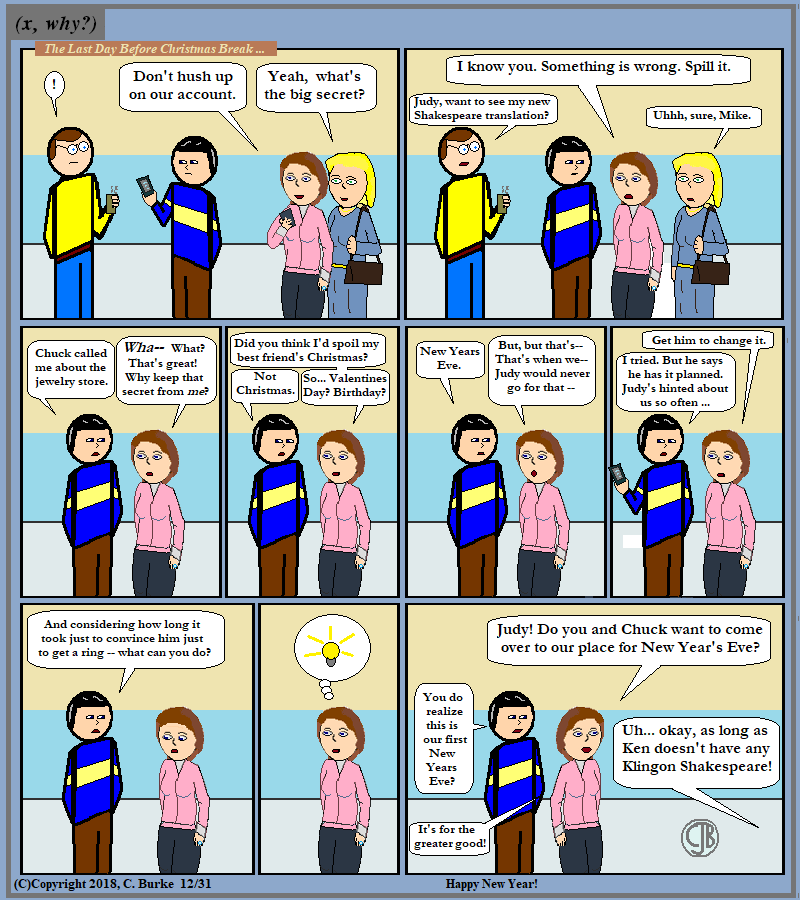
New Years Eve Plans!

(Click on the comic if you can't see the full image.)

(C)Copyright 2018, C. Burke.

Now I know why I like math puns so much. When people talk, it gets so wordy!

And there's a lot of standing around so that they get a chance to say this stuff.

And I deleted and rewrote a lot of dialogue.

Which is why this didn't actually appear on the last day before Christmas break!

I considered labeling this one "School Life", but I wanted to keep that for the students. And I've toyed with "After Hours" for the lives of the characters, but this is obviously school time. When else would Mike and Judy be around each other? Such is the life of a comic writer.

Oh, and Happy New Year! May all your plans be successful!


Come back often for more funny math and geeky comics.


Monday, January 01, 2018

(x, why?) Mini: Happy New Year 2018!

(Click on the comic if you can't see the full image.)

(C)Copyright 2018, C. Burke.

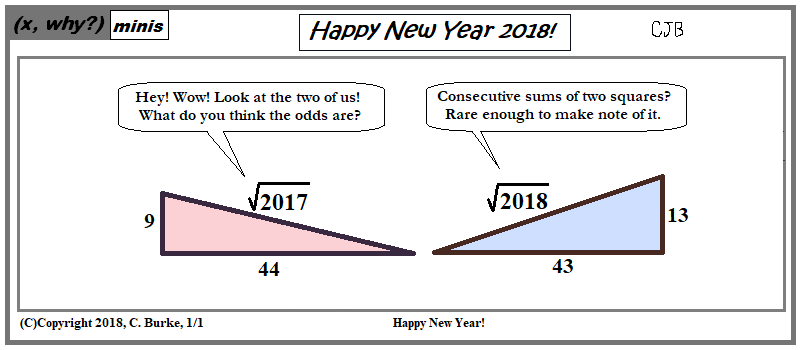
Happened 24 years ago, and will happen 24 years from now, but it's not a 24-year cycle.

Here's one list I found on the Internet.


Come back often for more funny math and geeky comics.


Sunday, December 31, 2017

Another New Years Eve

(Click on the comic if you can't see the full image.)

(C)Copyright 2017, C. Burke.

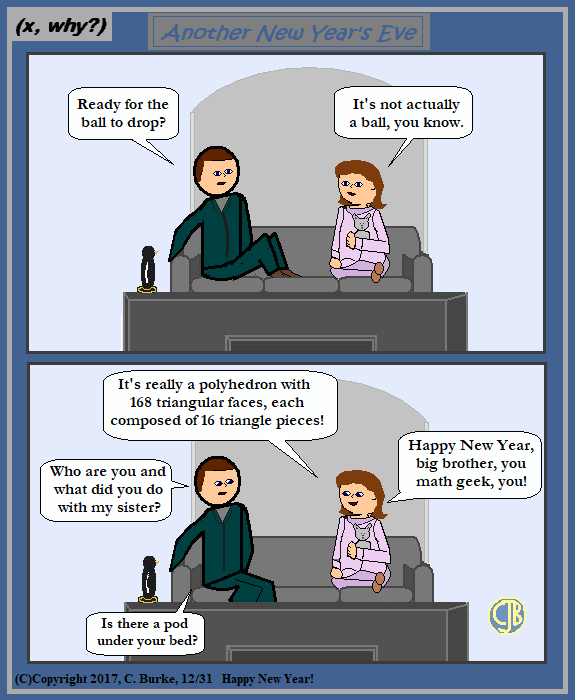
Sometimes you just have to surprise people

Or get replaced with a pod person.


Come back often for more funny math and geeky comics.
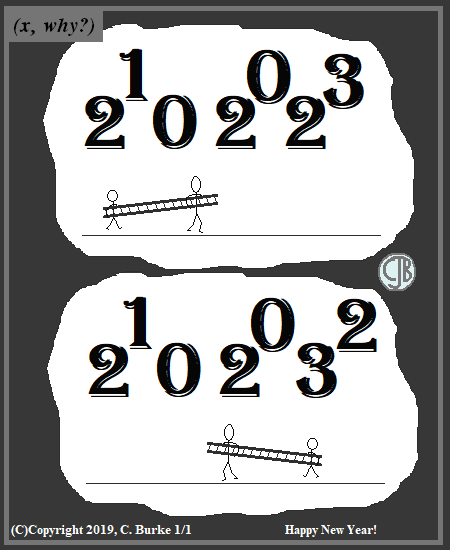


Sunday, January 01, 2017

Happy New Year 2017: Dependent Events

(Click on the comic if you can't see the full image.)

(C)Copyright 2017, C. Burke.

Two events are dependent if the outcome of the first affects the outcome of the second.

Safe to say, in this case, this year's going to be different either way. So 100%.

Also, in either case, I don't think I'll be drawing my characters from this direction again any time soon.


Come back often for more funny math and geeky comics.


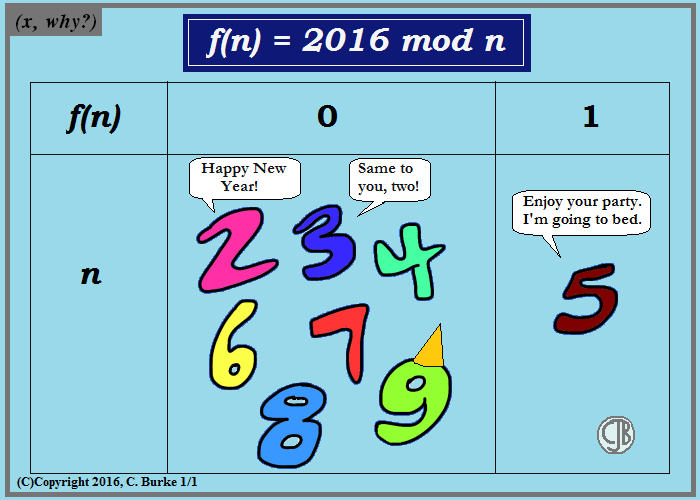
Friday, January 01, 2016

Happy New Year 2016!

(Click on the comic if you can't see the full image.)
(C)Copyright 2016, C. Burke.

Happy New Year!

I could've gone a lot of ways this year.

In binary, 2016 is 210 + 29 + 28 + 27 +26 + 25, but that is similar to what I did last year.

Also, 2016 is a Triangular Number, which I could have represented by 64 C 2, but I've done a lot of Triangular Numbers around Christmas Time in the past.

Someone on Twitter invented a cool binary addition palindrome. If I find a link, I'll post it on the blog. I'm not going to steal it and take credit for it. I didn't think to look for it myself.

Finally, the Answer to the Christmas Day Puzzle:

SANTA + CLAUS = 2016
The individual letter breakdown will be posted on the blog.


Come back often for more funny math and geeky comics.


Thursday, December 31, 2015

(x, why?) Mini: New Year's Eve 2016

(Click on the comic if you can't see the full image.)
(C)Copyright 2015, C. Burke.

Be careful! He might want to Rock the New Year, even if Times Square will be covered with paper.

Working in a scissors reference is left as an exercise for the reader.


Come back often for more funny math and geeky comics.


Thursday, January 01, 2015

It's All About The Year, The New Year ... 2015

(Click on the comic if you can't see the full image.)
(C)Copyright 2015, C. Burke.

And you know that he probably does, too.

HAPPY NEW YEAR!

The new year, 2015, brings some interesting numbers when converted into other bases. Granted, I find most numbers interesting in some way, but these still have interesting features.

In base 2 (binary), we have a palindrome; it's the same backward. The 0 in the middle means that we are 32 years away from all 1s and 33 away from rolling over the counter and adding another digit.

In base 3 (trinary), the number can be broken down into 2 20 21 22, which is somewhat sequential.

In base 4 (tetranary(?), ah skip it!), which is related to base 2 by virtue of being a power of 2, we get 133 133. It's not the palindrome that base 2 is; it's something more fun!

I don't have much to say about bases 5, 6, or 7. They have pairs of numbers, but that's hardly surprising. Two of them look like zip codes, so I checked: 31030 is Fort Valley, Georgia and 13155 in an area of upstate New York, south of Syracuse. (I thought it might be a section of Queens, in New York City, which is why I checked. Nope.) Last year, base 5 was 31024, which had all five available numbers in it, but we're a year too late for that.

In base 8 (octal), another power of 2, we get another repetition: 3737. Wonderful.

In base 9, meh. I hope everyone could figure out what base 10 was, so I skipped it. Base 11 likewise is boring as no alphabetic characters were required to substitute for numbers greater than 9.

In base 12, it gets interesting. While 12 is a multiple of 2, it isn't a power of 2. Using alphabetic characters, it's 11BB, but the "B" is a stand in for 11, so it's actually 1,1,11,11. Practically binary! (But it's not.) Note: in bases larger than 10, such as Sexagesimal, it is common to write the numbers in decimal form (no letters) and separate the powers with commas.

In base 13, we have 11, 12, 0 because the year is divisible by 13. Last year was 11, 11, 12. The year before 11, 11, 11. (You see: there's always something to be found!)

Finishing up, in base 14, 10 and 3 make 13. And we end with snoozy bases 15 and 16 (hexadecimal), which aren't all that interesting this year, although next year is 7E0 or 7, 14, 0. Something to look forward to!


Wednesday, December 31, 2014

Happy New Years Eve 2015

(Click on the comic if you can't see the full image.)
(C)Copyright 2014, C. Burke.

At least he came to give moral support. Two to the thirteenth won't be around for a while!

Two notes: First, 2^11 - 2^5 - 1 = 2015. That is to say, if all the powers of two, up to 10, were included, the sum would be 2047, which is one less that 2 to the 11th, which is 2048. Second, let's not forget the Y2048 bug! Or maybe the Y2(11) bug, just to be creative. Yes, it's true -- some really old computers, which will be really, really old 33 years from now, will have a problem handling the year as 2 to the 11th power. It should prove as Earth-shattering as Y2K did.

---------------

UPDATE: The Making of a Webcomic

This comic started with an 11-digit binary number, 10 ones and 1 zero. I thought it would be funnier if I used the powers of 2 instead, so I needed 11 twos. And then I decided to include the next power as an extra gag. So I needed to draw 12 twos.

Rather than use one of the two twos I usually use and instead of typing the twos, I decided to try on of the paint programs on my tablet and doodled them. I was worried that they might be too snakelike -- and then I was worried that I'd doodled a row of ducks. (I have to keep this in mind if I ever need ducks again.) Then I made the smaller numeric exponents from 12 on down to 0. Colored it in and emailed it to me PC.

Putting it together I realized that I had too many exponents and not enough twos! Oops! I made a mistake. BUT I PICKED THE WRONG MISTAKE! The problem wasn't that I didn't have enough 2s (and quickly created an extra). The problem was that if the lowest exponent was zero, then the highest exponent I needed was 11.

And somehow though all the checking and proofreading -- including all that stuff above (which I have since corrected) -- none of this popped into my head. Of course, moving to 2^11 power would be a bigger problem than moving to 2^12. Some things are stored as 10 bits (I don't know why, but they were) but nothing would be stored as 11 bits (well, maybe -- programmers are strange).

Anyway, the correction has been made. HAPPY NEW YEAR!!


Wednesday, January 01, 2014

Happy New Year 2014!

(Click on the cartoon to see the full image.)
IF YOU ARE SEEING THIS IN SOME SPAM LINK, PLEASE LET ME KNOW ABOUT IT. THANK YOU

(C)Copyright 2013, C. Burke.

Okay, so a lot less elaborate than last year, but also more applicable to what I'm teaching.

And I do have to adjust my watch on the first day of any month after a month with fewer than 31 days. Unless I wear the digital watch, of course.


Tuesday, December 31, 2013

Article: The Sums of Consecutive Squares

Fun fact for the 365th day of the year:

102 + 112 + 122 = 365 and 132 + 142 = 365

So 365 is the sum of two sets of consecutive squares, but, more importantly, those two sets are themselves consecutive: {10, 11, 12} and {13, 14}.

Now that's interesting! Okay, so it's also a co-incidence, really. Sums of consecutive squares have to add up to something, and, occasionally, those "somethings" will be the same number. But can we write a general rule for this?

Of course, we can. If we can write it, we can (hopefully) solve it. (Again, of course I can solve it, or I wouldn't be asking the question, but I'm sure that there are many, many rules which we could pose which I, personally, couldn't solve. However, this is a simple one to work with.)

At the very simplest level, we have the sum of the squares of two consecutive positive integers. It's obvious that these two numbers can't equal the sum of two higher integers, so the sum has to be of only one number. Not much of a sum, I grant you, but we're starting with a trivial case.

We want to find consecutive positive integers, a, b, and c such that

a2 + b2 = c2

so we'll use the variable n to stand in for the lowest integer, (n+1) for the next consecutive integer, and (n+2) for the third consecutive integer. Now we can rewrite the equation as

n2 + (n+1)2 = (n+2)2

Squaring the binomials, we get:

n2 + n2 + 2n + 1 = n2 + 4n + 4

Combing like terms gives us:

2n2 + 2n + 1 = n2 + 4n + 4

Rewrite this as a quadratic equation by subtracting the right side of the equation from both sides:

n2 - 2n - 3 = 0

Which factors into: (n - 3)(n + 1) = 0. Therefore, n = 3 or n = -1, but because we want a positive whole number, we'll discard the -1 and accept the 3. That makes the three consecutive integers 3, 4, 5 and, therefore, 32 + 42 = 52 .

But, of course, you already knew that. So why do all that work? Because now we can move up to four or five consecutive numbers. We can use the same procedure to find solutions to

a2 + b2 + c2 = d2 or a2 + b2 + c2 = d2 + e2

To save space, and to be as annoying as those textbook writers of my youth, I'll leave a, b, c, d to you to try. I'll give you a hint: there aren't any positive integer solutions, but you can prove that for yourself instead of taking my word for it. Go ahead -- challenge authority!

For the sum of the squares of three consecutive positive integers equal to the sum of the squares of the next two integers, this is the equation we write:

n2 + (n+1)2 + (n+2)2 = (n+3)2 + (n+4)2

When the dust settles, what will be the value of n? If you didn't get it, you weren't paying attention. It's in the first paragraph of this article. The solutions are n = 10 and n = -2. Once again, we toss the negative and we're left with: {10, 11, 12} and {13, 14}.

This brings two closing questions: The obvious question is what seven consecutive positive integers a, b, c, d, e, f, g fall into this pattern? (I didn't say that the answer was obvious, but it's easy to figure out.)

And another question about another pattern: In the first case, we threw out the solution n = -1. In the second case, we discarded n = -2. I'll go ahead and tell you that in finding the answer to the next sequence of numbers, you'll have to get rid of the solution n = -3. My question: will the negative solution we discard always have the same absolute value as the number of terms on the right side of the equation?

I'll leave that as an exercise to the reader. You have a whole, exciting, brand New Year to work it out!