Showing posts with label Real Number. Show all posts

Wednesday, January 13, 2016

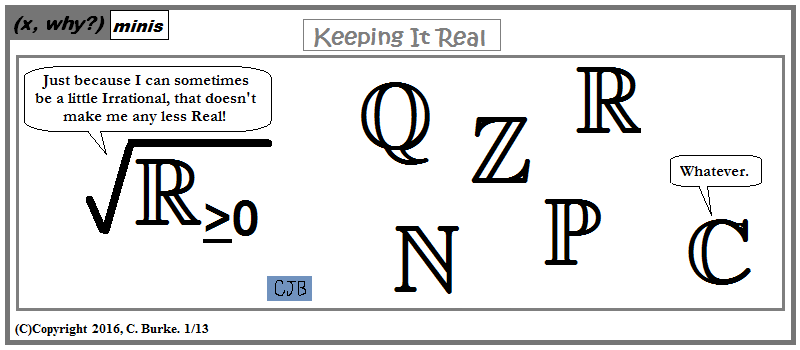
(x, why?) Mini: Real

(Click on the comic if you can't see the full image.)
(C)Copyright 2016, C. Burke.

At our roots, aren't we all a little irrational?

So R>0, the Non-Negative Real number set, is joined by, R, the Real number set; N, Natural numbers; Q, Rational numbers (R was taken); Z, Integers (don't ask); P, Primes; and C, Complex numbers.

I also saw a notation for H, denoting Quaternions -- I didn't even go there. Except to note that Q was taken already because R was taken already.


Come back often for more funny math and geeky comics.


Wednesday, July 08, 2015

(x, why?) Mini: Real

(Click on the comic if you can't see the full image.)
(C)Copyright 2015, C. Burke.

If we want to be successful real numbers around here, don't say 'i'!


Come back often for more funny math and geeky comics.


Sunday, August 10, 2014

N-RN.2 (Real Number System) - Rationalizing the Denominator

This is the third and final column on Common Core Standard N-RN.2. If you missed the first two parts, Part 1 dealt with evaluating expressions with rational exponents, and Part 2 showed how to simplify using factor trees and how to add and subtract radicals. The last piece of this standard (and since I'm only dealing with part ".2", I could really call it a "substandard" if I wanted to, mockingly) is to "Simplify radical expressions by rationalizing the denominator (Algebra 1 - EE.2)".

Previously, we mentioned that you can multiply two radical numbers by multiplying their radicands. We also factored radical numbers in order to simplify them. Let's talk about division. When you divide, you multiply by the reciprocal; that is, you can create a fraction of the two numbers without relying on your early education "gazintas". (You remember, "2 gazinta 6 three times".) Likewise, when you take the square root of a fraction, you are actually dividing one radical number by another.

So if you wanted the square root of 1/4, you would take the square root of the numerator (radical 1 is 1) over the square root of the denominator (radical 4 is 2). The result would be 1/2.

But suppose we wanted the square root of 1/2? Again, we can split it up into the square root of 1 (which is 1) over the square root of 2.

Here's where we run into a problem because there are rules from fractions. One of them is that there cannot be any radicals in denominator. You have to get rid of them.

We haven't discussed this before, but there's really only one simply way to get rid of a square root sign: square the number. We need to multiply the denominator by radical 2. We are allowed to do this because it's a fraction and we won't change the value of the fraction at all as long as we multiply the numerator by the same amount as the denominator. The fractions (square root of 2 over square root of 2 looks scary to evaluate until you remember that any number, even an irrational, divided by itself is one, with the exception of zero. If you multiply a fraction by 1, it doesn't change its value, even if it looks different. The result is that the radical is gone from the denominator and has moved into the numerator, which is allowed.

One more example. Try it yourself before scrolling down and looking at the image. What is the square root of 4/5?
Take the square root of each number. Rationalize the denominator. What's left in the numerator? What's left in the denominator?

Okay, check your work.

That's it for this standard. Time to move on to part 3, coming soon.

Saturday, August 09, 2014

N-RN.2 (Real Number System) - Dealing With Radicals

In a recent post, we explored evaluating expressions with rational exponents in them, but there's more to Common Core Standard N-RN.2. Don't worry, some of it's easier to deal with than what we already tackled.

These are the items listed below the standard, at least according to the IXL website, where I found the list:

  • Simplify radical expressions (Algebra 1 - EE.1)
  • Simplify radical expressions by rationalizing the denominator (Algebra 1 - EE.2)
  • Multiply radical expressions (Algebra 1 - EE.3)
  • Add and subtract radical expressions (Algebra 1 - EE.4)
  • Simplify radical expressions using the distributive property (Algebra 1 - EE.5)

Is there anything else to deal with? I don't know. Dealing with rational exponents isn't in this list, and yet I think that they might be encountered before Algebra 2. FYI, the notation "EE" stands for Expressions and Equations, which allows me to once again state that "Expressions don't have equal signs and are evaluated, and Equations do have equal signs and are solved."

Simplifying radical expressions is not a difficult task -- as long as you know that it does NOT mean pushing buttons on your calculator and coming up with an approximate decimal equivalent to 8 or 12 or 15 decimal places. Simplifying a radical is similar to reducing a fraction to its lowest terms. It makes it easier to deal with for computations (particularly adding and subtracting, when the radicals have to be "like terms") and comparisons. If the only thing you're planning to do with a radical number is square it, then, yes, simplifying it is a bigger waste of time than converting an improper fraction into a mixed number when it's only going to be used for slope.

There is a very straightforward method of simplifying square roots, but it seems to mystify some of my students who, apparently, never grasped the concept of what a square root (or a perfect square) was in the first place. They memorize steps, but uncertainty about the order causes them to mess up at the very end, removing radical signs from irrational numbers or leaving them in after taking a square root. (For example, they'll write that the square root of nine = the square root of three, instead of three.)

The simplest method involves finding the largest perfect square which is a factor of the radicand (i.e., the number under the radical sign). If it isn't the largest perfect square, then the radical hasn't been fully simplified. An example:

One problem my students face is not understanding the concept of a perfect square, so instead of 25 and 2, then use 5 and 10. After that, they're stuck, or they just decide, for example, that the square root of 5 is the same as 5 without the radical sign.

Because of this, I tried a different approach, using factor trees. They remembered doing them in middle school, and actually liked using them again. (You see, your teacher was right! You are using them again!) The example looked something like this instead:

After they have the prime factorization under the radical, I have them circle the pairs of numbers, cross them out and write one factor outside the radical. This has two downsides to it: first, if the number has a lot of factors, there will be a lot of extra work (but at least they will know, for certain, that they simplified their answer); second, if they don't complete the problem, they basically just drew a factor tree, which looks kinds childish and silly from a high school student.

Multiplying, Adding and Subtracting Radicals

Multiplying two radicals is as simple as multiplying two fractions. Just multiply the numbers under the radicand. For instance, radical 7 times radical 10 equals radical 70. If the number can be simplified, do it, according to the rules above. Obviously, if you square a radical, such as radical 6 times radical 6, the radical symbol goes away. In this case, you get radical 36, which is just 6.

As mentioned above, if you want to add or subtract radicals, they have to be alike. You can't add or subtract the following the way they are:

They aren't alike. It's like two to add 52 + 42 and getting 92. (In other words, you don't.)

But if you simplify the radicals, how to combine them becomes much clearer:

Finally, there is Division, but I'll save that for another column because of the standard, above, Simplify radical expressions by rationalizing the denominator.

Thursday, August 07, 2014

N-RN.2 (Real Number System) - More Rational Exponents

Continuing my post from Tuesday, on the Real Number system and rational exponents, let's move on to Standard N-RN.2, which reads Rewrite expressions involving radicals and rational exponents using the properties of exponents.

There's a lot to consider under this standard, so I'll continue with rational exponents, i.e., fractions. What if we wanted to evaluate an expression like this?

We need to recognize that the radical 5 is the same as 51/2, so

The rules for exponents say to multiply the 1/2 and the 4, giving us 52 or 25.

We can take this further. Suppose we had

The cube root is the same as 1/3 power. So

We can evaluate 63 as 6 * 6 * 6 = 216.

One more example: How would we handle

The fourth root becomes the 1/4 power.

Now we can get a little fancy with and deal with the multiplication of two fractions:

One final note: The answer doesn't always have to be a rational number. You may exchange one rational power for another, one root for a different one. Consider:

Problems could contain any combination of roots and improper fractions, which may or may not have a simple rational answer. But keep the calculator handy just in case you need to know the sixth root of 117,649. Showing your work, of course.

Tuesday, August 05, 2014

N-RN.1 (Real Number System) - The Meaning of Rational Exponents

While I'm trying to update every day in August, I might as well start taking a closer look at the Common Core standards, which have now been in place for one year in high school Algebra 1 classes in New York. The first standard I find is N-RN.1. The first N stands for Number and Quantity. Unfortunately, the RN stands for Real Number System and not Registered Nurse because the latter would be helpful when you got sick of all this! I could have helped that telling that joke -- I chose to tell it any way, if only because I had to look up what the letters meant, particularly the first "N".

The entire standard reads as follows: Explain how the definition of the meaning of rational exponents follows from extending the properties of integer exponents to those values, allowing for a notation for radicals in terms of rational exponents.

It then has two components, one for Algebra 1, the other for Algebra 2. The Algebra 1 component is Evaluate integers raised to rational exponents (Algebra 1 - V.9). Don't ask me about the "V.9", I've done enough searching for this column.

I used to start teaching each year with Order of Operations, something that all the students should have seen before, and yet seemed to forget about. They know an acronym, such as PEMDAS, but don't know what it means. Oh, they know what the six letters mean, but they don't get the concept. And even when they can explain the concept, when push comes to shove and the pressures on (and they're taking a quiz), you find them calculating from left to right as if they hadn't learned anything. I had to change that when we started welcoming calculators into the lesson (even before we started requiring them). The calculators were down the work for them, so they didn't have to learn it, right? Wrong. I just adapted the problems. I started added more operations within fractions and adding exponents, forcing them to pay attention to what they put into their calculator. For instance, you need explicit parentheses to group things in a calculator because the numerator and denominator are implicitly grouped.

But Common Core changes that. They have to learn it much earlier, so they're ready for Algebra by the time they get to high school. Yeah, right. I'm still doing it. But wait, there's more.

After parentheses, come the exponents. Some students know the concept of exponents, and some just press buttons on the calculator. They know (or they'll learn!) that they are multiplying the factor some number of times. What they haven't seen before is a fraction as an exponent. What do you do when you see a fraction? Hide under the desk, usually. Wait for it to be over. I'm not exaggerating much.

First, I have to teach the concept that exponent 1/2 means take the square root, as stated in the gem. And then see how well they know they're square roots, either with or without a calculator. (I try to get them to learn up to 256, with some success.)

Second, I have to teach them that exponent 1/3 means take the cube root. This usually entails explaining what a cube root is, and where to find it on the calculator. Maybe reviewing what "cubing" means, and possibly through in Volume = length X width X height somewhere, just so I can spiral back to it when that comes around again. Depending on the results, I could try to conquer the concepts of fourth and fifth roots. Seriously, a practice webpage asked me (729)(1/6).

At this point, I'm asking: are they getting it, or are they pushing buttons? I don't mind the button pushing if they understand the concept, because then they'll start recognizing patterns and will be smarter about their button pushing.

Okay, so the next step is the real doozy: explaining exponents of 2/3 or 3/5. The students have to deconstruct the fraction. That is, they need to know that 2/3 = (2)X(1/3), so they need both to square it and then take the cube root. And then I'll suggest that you take the cube root first, so that they're dealing with smaller numbers. Sometimes this makes sense to them.

Finally, there's the kicker: improper fractions. If fractions are Dr. Frankenstein, improper fractions are his monster. They're a whole new level of scary, and the first thing they want to do is turn them into mixed numbers. Or decimals. No! Wait! Stop!

Taking the (5/2) power of 16 is as simple as taking the fifth power of the square root of 16. Okay, read that again like you're a ninth grader.

No, it's not that difficult to do once the concept is learned, but it's something they haven't seen before, and they're learning it earlier. I can't remember exactly when the first time I was required to find a third or fourth root. I was probably using logs to do it. But then, I didn't have the calculators that they have today on their phones. They'll have the answers at their fingertips, but I'll make them show the work so I know they get the idea behind it.