Showing posts with label squares. Show all posts

Saturday, January 25, 2020

Blog: Difference of Squares, Cubes and Quarts

I wanted to do this before the Algebra Regents exams when it might have been more helpful to some students, but the fact is, they don't actually follow me. They just find the posts with the questions and answers on them through search engines.

The Difference of Squares is a common topic for Algebra 1, but what about other powers, such as cubes and quarts? (Quarts are is "quartic", fourth power.)

Squares and Quarts

In a binomial that looks like x2 - n2, where n is any number, which will be squared, we can factor the two terms into conjugates:

(x + n)(x - n)

All nice and neat. When you multiply the two conjugates (which have the same terms, but one has a plus and one has a minus), the two x terms -- (nx) and (-nx) -- are additive inverses and will sum to zero.

Every now and then, state exams like to throw a curve ball at you, and use a higher power, usually 4.

What if the problem said:

Factor completely x4 - 16

Since 4 is an even power, x4 is a perfect square. And, of course, 16 is a perfect square. So the regular rule applies:
x4 - 16 = (x2 + 4)(x2 - 4)

Ah, but have we factored "completely" as the question asked? We can't do anything with the first factor, (x2 + 4), which has no real roots, but what about the other factor? It's another Difference of Squares, so we can apply the rule again:
x4 - 16 = (x2 + 4)(x2 - 4) = (x2 + 4)(x + 2)(x - 2)

So, if they really wanted to be mean, er, I mean "challenging", they could go another step further and ask:

Factor completely x8 - 256

Sum of Cubes

I know that I started by saying "difference of ...", but that was to keep everything flowing.

Unlike squares (and other even powers), you can factor the sum of two cubes. Also unlike squares, a perfect cube can be a negative number, so it also could be written as a difference of cubes. So I'm not wrong -- I just renamed it for no reason.

There's a simple format for the Sum of Two Cubes:

(x3 + n3) = (x + n)(x2 - nx + n2)

First thing you should see is that (x + n) means that there is a root at x = -n.

The second thing you should see is that that is the only real root. If you check the discriminant, b2 - 4ac, you get the following:
(n)2 - 4(1)(n2).

As long as n has a nonzero value, the discriminant will always be less than zero. This example had a leading coefficient of 1, but it is still true if there is a different number in front the x3 term.

Final Example

If we wanted to put this together, we could try to factor x6 - 64.

Or really put it all together and got with an x12 term. But who wants to do that?

Friday, November 16, 2018

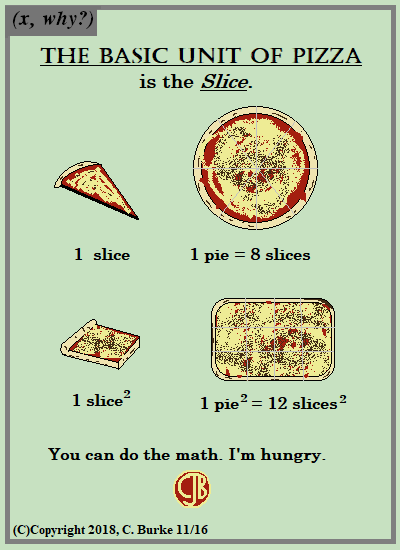
Units of Pizza

(Click on the comic if you can't see the full image.)

(C)Copyright 2018, C. Burke.

Rankings of Best Pizza: Brooklyn; rest of NYC; every place else, does it matter?

Rankings of Best Pizza chains:


Come back often for more funny math and geeky comics.


Monday, November 30, 2015

Strange Square Roots

(Click on the comic if you can't see the full image.)
(C)Copyright 2015, C. Burke.

Do NOT show my students this! They might think it's a rule and not a curiosity!

In fact, as strange as it looks, it isn't the only mixed number that has this property. And there isn't any reason to drop a jaw to the desk to figure out the pattern.

Let x be the whole number and y be the fraction (between 0 and 1, exclusive).

Then the equation says that (x)(sqrt(y)) = sqrt(x + y).
Square both sides we get (x2)(y) = x + y.
Subtract y from both sides (x2)(y) - y = x.
Factor the left side (y)(x2 - 1) = x.
Finally, divide y = x/(x2 - 1).

So you can pick any whole number value of x -- 2, 3, 10, whatever -- and substitute on the right side. You will get a value of y which is the fractional part of the mixed number that makes the "strange" square root work.

On a historical note: This is comic #1066. If you thought I'd do something about The Battle of Hastings ... well, it had crossed my mind, but too complicated and no way to plan in advance with the crazy schedule I'm keeping.


Come back often for more funny math and geeky comics.


Thursday, July 02, 2015

Prime Factorization, Perfect Squares and Irrational Numbers

Moving on from yesterday's discussion about Rational Numbers, what about irrational numbers, numbers which cannot be written as a ratio of two integers?

Most whole numbers have square roots which are irrational numbers, but not everything with a radical is irrational. The square root of a perfect square is perfectly rational. So how can you tell if a number is a perfect square without a calculator?

One way is through prime factorization. (Remember those factor trees from a long time ago. C'mon, they were fun to do -- and you can do them again.... just not when you're typing in a blog. Then, they're kind of a pain, but I'll try.)

Take a number such as 60. It's prime factorization is 2 X 2 X 3 X 5, or 22 X 3 X 5.
If we were to square 60, we'd multiply 60 X 60, but we could also multiply 22 X 3 X 5 X 22 X 3 X 5.
That number (3600) would have a prime factorization of 24 X 32 X 52.

Notice what happened to the exponents. They've all doubled from 1 to 2 or 2 to 4. Every time you square a number, the exponents of its prime factors double. So if a number has been square, then all of the exponents of its prime factors will be even numbers because they are multiples of two.

Going back to our original number, is the square root of 60 a rational number?

It could only be a rational number if 60 were a perfect square, and it can only be a perfect square if all the exponents of its prime factors are even. However, the prime factorization is 22 X 3 X 5. Only one factor is even, so it is not a perfect square and the square root of 60 is irrational.

But wait! There's more!

As long as we've done the legwork, there is one more thing that we can do. Radicals that are irrational can be simplified. This is done by factoring out the largest perfect square. If we look back at the prime factorization, 22 X 3 X 5, we can see that there are two factors of 2.

So the square root of 60 is the same as (the square root of 22) X (the square root of 3 X 5). The square root of 22 is just 2.
That means that the square root of 60 is (2) times (the square root of 3 X 5), or 2(radical 15).

Monday, June 22, 2015

Completing the Square

(Click on the comic if you can't see the full image.)
(C)Copyright 2015, C. Burke.

After 1000 comics, sometimes I surprise myself when I realize that there are puns that I still haven't used.

Also, 1017 is not a perfect square. You need to add + 7 to complete the square.


Come back often for more funny math and geeky comics.


Tuesday, December 31, 2013

Article: The Sums of Consecutive Squares

Fun fact for the 365th day of the year:

102 + 112 + 122 = 365 and 132 + 142 = 365

So 365 is the sum of two sets of consecutive squares, but, more importantly, those two sets are themselves consecutive: {10, 11, 12} and {13, 14}.

Now that's interesting! Okay, so it's also a co-incidence, really. Sums of consecutive squares have to add up to something, and, occasionally, those "somethings" will be the same number. But can we write a general rule for this?

Of course, we can. If we can write it, we can (hopefully) solve it. (Again, of course I can solve it, or I wouldn't be asking the question, but I'm sure that there are many, many rules which we could pose which I, personally, couldn't solve. However, this is a simple one to work with.)

At the very simplest level, we have the sum of the squares of two consecutive positive integers. It's obvious that these two numbers can't equal the sum of two higher integers, so the sum has to be of only one number. Not much of a sum, I grant you, but we're starting with a trivial case.

We want to find consecutive positive integers, a, b, and c such that

a2 + b2 = c2

so we'll use the variable n to stand in for the lowest integer, (n+1) for the next consecutive integer, and (n+2) for the third consecutive integer. Now we can rewrite the equation as

n2 + (n+1)2 = (n+2)2

Squaring the binomials, we get:

n2 + n2 + 2n + 1 = n2 + 4n + 4

Combing like terms gives us:

2n2 + 2n + 1 = n2 + 4n + 4

Rewrite this as a quadratic equation by subtracting the right side of the equation from both sides:

n2 - 2n - 3 = 0

Which factors into: (n - 3)(n + 1) = 0. Therefore, n = 3 or n = -1, but because we want a positive whole number, we'll discard the -1 and accept the 3. That makes the three consecutive integers 3, 4, 5 and, therefore, 32 + 42 = 52 .

But, of course, you already knew that. So why do all that work? Because now we can move up to four or five consecutive numbers. We can use the same procedure to find solutions to

a2 + b2 + c2 = d2 or a2 + b2 + c2 = d2 + e2

To save space, and to be as annoying as those textbook writers of my youth, I'll leave a, b, c, d to you to try. I'll give you a hint: there aren't any positive integer solutions, but you can prove that for yourself instead of taking my word for it. Go ahead -- challenge authority!

For the sum of the squares of three consecutive positive integers equal to the sum of the squares of the next two integers, this is the equation we write:

n2 + (n+1)2 + (n+2)2 = (n+3)2 + (n+4)2

When the dust settles, what will be the value of n? If you didn't get it, you weren't paying attention. It's in the first paragraph of this article. The solutions are n = 10 and n = -2. Once again, we toss the negative and we're left with: {10, 11, 12} and {13, 14}.

This brings two closing questions: The obvious question is what seven consecutive positive integers a, b, c, d, e, f, g fall into this pattern? (I didn't say that the answer was obvious, but it's easy to figure out.)

And another question about another pattern: In the first case, we threw out the solution n = -1. In the second case, we discarded n = -2. I'll go ahead and tell you that in finding the answer to the next sequence of numbers, you'll have to get rid of the solution n = -3. My question: will the negative solution we discard always have the same absolute value as the number of terms on the right side of the equation?

I'll leave that as an exercise to the reader. You have a whole, exciting, brand New Year to work it out!

Thursday, June 10, 2010

Sums of Squares of Consecutive Numbers

Continuing what I started on Tuesday's post:

Giving the Pythagorean Theorem, a2 + b2 = c2, find three consecutive numbers for a, b and c.

The answer, of course, is everyone's favorite Pythagorean Triple, 3, 4 and 5.

But suppose instead of three consecutive numbers, we had five consecutive numbers, which were split with the three smaller values on the left and the two greater values on the right? That would give us:

a2 + b2 + c2 = d2 + e2


The answer is in the previous post. I'll omit it here in case you want to work it out.

Now, a couple approaches could work here. The first, and probably best if you plan on going further, is to replace the variables with n, n+1, n+2, etc., and then using FOIL (or a "FOIL"-free alternative if you hate "FOIL"), combining like terms and solving the resulting equation.

The other, which I can use on Day 1, is guess and check. Okay, stop laughing and rolling your eyes, and hear me out.

First of all, most of my students haven't handled a scientific calculator very much let alone a TI-83, 84, or N-Spire. (Yes, we had a bunch donated to the school as part of a technology initiative. Unfortunately, they aren't allowed to be used during the Regents exams, so we have to switch back to the older calculators. But that's a rant for another day.) An activity like this could be a simple and thoughtful first exercise.

Second, many of them have little or no Number Sense or Estimating skills. How would they approach the problem? Would they try 3, 4, 5, 6, 7 first? When that doesn't work, will they move to 4, 5, 6, 7, 8, or will they jump a little higher a little faster? But if they don't try every combination, how will they know if they went too far and passed the answer?

Then, after finding the answer and comparing it to 3, 4, 5, what would their first guess be for
a2 + b2 + c2 + d2 = e2 + f2 + g2 ?


Naturally, all of this occurs to me during the last week of classes, after the
final exam has been given.