Sunday, August 24, 2014

What Makes the Golden Ratio so Golden?

Now that I’ve concluded my Golden Ratio-themed comic serial, I wanted to get into a little what the Golden Ratio actually is. Just saying that it’s some number that’s approximately 1.618, doesn’t quite do it justice. What’s so special about that number? And what makes that a ratio?

Second point, first. A ratio is a comparison of two numbers, so it can cause confusion if only a single number is written, even if “to 1” is implied.

What makes it so special is what is being compared. Look at these two images, for example. They are basically the same thing, only the notation for the lengths are different.

Suppose we wanted to find a ratio of the length of the square to the length of the rectangle, and we wanted that ratio to equal the ratio of the length of the smaller rectangle to that of the bigger one, what value of x would accomplish that?

It terms out that we could set up the problem in either of these two ways (and many more, besides!). On the left, the square has a length of 1, the smaller rectangle has a width of x, so the bigger rectangle has a total length of x + 1. One the right, the square still has a length of 1, but the bigger rectangle has a total length of x, so the smaller rectangle has a length of x – 1.

Setting up the proportions and cross-multiplying we find:

In either case, we get the same quadratic equation: x2 – x – 1 = 0.
That’s not something easily factorable, so we have to use Ye Olde Quadratic Formula, after which we discover that the roots are

If we take the positive value, we get x = 1.618033988749894848204586... But what about the negative value? If we subtract root 5 from 1 and divide by 2, we get x = -0.618033988749894848204586...

Look at the decimal portion. They are the same! Keep in mind, that we’re dealing with irrational numbers here, which aren’t supposed to conform to patterns, but this one is just brilliant. And, yes, there is a reason for it.

Take a look at that second proportion, above, on the right, with the removable 1 in the denominator.

This is saying that one less than the number is the reciprocal of that number! If you divide 1 by 1.618033988749894848204586..., you will get 0.618033988749894848204586..., the same as if you just subtracted one.

This works for the negative value as well: If you divide 1 by -0.618033988749894848204586..., you will get -1.618033988749894848204586..., the same as if you just subtracted one.

One last point, and a hat tip to William Ricker for mentioning it, how else can we write the reciprocal of x, 1/x? What exponent gives us the reciprocal of x? An exponent of -1. That means that this equation, this proportion, can be written as:

Absolutely brilliant. And quite Golden, if I say so myself.

Saturday, August 23, 2014

A Little Bit of Fibonacci ...

Today's column isn't going to happen the way I wanted it to, so I'll try it for tomorrow. In the meantime, I'll leave you with this:

I just finished posted a series of comics with crazy numbers in the titles after the word "part", instead of the normal "Part 1/10, Part 2/10, ..." etc.

This is because those numbers were intended to be ratios, and not just any ratios, but Fibonacci number ratios. As you might have guessed from the first episode in that sequence, I would be working with Fibonacci numbers. You might also have guessed that I would have been done by the time I got to 21 -- That's okay! I was expecting to be done a lot sooner, too!

As I hope to get into a little more depth tomorrow, when you divide two consecutive Fibonacci numbers, you get a ratio that is close to the Golden Ratio, which is also known as "phi", and is approximately 1.6180339887. The larger the terms, the smaller the difference between the two ratios.

Here is a table showing you the first 15 terms:

But that's not the only thing interesting about the Golden Ratio. (Well, of course not! Books could -- and have -- been written!) There should be more about it in tomorrow's entry.

Friday, August 22, 2014

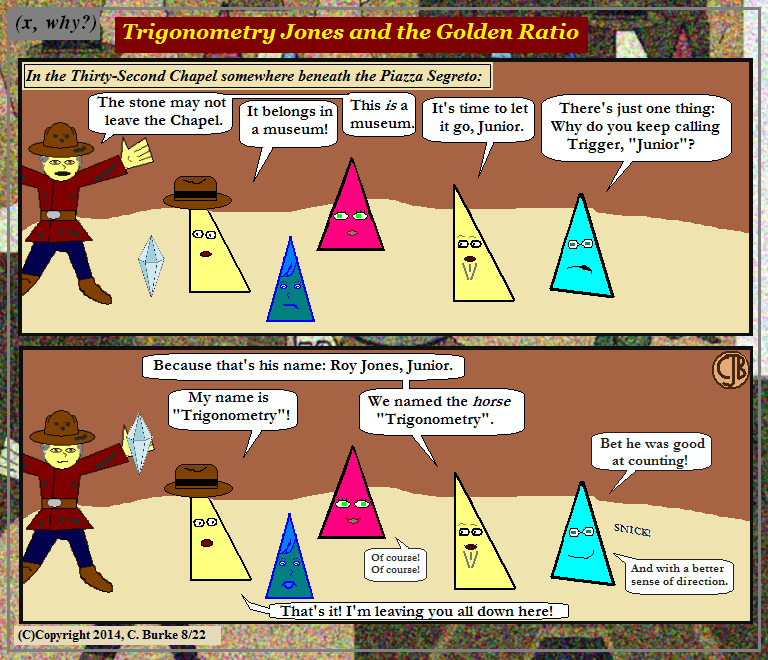
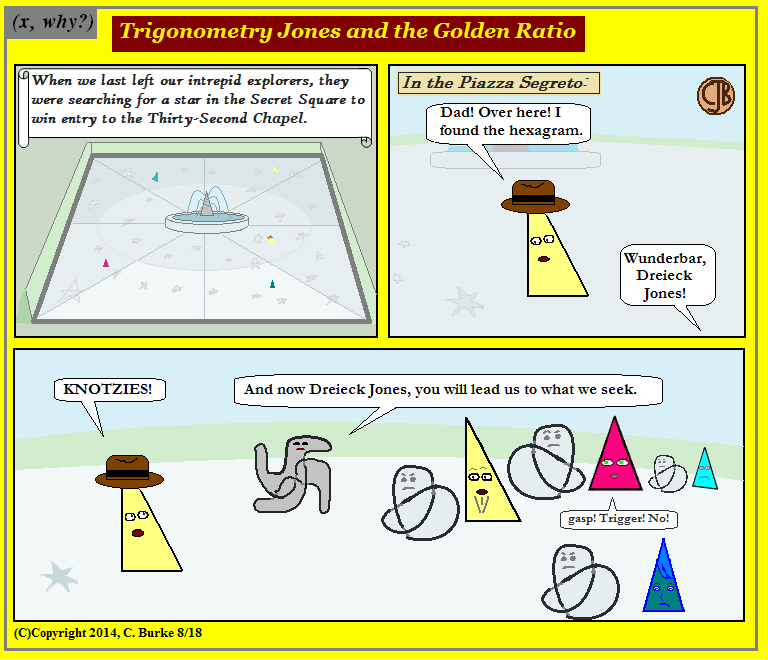
Trigonometry Jones and the Golden Ratio, Part 1.618033988749894848204586...

(Click on the comic if you can't see the full image.)
(C)Copyright 2014, C. Burke.

And if the horse were here, they could ride off into the sunset.


For anyone who joined in the past five years and missed out, or are wondering about "Part 144/89", check out the following:

For a quick read, check out the Comics-Only site, starting here, and then continuing here.

Or if you might want to comment, check out these blog entries:
1/1, 2/1, 3/2, 5/3, 8/5, 13/8, 21/13, 34/21, 55/34, 89/55, 144/89, 233/144, 377/233, 610/377.


Thursday, August 21, 2014

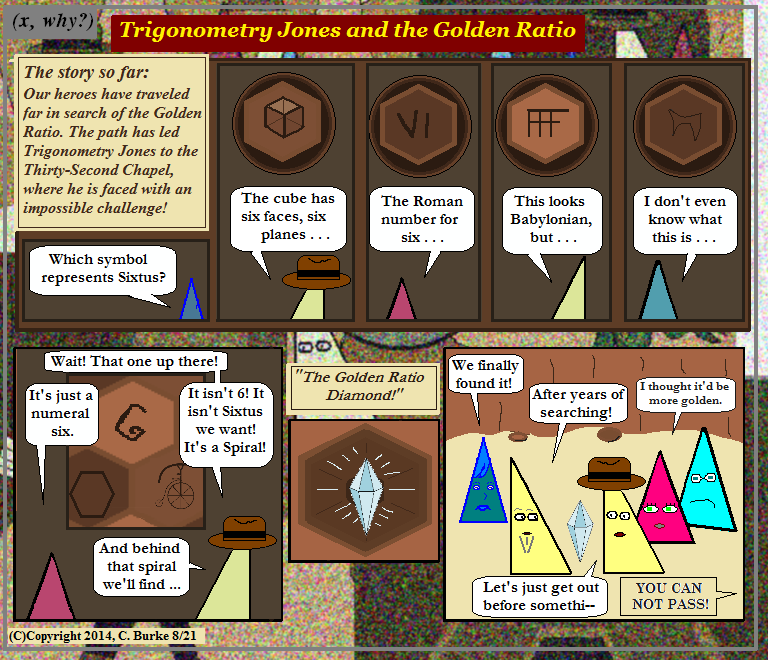
Trigonometry Jones and the Golden Ratio, Part 610/377

(Click on the comic if you can't see the full image.)
(C)Copyright 2014, C. Burke.

So the Golden Ratio was actually a rare gem the whole time? Who knew?!

The gem came as close to the golden ratio as I could manage in Paint. Actually, it was closer, but I hated the way it looked, so I altered it a little to make it more esthetic.

It does seem like they've been looking for years. And now it's almost done.


For anyone who joined in the past five years and missed out, or are wondering about "Part 144/89", check out the following:

For a quick read, check out the Comics-Only site, starting here, and then continuing here.

Or if you might want to comment, check out these blog entries:
1/1, 2/1, 3/2, 5/3, 8/5, 13/8, 21/13, 34/21, 55/34, 89/55, 144/89, 233/144, 377/233.


Wednesday, August 20, 2014

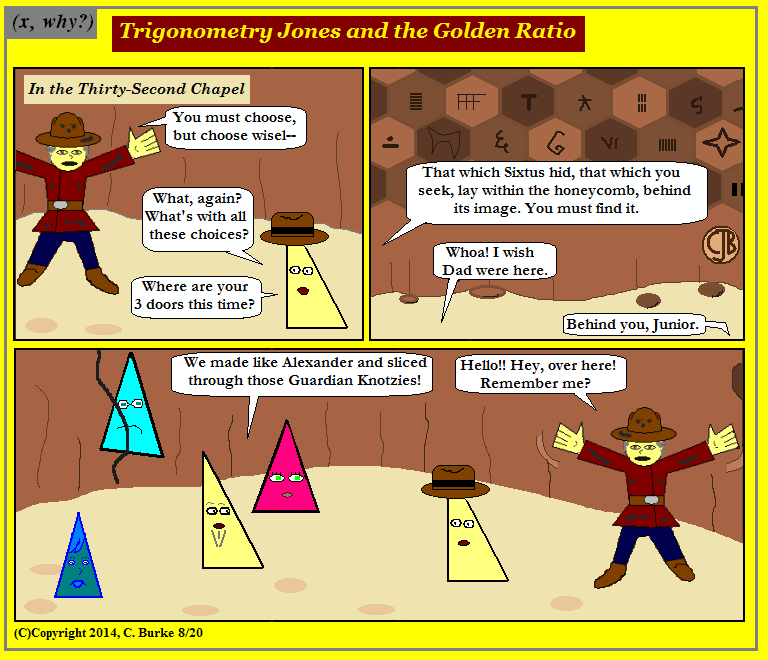
Trigonometry Jones and the Golden Ratio, Part 377/233

(Click on the comic if you can't see the full image.)
(C)Copyright 2014, C. Burke.

Trigonometry is referring to the last time he was in the Mountie's Hall.

That happened in the final trailer for Trigonometry Jones and the Lost Compass.

One other note: Even though I storyboarded this, it's still not turning out exactly as I planned. But it is coming to a conclusion!
And that will be the last time I get this involved in the details!


For anyone who joined in the past five years and missed out, or are wondering about "Part 144/89", check out the following:

For a quick read, check out the Comics-Only site, starting here, and then continuing here.

Or if you might want to comment, check out these blog entries:
1/1, 2/1, 3/2, 5/3, 8/5, 13/8, 21/13, 34/21, 55/34, 89/55, 144/89, 233/144.


Tuesday, August 19, 2014

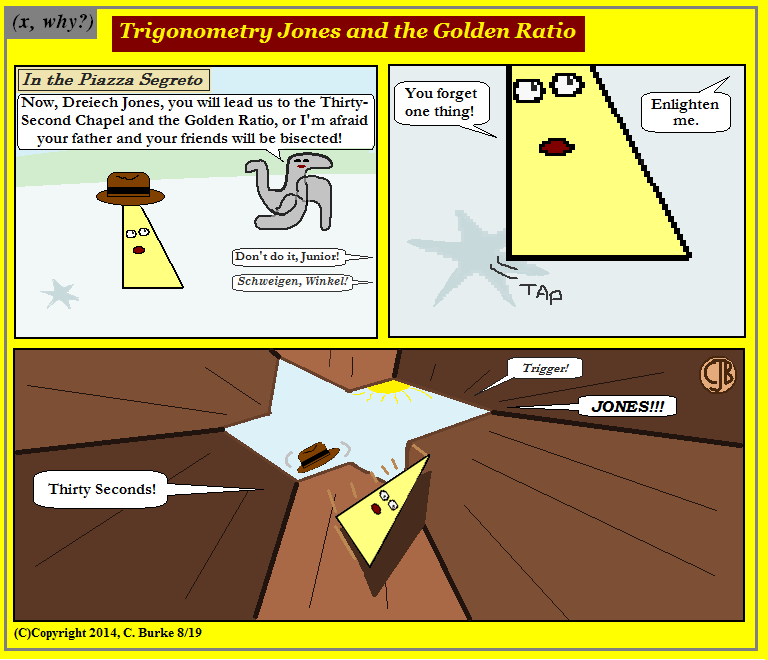
Trigonometry Jones and the Golden Ratio, Part 233/144

(Click on the comic if you can't see the full image.)
(C)Copyright 2014, C. Burke.

Dum da dum dum. Dum da dum. Dum da dum dum. Dum da dum dum dum.


For anyone who joined in the past five years and missed out, or are wondering about "Part 144/89", check out the following:

For a quick read, check out the Comics-Only site, starting here, and then continuing here.

Or if you might want to comment, check out these blog entries:
1/1, 2/1, 3/2, 5/3, 8/5, 13/8, 21/13, 34/21, 55/34, 89/55, 144/89.


Monday, August 18, 2014

Trigonometry Jones and the Golden Ratio, Part 144/89

(Click on the comic if you can't see the full image.)
(C)Copyright 2014, C. Burke.

Will Trigonometry do the Right Thing or the Reich Thing?

Yes, the gang is back! That chilling cliffhanger to which you've waited nearly FIVE years for its resolution!
... which will hopefully be happening, even though I've been dreading this.

For anyone who joined in the past five years and missed out, or are wondering about "Part 144/89", check out the following:

For a quick read, check out the Comics-Only site, starting here,

Or if you might want to comment, check out these blog entries:
1/1, 2/1, 3/2, 5/3, 8/5, 13/8, 21/13, 34/21, 55/34, 89/55.


Sunday, August 17, 2014

Sunday Night, Thinking About the Numbers

Be forewarned: this is the obligatory filler post to keep my every-day-in-August streak going. Any ideas bouncing around my head all day would take too long to plot out, type up and semi-illustrate. So I'm punting. This may be boring, or it could be fun. Let's see.

Some numbers have been on my mind this past week or so. Those were the numbers 2000 and 900. Odd numbers to be sure -- except that they're both even. Actually, they're both sort of "anniversary" numbers, with one being a centenary and the other a millennial.

I noticed this past Monday, that I had reached more than 1900 tweets on my twitter account. I was wondering if I might do something silly for 2000. Or maybe 2001 would be better. Or maybe 2001 could say, "Hey, that was my 2000th tweet!" (First-world problems, right?) Hey, it's all about "branding", or so I'm led to believe. Funny thing is that this was on my mind during the last Weird Ed twitter chat. I didn't want to randomly comment on so many things that I'd fly over the top. I also didn't retweet a few funny or interesting links, and I hesitated on the reply button.

I checked the counter before tweeting every link to my posts and comics.

And then I had some fun, and the geek within created these:

I haven't gotten to Tweet 2010: the Tweet I Make Contact yet. Or maybe I have -- I wasn't paying attention earlier today.

The second number: 900.

Since 2007, I have posted comics on a sometimes regular basis. It's the reason why some of you are here. Math puns, teacher jokes, general geekiness. That's me.

I'm closing in on comic #900. Every 100th comic has been a little special, generally (but not always) having something to do with that number specifically.

Sadly, I noticed that it took over a year to get from 600 to 700, and from 700 to 800. For a while I was posting four times per week, over and above the promised three times per week. In the past couple years, there were weeks with only one update. Then again, this has been a year from Hell.

Finally, there were a couple more Number-Specific comics that come to mind that I want to add:

  • 99: Luftballoon, read it anyway if you got the joke
  • 666: Devil's Staircase, which, co-incidentally, fell on St. Valentines Day.

    So what's coming up for Number 900? I guess I'll know in five more comics!

  • Saturday, August 16, 2014

    Lines in Planes

    (Click on the comic if you can't see the full image.)
    (C)Copyright 2014, C. Burke.

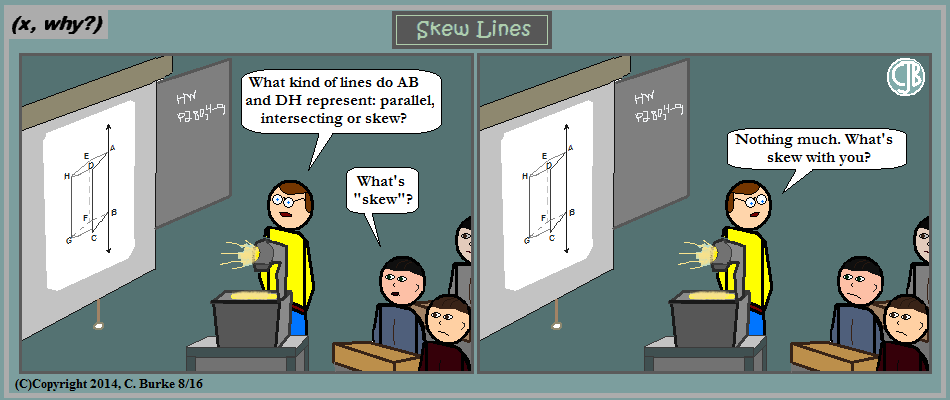
    You've been skewered.

    Skew lines are neither parallel nor intersecting, occuring in three-dimensional space, not two. Imagine skew lines as an overpass and a roadway passing beneath. They don't intersect, but they're not parallel, and they aren't traveling in the same direction.

    Or think of the front-right edge of a shoebox and the top-left edge. They each join two planes, but there isn't a common plane containing both of them.


    Friday, August 15, 2014

    August 2014 Integrated Algebra Regents Exam, Multiple Choice

    If you find this page helpful, please Like or Share or Leave a Comment. Thank you!

    The problem with these exams is that they all happen at the same time and leave a lot of time to work on blog posts (and have a life, too!). Then again, whoever said that teachers have lives?

    Here are the multiple-choice questions, the quick-and-dirty edition, which may or may not get updated in the near future.

    1. What is the product of 3a2b and -2ab3?

    (4) -6a32b4. Multiply the co-efficients, add the exponents (no exponent = 1).

    2. The value of the expression |-20| - |6| is

    (2) 14. (20 - 6 = 14)

    3. When 9x2 - 100 is factored, it is equivalent to (3x - b)(3x + b). What is the value of b?

    (2) 10. Difference of Squares Rule.

    4. Which equation represents the line that passes through the points (1, 1) and (-2, 7)?

    (4) y = -1/2 x + 6. Find the slope of the line first, (7-1)/(-2-1) = 6/(-3) = -1/2. Plug in x and y and check the two equations with that slope.

    5. The graph below represents the parabolic path of a ball kicked by a young child. What are the vertex and the axis of symmetry for the parabola?

    (1) vertex (3, 8); axis x = 3.

    6. Which relationship can best be described as causal?

    (3) The snow is falling and the stores run out of snow shovels. The others aren't related at all.

    7. In a class, which data can be classified as qualitative?

    (4) Hair color of students. Qualitative are descriptive, quantitative are amounts. I don't like this question because shoe size is more descriptive than an actual measurement. It is a measurement, but you'll never see it added, subtracted or averaged -- what would the point of knowing the "average" shoe size by, unless by "average" you meant "mode". But that's for another day.

    8. Given the following:
    ..........................................................
    What is the intersection of sets A, B, and C?

    (4) Jade and Kyle are in all three sets, so they are the intersection.

    9. The sun of (3x - 4)/(x + 3) and (2x - 5)/(x + 6) is

    (1) (5x - 9)/(x + 3). Add the numerators, leave the denominators alone.

    10. If Rosa's age is represented by R, which inequality represents the statement "Rosa is at most 29 years old"?

    (3) R < 29

    11. What is the slope of a line passing through points (-7, 5) and (5, -3)?

    (2) Another slope question! Rise over run gives you (-2/3)

    12. A positive correlation always exists on a scatter plot when

    (4) y increases as x increases. Also, y decreases as x decreases. It trends up and to the right.

    13. A sandwich consists of one type of meat, one type of condiment and one type of cheese. The possible choices are listed below:
    .......................................................
    In the sample space of all the possible different sandwiches consisting one type of meat, one type of condiment and one type of cheese, how many sandwiches do NOT include provolone cheese?

    (1). Use the Counting Principle and multiple 3 * 3 * (4-1) = 27. There were four cheese, remove 1 for provolone.

    14. The graph of the equation y = x2 is shown below.
    ....................................................
    Which statement best describes the change in this graph when the coefficient of x2 is multiplied by 4?

    (2) The parabola becomes narrower because it would increase higher, faster.

    15. A parking lot is 100 yards long. What is the length of 3/4 of the parking lot, in feet. 1 yard = 3 feet.

    (2) (3/4) * (100) * 3 = 75 feet

    16. What is the solution of the equation (12/7x) + (3/2x) = 15/14

    (3) Multiply the entire equation by 14x and you get 24 + 21 = 15x, so 45=15x and x = 3.

    17. The expression (2x2 + 10x - 28)/(4x + 28) is undefined when x is

    (2) -7, only. The fraction is undefined only if the denominator = 0. If the numerator is 0 (and not the denominator), the fraction is 0, not undefined.

    18. In right triangle JKL in the diagram below, KL = 7, JK = 24, JL = 25, and angle K = 90 degrees.
    ...............................................
    Which statement is not true?

    (2) cos L = 24/25. That is false because cos L = 7 / 25.

    19. A teacher asked the class to solve the equation 3(x + 2) = 21. Robert wrote 3x + 6 = 21 as his first step. Which property did he use?

    (3) Distributive property.

    20. If the roots of a quadratic equation are -4 and 2, the equation is equivalent to

    (1) (x + 4)(x - 2) = 20. Flip the signs.

    21. Kelsey scored the following points in her first six basketball games: 22, 14, 19, 22, 8 and 17. What is the relationship between the measures of central tendency?

    (1) mode > median > mean

    22. Sheba opened a retirement account with $36,500. Her account grew at a rate of 7% per year compounded annually. She made no deposits or withdrawals on the account. At the end of 20 years, what was the account worth, to the nearest dollar?

    (3) $141,243. Exponential growth/compounded interest: Balance = 36500 (1.07)20

    23. Which equation represents a vertical line?

    (4) x = 12. Set x = to any constant, and you have a vertical line. In this case the line contains the points {... (12, -2), (12, -1), (12, 0), (12, 1), (12, 2), ... }

    24. Byron has 72 coins in his piggy bank. The piggy bank contains only dimes and quarters. If he has $14.70 in his piggy bank, which equation can be used to determine q, the number of quarters he has?

    (3) 0.10(72 - q) + 0.25q = 14.70

    25. Which graph represents the equation y = |x - 2|?

    (4) The V shape in on the x-axis at (2,0). The -2 shifts the graph to the right.

    26. If ax + 3 = 7 - bx, what is x expressed in terms of a and b?

    (3) Subtract 3 from both sides. Add bx to both sides: ax + bx = 4.
    Factor: (a + b)x = 4.
    Divide: x = 4/(a + b)

    27. Which equation represents a line that is parallel to the line whose equation is y = -3x?

    (3) 6x + 2y = 4. Another slope question, but this time you had to work out which of the choices has a slope of -3 so it can be parallel to the given line.

    28. What is the result when 6x2 - 13x + 12 is subtracted from -3x2 + 6x + 7?

    (4) When you subtract 6 from -3 you get -9, and only choice (4) has that.

    29. What is the solution set of the equation x / 3 = 8 / (x + 2).

    (2). Cross multiply to get x2 + 2x = 24, subtract 24 from each side, factor and solve. Or plug in the choices and see what works. {-6, 4} both work.

    30. Which set of integers is included in (-1, 3]?

    (1) -1 is NOT included, but 3 IS included because of the square bracket. (I just went over this when I subbed last week. I hope they remembered!)

    That's it for part one.
    I will try to clean this up a bit over the weekend.

    Thursday, August 14, 2014

    August 2014 Integrated Algebra Regents Exam, Open-Ended Questions

    If you find this page helpful, please Like or Share or Leave a Comment. Thank you!

    This morning was the Integrated Algebra Regents exam, and it was either the last one or next to last one. (There may be one final one in January.)

    I've decided to start with the Open-Ended questions because they're quicker to type and I can scan in some of the answers I worked out.
    There were three two-point questions, three three-point questions, and three fout-point questions. Partial credit was available for all of them, and work was required.

    Part 2

    31. Using his data on annual deer population in a forest, Noj found the following information:

    25th percentile: 12
    50th percentile: 15
    75th percentile: 22
    Minimum population: 8
    Maximum population: 27

    Using the number line below, construct a box and whisker plot to display the data.

    They gave you the Five-Number Summary. All you had to do was graph it. Start by using the number line, which had 30 hash marks, so you could've gone from 1 to 30, if you wanted to. You MUST have a scale designated, don't put one number here and one number there just because. Don't skip one here and skip two there.

    Here is a sample answer:

    32. The diagram below consists of a square with a side of 4 cm, a semicircle on the top, and an equilateral triangle on the bottom. Find the perimeter of the figure to the nearest tenth of a centimeter. [Diagram omitted.]

    First of all, realize that if you didn't round correctly, you lost one point on a two-point problem. Don't throw away points!

    The square has two sides showing, each side is 4. The equilateral triangle has two sides showing, and the third side is the side of the square, so those two sides are also 4. So far we have 4 + 4 + 4 + 4 or 16. Finally, the length of a semicircle (half the circumference) is 1/2 times pi times the diameter, which is the side of the square, which gives us 1/2 * 3.14 * 4, which is 6.28, rounded to 6.3, as per the question. Add 16 + 6.3 to get 22.3, which is the final answer.

    NOTE: In this question, you could get away with using 3.14 for pi because the numbers were small and you had to round. That won't be the case in the next problem.

    33. A thermos in the shape of a cylinder is filled to 1 inch from the top of the cylinder with coffee. The height of the cylinder is 12 inches, and its radius is 2.5 inches. State, to the nearest hundredth of a cubic inch, the volume in the thermos.

    Note: If you used either 3.14 or 3.1416 for pi, you got the wrong answer. I am serious. If you didn't use the Pi key on the calculator, or at least use 3.141592, you answer will not round correctly. Will you lose points for this? You're supposed to, but it might slip by, depending on the scorer.

    The formula for Volume is pi * r2 * h, where h is the height of the coffee, not the thermos, so h = 11, not 12.
    The correct equation is V = (3.141592...)(2.5)2(11) = 215.98, to the nearest hundredth.

    PART 3.

    34. The top of a lighthouse, T, is 215 feet above sea level, L, as shown in the diagram below. The angle of depression from the top of the lighthouse to a boat, B, at sea is 26o. Determine, to the nearest foot, the horizontal distance, x, from the boat to the base of the lighthouse.

    The angle of depression from the top of the lighthouse is equal to the angle of elevation from the boat. We have a right triangle, and we know the side opposite angle B and we want the side adjacent to angle B. This means that we need to use tangent to solve the problem.

    Tan 26 = opp/adj = 215/x. So x = 215/tan 26 = 440.815..., or 441, to the nearest foot.

    35. There are six apples, five oranges and one pear in John's basket. His friend takes three pieces of fruit at random without replacement. Determine the probability that all three fruits taken are apples.

    There are twelve pieces of fruit to begin with, six of which are apples. Each time he takes one, there is one fewer piece of fruit and one fewer apple.
    The equation you needed to write was P = 6/12 * 5/11 * 4/10, which after cancelling factors (or multiplying and simplifying) leaves you with 1/11.

    36. Express [THE FOLLOWING in simplest radical form.

    I'll leave this for pictures as there are too many radical signs.

    The y is there for no apparent reason, and the two radicals cannot be combined because they aren't alike. This was a bit of an unusual question, with three twists: the variable, the distribution of the negative sign and the different radicals in the answer.

    PART 4.

    37. On the set of axes below, solve the following system of inequalities graphically:

    y + 3 < 2x
    -2y < 6x - 10
    State the coordinates for a point in the solution set.

    Again, I'll let the scan speak for me. Your answer should look similar if you rewrote the inequalities in slope-intercept form correctly. The "Ex", means "Example" and that was there for me as a scorer, as a reminder that there wasn't a single answer for that point.

    Remember to label at least one of the inequalities. You can choose any point in the solution set, but don't pick a point on the broken line because that isn't part of the solution. It's a boundary.

    38. The actual side of a square tile is 4 inches. The manufacturers allow a relative error of 0.025 in the area of a tile. Two machines are used to cut the tiles. Machine A produces a square tile with a length of 3.97 inches. Machine B produces a square tile with a length of 4.12 inches. Determine which machine produces a tile whose area falls within the allowed relative error.

    This was another unusual question. It was easy in that they didn't have you calculate any surface areas or volumes. On the other hand, you had to calculate the relative error for both machines. This was also, arguably, a dumb question because the question implies strongly that the answer is Machine A. For this reason, if you said Machine A without any calculations, you will not get any points.

    The work is shown in the scan below:

    39. Solve the following system of equations algebraically:

    y = x2 - 6x + 9
    y = -9x + 19

    Another scan. You didn't need to check your answers, but when I saw (-5, 64), I thought that that couldn't possibly be right, so I checked -- and it was. The other answer was a more reasonable (2, 1). You needed two find both x values and the y values associated with them.

    And those are the open-ended questions.

    Questions, comments, corrections, or complaintsm, use the comments section. If you sign in, then you can get an email notification of any response.

    Thanks for reading. I do this for you.

    August 2014 Geometry Regents, Part 2 and 3

    If you find this page helpful, please Like or Share or Leave a Comment. Thank you!

    Continuing with the answers to yesterday's exam. If you missed Part 1, it's here.
    There were six two-point questions, three four-point questions, and one six-point question. Partial credit was available for all of them, and work was required.

    Part 2

    29. Triangle ABC has coordinates A(-2, 1), B(3, 1) and C(0, -3). On the set of axes below [OMITTED], graph and label Triangle A'B'C', the image of triangle ABC after a dilation of 2.

    You only needed the image, but it helped to graph the original first. A dilation of 2, centered on the origin (because nothing else was stated), means that you double all the x- and y-coordinates. You had to label them A', B', and C', but you didn't need to write the actual co-ordinates.
    If you didn't do the graph, but wrote and labeled the coordinates of the image, you scored one point. If you Dilated by something other than 2, or did a different Transformation, you may get one point if you carried it through correctly to the end of the problem. (I saw kind a few T-2,-2.)

    30. In the diagram below of triangle ABC, DE and DF are midsegments.


    If DE = 9 and BC = 17, determine and state the perimeter of quadrilateral FDEC.

    If DE is a midsegment then E is the midpoint of BC. That makes EC half of 17, which is 8.5. (Don't round!) Because DF is a midsegment, it is half the length of BC, so it is also 8.5. AC is twice as big as DE, so 2 X 9 = 18. CF is half of 18, which is 9 again. Quadrilateral FDEC is a parallelogram (hopefully, you knew that!), and the perimeter is the sum of its four sides: 9 + 9 + 8.5 + 8.5 = 35.

    I saw a couple of 34 and 36 from people who apparently didn't like fractions or decimals.

    31. The image of triangle ABC under a translation is triangle A'B'C'. Under this translation, B(3, -2) maps onto B'(1, -1). Using this translation, the coordinates of image A' are (-2, 2). Determine and state the coordinates of point A.

    Note: They gave you A', and you need to work backward. First, calculate the translation: to go from 3 to 1, you subtract 2. To go from -2 to -1, you add 1. The transformation is T-2, 1. You have to do the opposite to A' to get A. (-2 + 2, 2 - 1) gets you A(0, 1). The most common incorrect answer I saw was (-4, 3).

    32. As shown in the diagram below, quadrilateral DEFG is inscribed in a circle and m<D = 86. [Diagram coming soon.]
    Determine and state mGFE (arc)
    Determine and state m<F.

    Angle D is an inscribed angle. It measure 86 degrees, so the arc GFE is double that amount or 172 degrees.

    Angle F is also an inscribe angle. If arc GFE is 172, then arc EDG is 360-172 = 188 degrees. The angle is half as much, which is 94 degrees.

    Note that the shape inscribed in the circle is neither a parallelogram nor a trapezoid. It's just an oddly-shaped quadrilateral. If you made a mistake on part one, but were consistent throughout the problem, you got half credit.

    33. In the diagram below, QM is a median of triangle PQR and point C is the centroid of triangle PQR.


    If QC = 5x and CM = x + 12, determine and state the length of QM.

    The centroid is two-thirds of the way from the angle to the midpoint of the opposite side. The equation you would write is 5x = 2(x + 12). Don't forget to double the expression on the right because it's only half as long.

    5x = 2x + 24
    3x = 24
    x = 8

    So QM = 5(8) + (8) + 12 = 40 + 8 + 12 = 60

    34. The sum of the interior angles of a regular polygon is 540 degrees. Determine and state the number of degrees in one interior angle of the polygon.

    You should have known that the polygon is a pentagon because the sum of the interior angles of a pentagon is 540. You could have calculated any way you wanted to if you didn't know, making a chart if you needed to. (I don't think you needed to. You could have just stated it as a fact because you can't learn about interior angles and not know a pentagon has 540 degrees.)

    Divide 540 by 5 and you get 108 degrees, which you also probably knew before you did the problem, but you needed to show the work. Did you have to state or show that the polygon had five sides? I don't know. I would say "No". There was nothing in the scoring chart that says so (other than a note that if you calculated that it had 5 sides, but did no further work, you got one point.)

    Part 3

    35. Given: MT and HA intersect at B, MA || HT, and MT bisects BA.
    Prove: MA = HT.

    You had two choices here, one using AAS and another using ASA. Make sure you provided the correct reasons for the one you chose.
    In paragraph form:
    MA is parallel HT, which is given. This means that angle M is congruent to angle T AND angle A is congruent to angle H because they are pairs of alternate interior angles. MB = TB because MT is bisected by HA. So by AAS, triangle AMB is congruent to triangle HMT. Then by the definition of congruent polygons (or CPCTC, corresponding parts of congruent triangles are congruent), MA must be congruent to HT.

    If you used the fact that angle MBA is congruent to angle TBH because they are vertical angles, you could have used ASA, instead of AAS.

    If you thought that MT and HA bisected each other and that MB was congruent to TB, you are incorrect. However, if you made only this mistake and then used SAS (NOT SSA) to prove the triangles congruent and finished with CPCTC, you should have gotten at least half credit for the problem. I don't think that thinking the lines bisected each other is a "conceptual" mistake or just a logical one, so I can't say if you would lose one or two points on that.

    36. A right circular cone has an altitude of 10 ft and the diameter of the base is 6 ft as shown in the diagram below. [COMING SOON] Determine and state the lateral area of the cone, to the nearest tenth of a square foot.

    The good news: the formula was in the back of the book. Lateral area of a cone is L = Pi * r * l, where l is the slant height. Note that r is NOT squared.
    Now the bad news: if you used r = 6 or l = 10, you messed up. If you did both, you probably scored zero points. The radius is 3, which is half the diameter. The height of the cone is not the slant height, which is the length from the tip of the cone to the edge of the base. The slant height can be found by making a right triangle with the height and the radius, which is actually shown in the picture. Using Pythagorean Theorem, we find that the slant height is the square root of 109. If you thought you made a mistake because it was so terrible, you didn't. I hope you didn't erase it, thinking you got it wrong.

    The equation you should have written was L = (3.141592)(3)(108)(1/2), which gives 98.4, to the nearest tenth.
    Warning: if you used 3.14, instead of the pi key, you will be off by a tenth. Will you lose a point for that? Very likely, yes. Maybe not.

    37. The construction question:

    To divide the line into four equal segments using only a compass and straightedge (and NOT a ruler, measuring the line), you needed to construct a perpendicular bisector. Then construct a second between the left endpoint and the midpoint and finally construct a third one between the midpoint and the right endpoint. You have four equal pieces.

    To be continued . . .

    EDIT: continuing

    38. I have to make another copy of the sketch of the locus problem. It was a little complicated, if only because they have NEVER asked a question like that in that way. I had told me review class the day before that questions like this one always have a vertical or a horizontal line, and to make sure they make the correct one. This one had a line with a slope of -1, and you have to write the equations.

    I hope to have a sketch posted soon, but in the meantime:

    The equation of the circle was (x - 3)2 + (x + 2)2 = 25
    The two points given had a midpoint of (1, -5) and the locus was a line with a slope of -1. The equation of that line was y = -x - 4.
    The line intersected the circle at the leftmost and bottommost points of the circle (-2, -2) and (3, -7), which you had to state, not simply mark with an X.

    UPDATE: Here's a sketch. Obviously, your sketch doesn't have to have a perfect circle drawn. If you did, you might have noticed that the circle goes through (0, -6), but it is NOT one of the solutions.

    The question stated On the set of axes, graph the locus of points 5 units from the point (3, -2). Write an equation that represents this locus. On the same set of axes, graph the locus of points equidistant from the points (0, -6) and (2, -4). Write an equation that represents this locus. State the coordinates of all points that satisfy both conditions.

    If you sketched either incorrectly, you needed to state whatever points satisfied both conditions in your graph. If your graph didn't overlap, you had to say that No Points satisfied the conditions, and so on.

    I don't know where all the points came from, but you basically got one point for each locus, one point for each equation, and one point from the two points satisfying the conditions. Where's the sixth point? I don't know, but if you had the other five, you had all the points.