Sunday, August 03, 2014

Checks and Balances: No, Seriously, Check Your Balances

This country, as you should be aware, has a system called Checks and Balances, which simply put states that each branch of government serves as a check on the others, so that one branch cannot become more powerful than the others, and everything remains in balance. Whether or not these checks are always applied and whether or not the balance is usually (or even "currently") maintained, is a matter of debate for the Social Studies departments (and, I guess, the Debate teams).

Today, I'm more concerned with a different type of checks and balances, specifically, your bank account. I just taught a year of Financial Algebra, a.k.a., "Math you actually will use for the rest of your life", and being able to manage and balance a checkbook is an early part of it. It's frightening when you see statistics about the number of people who can't (or don't) balance their checkbooks regularly, not to mention the ones who don't seem to have a problem with their inability. Maybe it's because of their ATM card usage or their online bill-paying when they don't have their check registers in front of them, noting everything down, but it's a poor habit to get into.

The leading explanation I can find is that everyone figures that the computers are doing everything know and the computers don't make mistakes. As a former computer programmer, I will attest to this: computers do NOT make mistakes. On the other hand, the humans interacting with them sometimes do. I know this because it just happened to me.

Don't Worry!: This is NOT a Rant. A minor inconvenience, but it looks like it will be resolved quickly.

One of the topics in the Checking Account chapter of Financial Algebra is balancing your checkbook and making corrective entries when it doesn't balance. What I found odd were the number of questions that contained a "bank error" that the student had to find. I guess that this was to make them aware that this could possibly happen, even though it rarely does. At the very least, it is less likely than the number of questions might indicate.

But mistakes can happen and I was lucky that I discovered mine as quickly as I did. My statement, containing an error, hasn't even arrived in the mail yet. What happened was this: I have direct deposit, and I went online to make sure that my paycheck had been posted and to double-check the exact amount as it varies (by a few cents). I noticed that the last two checks posted were for $20.00 and $25.00. Now, I rarely use checks any more as I pay most bills online. Generally, checks are for donations to charities and co-payments to doctors' offices that bill through the mail. Out of all of that, I couldn't remember anything that was $25.00.

Clicking on the entry brought up an image of the check. The title had the posted date and the posted amount of $25.00. The check clearly stated in words "Twenty dollars" along with the numeric amount $20.00. There was no way that it could be misinterpreted. (For what it's worth, I worked in a bank in college where I learned that even if the "0" looked liked a "5", it wouldn't matter because the amount written in words is what counts.)

I contacted the bank through email and they responded within twelve hours, which actually surprised me because it was the weekend. They are looking into it and correcting the situation. Way to go. Thank you. Accidents do happen, so I can't be too upset.

BUT ... imagine I was one of those people that rarely balanced my account. Suppose I just had a general idea of how much I had in there and I only took the bank's word for it whenever I checked at an ATM? I'd be out five dollars. Not much now, but if one mistake can happen, couldn't a bigger mistake happen?

And what about when I did get around to balancing my checkbook and found that I was off by $5.00 -- and let's hope that it was only that five dollars I was off by! -- how long would it have taken me to find the mistaken entry? How many times would I have double-checked the math in my register before noticing that one of the amounts were different. And then I'd have to find a copy of the check to find out just who was mistaken here. Did I write it out incorrectly? Did I record it incorrectly?

So not being capable -- or worse, not being willing -- to balance a checkbook is not something to laugh about. Innumeracy -- numerical illiteracy, basically -- isn't anything to be proud of.

Saturday, August 02, 2014

Tweets and Blogging: What's Signal, What's Noise?

Years ago, when the Internet was younger and fewer people were on it because it was expensive and slow, Net surfers would talk about the signal-to-noise ratio of certain websites and, before that, newsgroups. If you went there, how much time would you waste? Was it worth it, especially if you had a slow modem and paid for access by the hour? (Once upon a time, you data usage wasn't unlimited ... except maybe for your first month of a new service.)

If you're really dedicated to a certain topic or hobby, you didn't kid around much. There was one big problem: this is the Internet -- everyone kids around. It's part of its charm, as it's filled with references to Star Trek and Monty Python. No one takes anything seriously. And a lot of people appreciate this. And a lot do not.

Fast-forward to today (using a metaphor from a device many young Net users don't own), with social media taking the Internet to another level, users are paradoxically talking longer with their own dedicated pages and videos while at the same time limiting themselves to 140-character tweets and ten-second film clips. Anyone can follow anyone else and see everything that have to say, all consolidated into one mighty newsfeed. (Actually, several ... there are still many different platforms, even if they seem to merge, or at least combine symbiotically, every day.)

This brings me to three subjects I wanted to address: my blog posts, my Twitter feed, and everyone else's Twitter feeds. Seriously.

I maintain several blogs, using the word "maintain" in a very loose manner. Basically, I update this one, the math blog, as regularly as I can. (Not exactly, I could go a little more often with text posts, but I hesitate, waiting for a Muse to come along with another comic.) The others are side projects, which only get discovered through accidental results on search engines. I don't publicize my reading or cooking blogs, other than their appearances in my blog roll. I also have one for the 90's trading-card game Guardians by FPG, Inc., which may or may not still exist. (The company I mean. My page exists. The game does NOT anymore.) And, finally, I have an online writing journal, which is closed to everyone except me because if you could read it, then everything in it would be "published" and I couldn't sell "first publication rights" for anything. As the circle said to the passing line, "You're off on a tangent."

This blog is composed mainly of comics, but also Articles. The non-comic posts fall into two categories: math-related & other educational stuff, and whatever I feel like talking about. The former is self-explanatory. The latter includes my love of geeky things as well as random rants. It's my blog and I can write what I want. But do people want to read it? I don't know, but I do tend to be a little on the apologetic side when I stray far from where I should be. I'll go where I want, but I try not to do that too often.

My defense for my tangents is simply this: you, my readers, are getting to know a little bit more about me. I'm letting my guard down a little so that you can see that I'm not just some tightly-wound teacher who lets off steam by telling bad puns (or even good ones). I'm a three-dimensional person and there are things I like. On the other hand, pulling back the curtain is fine, but it's not the reason most of you came here.

That said, many people come to the blog through links to specific posts or from search engines. Those people probably will never see this post. I don't know the number of regular readers I have that come to this blog through an RSS feed and not through my posts on Facebook, Twitter and Google. (I broke down and finally starting posting there, too.) To all of you, who are interested in everything I have to say, I'll let you know more about me every now and again, but the main focus of this page will always be the Math.

This brings up my Twitter account. Thanks to a recent app, I now know what I first (long-forgotten) tweet was:

Finally got a twitter account. Why? Darned if I know. Someone asked me to. Whether or not I actually remember to use it remains to be seen.

I recently posted a goal: 1/3 of all my points should be related to this blog in some way; i.e., self-promotion. Let's face it: that's the reason I started the twitter account in the first place. I'm not texting my "bruhs" all the time. (I actually spelled it "brah", from the closed-captioning on "Hawaii Five-0".) Second, I think another 1/3 of my posts should be something related to education, for the simple reason that mostly other educators are following me because of this blog. This could be random mathematical observations, or it could be me taking part in some "edchat", one tweet at a time. Finally, I let people know that I'm a real person. I read other people's tweets, and I respond. I follow geeky things dealing with sci-fi and comics, and I'll respond. You're getting to know me a little more. Is that noise taking away from the signal? I'd rather hope that it was fine-tuning the signal so you had a better overall picture.

This brings me to my final point for today: your tweets! Now, I'm not talking to all of you because, frankly, I don't follow all of you. I can't. I don't know how people follow 1,000 accounts. I can't keep track of 50, and some of them I should drop for various reasons. The silliest is because they tweet so rarely that they're lost in the shuffle. More reasonable (for dropping) is the person that tweets 30 times per hour, every hour. If you're always my entire screen, you're an attention hog. I lost a couple of people for this. Once in a while, fine. Sometimes you have a lot to say or share, okay. But it can't be constant.

However, there are other people who have their own signal-to-noise problems. Worse, for some of them, their noise is their only signal. Self-promotion is fine, it may be the reason I'm following you. But have something different to promote. If I get 20 tweets in a day (or even a week) promoting the same thing, you're overselling it. Especially if you have nothing else to talk about. And let your guard down once in a while and just talk about your day, or your family, or your dog, or the last movie you saw. (If you're going to talk about the great meal you had, skip the pictures.) I'm ready to drop people of this, too. I'm ready to start tracking other people's tweet and closely as I'll track my own.

It's social media. Be social about it. Have fun! You'll be more interesting to read and follow. And then I'll be more likely to visit your site or (and you know who you are) buy what your selling.

By the way, I'm still not selling anything. I'm doing all this because I enjoy it. Some days more than others.

Friday, August 01, 2014

Summer Subbing, Old School

(Click on the comic if you can't see the full image.)
(C)Copyright 2014, C. Burke.

Funny how they remember all the good times and what I great teacher I was ... but they're in summer school.

Returning to the old school is more convenient, and I don't mind seeing the old faces. I just hope that that they're taking a higher level course. Or a different subject!


Thursday, July 31, 2014

Student Artist, Blog-Only Bonus

I was clearing out some old worksheets that I either have stored somewhere electronically or that I know that I'll just never use again, given all the material that I have available to me, stored electronically, when I found the following that I picked up off a student's desk years ago. If I ever knew who the student was (and I probably did at the time), I've forgotten. He (possibly, but not likely, "she") didn't sign the work, nor put their name at the top of the sheet of loose leaf, as they have a tendency to do.

This is a bonus, not a Guest Artist, and isn't numbered along with my other (x, why?) strips.

I hope it's not a commentary on the situation in my classroom. More a commentary on social life: keep your head down and you won't get hurt. Or something.

Wednesday, July 30, 2014

Book Review: Realm of Measure, Isaac Asimov (1960)

Removed from circulation from my school library and regulated to the trash pile before I spotted the circa-1960 photo of Isaac Asimov on the back cover (looking younger than I've ever seen him before, so I surprised myself by recognizing him), serendipity brought Realm of Measure: From the yardstick to the Theory of Relativity into my possession.

I'm happy that it did. Though billed as an exploration of mathematics, he veers off a bit into scientific measurements, but I'll still count this toward my goal of reading one interesting book on math each summer, and this one does it without spinning out of control with endless, overly-complicated and overly-ridiculous equations.

Asimov goes into the history of measurements and how certain units came about and how the different units relate to one another. Not only did lengths like palms and feet have to be standardized from person to person and town to town, but also in relation to each so that they could be divided more evenly among people without formal education but who could count and compute the basic operations.

Asimov pushes for the metric system often throughout the book, as it's used a lot in science (where he was quite at home), not to mention in most of the non-English-speaking world. (He doesn't actually mention the measure of the English-speaking world using British units.)

The biggest problem with his arguments is that he presented the beauty of American/British system in its origins. If you were a wordsmith, you might be interested in the etymology of words, where they came from and how they came to be. You wouldn't stand for simplified spellings that are attempted from time to time. (Benjamin Franklin had a serious plan to change the language and simplify spelling, for instance.) When you read the origin of who's foot we use and who's armlength, and why a furlong is 1/8 of a mile, there is a wonder to it that goes beyond, "You see, there's this stick, and it has these two marks in it...."

Further, the system of divisions make sense. Think of the times. Think of the people and how they lived. If they split things, they likely halved them. If they had to quarter something, they halved it again. How often did someone come along with nine of his friends and need things sorted out evenly among them. And for all those divisions, 10 isn't a great number to work with: you can only divide it by 2 and 5, but not 3 nor 4. Dividing 12 by 2, 3, 4 and 6 proved more convenient, if it you lose 5. Moreover, metric conversion is easy in that you can switch units simply by moving the decimal point, but first you had to invent the decimal point! And that didn't happen to, what, the sixteenth century?

Oddly enough, I can sit here and argue that the time for the metric system has passed. We're living in a computer age, ruled by binary and hexidecimal. The number 10 really doesn't fit well into that scheme. And once you get passed 11th year math, base 10 goes out the window in favor of natural logs and e.

Not that any of this took away from my enjoyment of his book, which I heartily recommend to all with the proviso, "Don't try to read it in bed when you're really tired."

And I'll close by considering how close NYC came to allowing 16-ounce soft drinks while banning 500 milliliters. Metric: not even once.

Monday, July 28, 2014

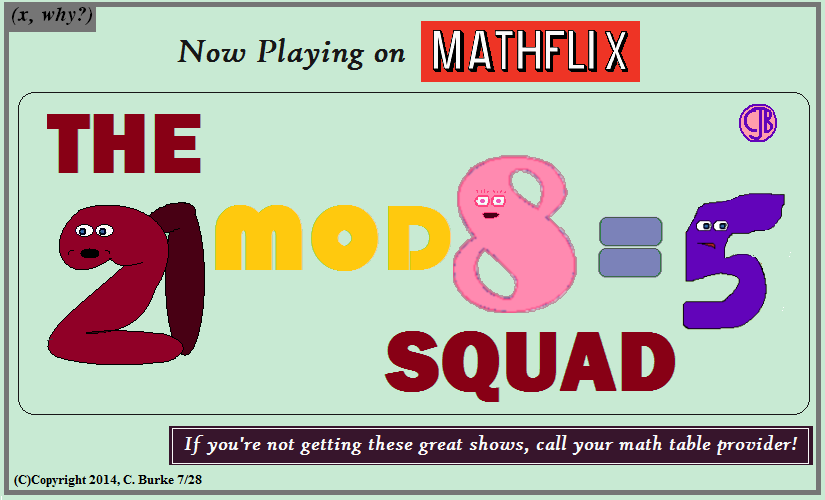
Retro Math TV

(Click on the comic if you can't see the full image.)
(C)Copyright 2014, C. Burke.

The 90s version, The Rad Squad, wasn't as successful.

Oscar and Fivex appeared together in another classic show.

You know how those numeric actors always like to work in pairs.

Interesting (to me) Trivia!: This is comic #888 and it's appearing on 7/28/14, a day of sevens! Not that this was planned, my Internet was actually out for a day or so last week, and I wasn't feeling all that great anyway....


Wednesday, July 23, 2014

Because There Aren't Enough Vampires on TV...

(Click on the comic if you can't see the full image.)
(C)Copyright 2014, C. Burke.

They call him The Count because he loves that old cloak thingy he wears.

You might remember the Count from one of his previous appearances.


Monday, July 21, 2014

Coming Soon: More New Math TV

(Click on the comic if you can't see the full image.)
(C)Copyright 2014, C. Burke.

And wait until you see the New Five! He's like the old Five, but new.


Saturday, July 19, 2014

Math/Educator Website Links

The following are a bunch of links from pages I ripped out of teacher magazines. I haven't visited any of them despite having these pages for a very long time. So I'm sharing them here so I can look at them sometime in the future and clean up some of the random clutter on my desk at home.

CC.BetterLesson.com/mtp: More than 3000 classroom-ready lessons that can be integrated into any curriculum.
Lessons created by more than 130 Master Teachers, with step-by-step instructions, videos, thoughts on how the strategies help to implement Common Core, sample work, etc.

Share My Lesson: "Numerous resource aligned to the Common Core State Standards". A reminder that you are not alone.

10 Free Things! A page from NEA.org, where you can find books, activities, posters, lessons, videos, and more (or so they say!).
Some of the 10 things listed

This list may be amended at any time if I should find more resources I like, if any of these links are dead, or if I just don't like them.

Thursday, July 17, 2014

Useless Junk

(Click on the cartoon to see the full image.)
(C)Copyright 2014, C. Burke.

I just have to make sure that I don't make it on her list.


Tuesday, July 15, 2014

Math Lunch

(Click on the cartoon to see the full image.)
(C)Copyright 2014, C. Burke.

I'm hungry. Can I get sum of that?


Thursday, July 10, 2014

Null Set

(Click on the cartoon to see the full image.)
(C)Copyright 2014, C. Burke.

Gives new meaning to ''set the table''.

Poor guy in the corner heard "set ... zero" and thought he was being called. And then realized he wasn't. Hate when that happens.

Assignment for math students: define or describe each of these four sets in words and in set-builder notation, or however your teacher taught you that you're supposed to remember for that test.