Sunday, May 11, 2014

Day 16 of 30: Thinking of Mom

This is the 16th day of a 30-day blogging challenge. My comics count toward the daily blogging requirement, but I'm trying to write every day anyway.

The day is almost over, but Happy Mothers Day. At least, I hope it was happy. I spent it with my in-laws and my little nephew (and two fully-grown nephews, as well as my kids). I just want to talk about Moms: no math, no probability, no graphing, nothing.

In total, there were five Moms there. They had a good day. The cooking had been divided up among all the men, for a change. (My brother-in-law is now in charge of pulled pork forever. Good thing he enjoyed making it!)

For my regular readers, you know that it hasn't been the greatest of years for me and my family (and my extended family). I've lost six people since last August. Of those, five were Moms. For once, I was happy for social media because I followed how everyone else was doing. Some seemed to be doing better than me, and they had it rougher than I do.

I lost my Mom, my niece, my aunt and two cousins. Follow the family tree and you'll realize that I have a sibling who lost her mother and her daughter. One cousin passed away not long after her daughter became a first-time mother (and that little boy is credited with my cousin's survival until then), and my other cousin's daughter lost both her mother and grandmother. There are sad feelings all around.

But looking online, I see the notes to their mothers. I see the old pictures and fairly recent ones. There are poems and sayings and feelings. They're sad, but they're not miserable. They aren't in a funk, so why should I be. She's not forgotten (as today's comic will attest to).

I read a lot of remembrances online. Many of my "friends", both real-life and online-only, have lost parents, some when they were teens or younger. They're reminded every year. But they're happy memories, even if they aren't happy.

This "rough patch" the family went through is over, God willing. And we'll move on. Mom would've wanted us to.

And she also would've wanted us to post a picture of her when she was young and vibrant and dancing. But don't mention the year unless you want to be haunted.

Mothers Day 2014

(Click on the cartoon to see the full image.)
(C)Copyright 2014, C. Burke.

Next up: something with Frank Sinatra. Doesn't really matter what.

Oh, and Cool Runnings. That was Mom's feel-good movie whenever she was down.


Saturday, May 10, 2014

January 2014 Algebra Regents, Part II and III

Note: Part I of the test was covered in two earlier posts: 1 - 10 and 11-30.
You can also check out the Regents tag.

Part II

31. Express (84)^.5 / (2 * (3) ^.5) in simplest radical form.
In other words: Express the square root of 84 divided by the product of 2 times the square root of 3, in simplest radical form.

Divide 84 by 3. Do NOT divide 84 by 2. There are Rules for Radicals, because square roots are numbers with the same exponent (i.e., one-half).
84 / 3 = 28, so this becomes the (square root of 28) / 2. Radical 28 can be factored into radical 4 times radical 7. However, the square root of 4 is 2. So you have 2 times the square root of 7 over 2. That simplifies into the square root of 7. Here's a picture:

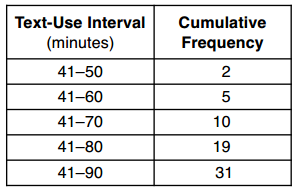
32. The cumulative frequency table below shows the number of minutes 31 students spent text messaging on a weekend.

Determine which 10-minute interval contains the median. Justify your choice.

There are 31 pieces of data (in this case, students). The median is the amount of time spent by the 16th student because he or she is in the middle. (Think if they were lined up in order.) 41-70 is less than 15, but 41-80 is over 15, so the 15th student is in the 71-80 group. Note: If you said 41-80, you would have lost a point because it specifically says that it must be in the ten-point interval.

33. Kirsten invested $1000 in an account at an annual interest rate of 3%. She made no deposits or withdrawals on the account for 5 years. The interest was compounded annually. Find the balance in the account, to the nearest cent, at the end of 5 years.

Use the Compound interest formula. If you don't remember the compound interest formula, use I=PRT to figure out the interest for the first year. Add the interest to the $1000 principal, and use the formula on the new value for the second year. Repeat until you have all five years. This is acceptable. It is a lot of work for two points, but it is acceptable.

The actual formula you should be using is B = P(1 + (r/n))nt, where n is the number of times per year that you are compounding interest. Since it's only one time per year (annual rate), n = 1 and it falls out of the formula.
Substitute and you get B = 1000(1 + .03)5 = 1159.274, which rounds down to $1,159.27.

If you think you might be wrong with the formula, use the first method.

Part III

34. Graph and label the functions y = |x| and y = |2x| on the set of axes below. Explain how increasing the coefficient of x affects the graph of y = |x|.

The absolute value means that y is equal to the value of x or the value of 2x without the sign (i.e., positive). You will have two V-shaped graphs with their bottoms on the origin (0, 0). (I'm not really sure how much more I can say about this without just posting a graph.)

Explain: Increasing the co-efficient of x will make the graph more narrow.

35. Terry estimated the length of the edge of a cube to be 5 cm. The actual length of the side is 5.2 cm. Find the relative error of the surface area of the cube, to the nearest thousandth.

Relative error -- one of my least favorite topics because a) it doesn't lead into another topic in any meaningful way, and b) if you express the answer as a percent, which you were required to do just a few years ago, you will lose a point. Seriously.

The Surface Area of a Cube is six times the area of one face, which equals six times an edge squared: 6s2.
Relative error is the difference in the two surface areas, divided by the actual surface area. So ((6)*(5.2)^2-(6)*(5)^2)/((6)*(5.2)^2)=0.075443787, which is 0.075 to the nearest thousandth. Again, rounding errors will cost you a point. Don't make them.

36. From the top of an apartment building, the angle of depression to a car parked on the street below is 38 degrees, as shown in the diagram below. The car is parked 80 feet from the base of the building. Find the height of the building, to the nearest tenth of a foot.

The angle of depression is the same as the angle of the triangle where the car is. The wall is opposite the car. The ground is adjacent to the car. This a trigonometry question involving the tangent. That is, Tan 38 degrees = x / 80.
So x = 80 * Tan 38 degrees, which is 80 * 0.781285627 = 62.50285012, if I've calculated correctly, which is 62.5 feet.

to be continued . . .

Friday, May 09, 2014

Day 14: Does Primetime Need Writers? My Students Are Hatching Plots!

For anyone keeping track, this is Day 14 of a 30-Day Challenge. Thirty days of updates. Counting today's comic, this makes two for today.

Yesterday's "Life Insurance" lesson in Financial Algebra class didn't go -- to use the vernacular -- too, too badly. There were diminishing returns as the day wore on. Basically, period 3 with the co-worker worked better than period 4 solo, when I didn't have another adult to bounce thoughts back and forth. I did my best in period 4 to cover the most crucial topics. But period 7, late in the day, wasn't the time to bore the students with such a topic, especially when it became evident that whatever worksheet I might have had wouldn't be given out. (And it wasn't.)

But the kids did have some interesting questions, many of which I expected, although perhaps not in the way they were presented. There were questions about policies and suicides, which were quickly replaced by hiring someone to kill you or beneficiaries killing the policyholder. Not that they had dollar signs in their eyes -- as I informed them, first they'd have to find someone with a sizable life insurance policy to name them as beneficiary. Then they'd have to make it look like an accident.

Well, I didn't have to tell them that part. Most of them were already planning ways to do just that. And, of course! they'd get away with it! They're teenagers, after all! They know how to do everything! (Except, perhaps, some of the problem in Chapter 8 ... and Chapter 6 ... but I digress.) I think the big unanswered question was, "How would they know?"

They weren't satisfied with, "Trust me, they'd know. They have investigators who seen this sort of thing before." When that didn't convince them, I added, "And you haven't even done this once." (That I know of...) "It's not like you'll get it right the first time. It'll probably take four or five tries to get it to really look like an accident. The problem is dealing with the fallout from the first three or four tries."

I think that convinced them to give up their plans for fraud and murder. One can only hope. My final thoughts on the topic (which I actually repeated when the topic came up the next period and the one after that), check out an episode of Law & Order or Bones or any other criminal show. They just know.

That being said, I think my students could hatch a plot worthy of prime-time, even if it unravels, as all such criminal plots tend to do when the investigators take the case.

But one show they can't write for: when I showed the final slide of my presentation with the Mortality Tables, I introduced it with "Valar Morghulis". Not a comment. Not even from the geekier kids. I had to fall back on another punch line: talking about using life insurance to pay for funeral expenses because they are quite costly, a student asked why cemeteries are so expensive. I couldn't stop myself from telling her: "Cemeteries are crowded and they're very popular.... People are dying to get in."

Oh, yeah. I did.

Problem and Solution

(Click on the cartoon to see the full image.)
(C)Copyright 2014, C. Burke.

An open circle is like a boundary. Kind of like a fence sitter. Those fence sitters are always trouble, you know.


Thursday, May 08, 2014

Day 13: What If They Gave Tutoring And Nobody Came?

What if they gave tutoring, and nobody came? I almost found out today.

It's been an interesting few weeks. I signed up for Tuesday and Thursday afternoon Regents prep, mainly because I could use the hours. Don't get me wrong: I'm happy to help a handful of kids in the morning, during period 1 (which was "period 0" in my old school). There's just something about having a large group of students to work with. Too often, it just feels like I'm teaching another class, and like students in those classes, too many of them just wait for the knowledge to appear instead of pursuing it, running down whatever avenue they have to until they find it. But I gave it a shot. The AP sounded desperate for bodies inthe classroom, and I thought it might be helpful for some "artifact" or "rubric" or "agenda item" or whatever those 22 points or 39 steps we're being rated on actually are.

Then I found out that she had so many people, that I'm only doing it on Thursday. That actually seemed like a waste of my time -- I'll be getting half the hours that I thought I would.

Then -- we're talking next morning -- one of my students approached me and asked if I'd be interested in moderating (or assisting in moderating) the new Anime Club. Of course, I would! Unfortunately, it meets on Thursdays. I've wanted to poke my head in over there, knowing a little bit about Anime (although very little about Manga). I even had the ulterior motive of trying to lure a group up to Lunacon next year. It worked for old Dom and his kids from the Bronx High School of Science so many years ago. (Many of that group still turns out year after year. Sadly, we lost Dom Corrado in the past year.) But that's a topic for another column.

Last week was actually the first Thursday of tutoring. I had six kids. Not bad, except four of them were mine, and they were more interested in reviewing for the test we were having the following day than for the Regents exam next month. (They do want to review for that. They just didn't at that moment.) I had two others retaking the Integrated Algebra Regents. We reviewed an old exam, and I think some learning occurred, but it's always hard to tell with those exams. Are they checking their answers or just filling them in? Are they copying the work or just circling a letter. I wasn't collecting or grading the sheet, so writing down the correct choice isn't a helpful strategy, but it does get employed often.

I have no test tomorrow, so I had none of my own students today. And I lost half of the other students. Were you paying attention? How many did I have left?

That's right: one.

I had printed out ten copies of the open-ended questions from the same test. I gave him about ten minutes to work on the problems to see where he had trouble and to allow time for other students to appear. I knew they wouldn't, but I hoped.

And then he leveled with me, that he wasn't sure how to do any of the problems. Not a good sign. I wound up "teaching" each of the questions to some extent or other. There were a couple of "a-ha!" moments where he couldn't believe the question was as easy as it turned out to be (a good reason to get started on each question and try something). In others, he went through the paces and got the answer, but it seemed like an experiment he didn't think he could duplicate.

With only one student to ask questions, we finished a little early. It wasn't my room, and I didn't have any extra materials with me.

We'll see how much interest there is next week. Will he bring a friend or two? Will he skip out, too?

What will I do if no one shows up?

Probably punch out and go watch Anime.

Wednesday, May 07, 2014

Day 12: I'm the Sugarless Gum of Math Teachers

I'm the sugarless gum of math teachers. Four out of five classes have high scholarship. This is a new experience for me. I've had good marking periods before, but never this good. Did I suddenly become a highly-effective facilitator of learning? Or did I just happen to take over a bunch of classes at a school where more kids seemed determined to go to college (or at least get that last math credit)?

Smart money (and empirical data) would bank on the latter.

Granted, I was a little surprised when I calculated the grades. I know that there were some poor showings here and there throughout the marking period (roughly six weeks and some vacation times squeezed in), but most of the people having difficulties only had it in one spot or the other. It wasn't continuous. And the homework and assignments were being handed in (even if there wasn't enough "originality" to that pile on the corner of the desk). It seemed worse that it was mostly because of the noise level in the classroom. Now, I've had APs who like noisy classrooms. If they aren't noisy, then discussions aren't going on. No discussions means learning isn't taking place. However, the inverse of that is most certainly Not logically equivalent. By this I mean that Discussions DO NOT mean learning IS taking place.

Sometimes it's just noise. However, that is on me. That's a classroom management issue, and I have to adjust my approach any way I can. The main way to do this is to establish rules on Day One. However, my Day One and theirs were NOT the same day. I started in the end of October, and I was their third teacher. I was in a new school and I tried to ease my way into my "temporary" role (I wasn't supposed to still be there at this point). That was a mistake, but it's one I'm dealing with. They get a participation grade, and for some it's lower than others, but that's only a small part of the grade. The testing is the largest part, and they are, for the most part, doing better. For this, I'm thankful. And they aren't just squeezing by, they're getting high numbers.

A little true time: the classes with the highest grades are "Financial Algebra", and anything involving logarithms have been dropped. It's math that they can use (although I'm not looking forward to tomorrow's lesson on Life Insurance, which will be even less exciting than Pensions has been), but it's still a lot of compound interest formulas and other computations. And it's planning and thinking about the future. Good stuff. The best part: I don't have to be crazed about the amount of material in each assignment or on the tests.

My Common Core Algebra class is an entirely different situation. I have to push and push and push, and still I'm behind. However, I'm making sure that they know the material I cover. I just keep reminding them that knowing 90% of 70% of the material is 63%, which isn't a good result. So while I'm happy to review to answer everyone's questions, we still have to move along. Today, they were asking me when we were going to start reviewing for the exam, which is less than a month away. I told them the truth: when I finish covering the material.

Sadly, this brings me to the one class that's totally disengaged. I've called parents. I've written anecdotals. I've failed students. "Whatever" is the response. "You're just going to fail me anyway, so why bother?", which is only slightly more annoying than, "When am I ever going to use this?"

They might be lower performing students, but they can do the work when challenged to do so (or mildly coerced by a parent). I've been told that if you raise the bar, the students will rise up to meet that challenge. Not all of them. Some will look at that bar and walk away. Some will want to do a limbo contest no matter how much you lower that bar. There are carrots to dangle in front of them: no summer school, seniors get to go home earlier, hey wasn't there a college you were interested in?

Still working on it for next year. Highly effective? Pipe dream. I hate to say that I'm wondering what next year will bring.

In the meantime, I'm still thrilled by four out of five, and how high they were.

And I'm starting to understand that fifth dentist a little more.

Tuesday, May 06, 2014

Day 11: I'm Still Here... I'm Still Blogging ...

It's been a brutal couple of days, getting everything out of the way, cleaning off the desk, and getting grades ready for submission. I usually have my own calculations, done through a spreadsheet, which can look at the best scores that students have handed in. Instead, this time around, I'm relying more on the automated online process. Partly because parents and students at this school check them out more frequently. Partly because they will challenge me if I differ by even a point from the way the computer grades it. Yes, some of them, a select few, are absolutely nuts while simultaneously being in own their own, or their little precious's, failings. I massaged the numbers online, putting in zeroes where they were needed, and slightly higher numbers when I didn't want to crush or cripple a decent grade.

But it's not an automated system. They grade shown is not the one that gets put into the system unless I put in there. In general, I put in a figure that matched or exceeded what the computer showed. The trick is to make the computer show what I want it to show (or less than I want it to show). Then I come off looking pretty good. Score one for Number Sense.

Back tomorrow. Hopefully, with the new marking period under way, there will be time now. Time enough at last.

Monday, May 05, 2014

Day 10: It's 5 - 5 (Revenge of the Fifth?)

The date is 5/5, and you know what that means! That's right! It's Day 10 of my 30-day writing challenge.

Oh, and it's something called cinco de mayo, literally, the Fifth of May, the day after May the Fourth.

I know it's late and the day is almost over. On the other hand, for those who are celebrating, it's probably only beginning!

With this limited space and shortness of time, allow me to briefly split an infini-- er, I mean, to briefly explain the story behind the story of this old cinco de mayo classic from 2008.

First of all, let me state for the record that this comic is NOT based on a true story.

Oh, no. It most certainly IS the True Story.

It was early in 2008, not May, when I taught a double-period class of Integrated Algebra students. Actually, given that it was 2008, it was still called Math A back then, which combined Algebra and Geometry in a two-year cycle. Given that it was a double-period class, I could take my time with the explanations and allow plenty of time for student activity. The strange thing about this class was that it was a team-teaching class. The stranger thing was that the other teacher was not a Special Ed teacher, but someone else from the general ed Math department. The strangest part was that I didn't actually have one co-teaching, but, in fact, had two co-teachers: one in each of the two periods.

This last thing becomes less strange when you realize that one of the two was the Assistant Principal who was obligated to teach one claas. So he picked half a class. And then most of the time he was a no-show because of "meetings" and "observations" and "bears, oh my!". If you knew him, this wasn't strange at all. Uh-uh. At times, he could have been the A.P. from the comic.

The other co-teacher, Mr. Prato, loved the class, and it was a shame that he had to leave halfway through it. He could relate to the students and work with the individuals while I worked with the entire class. (There are at least six ways to co-teach, and this one generally worked for us, although on some days/topics, we'd switch roles and he'd take the lead.)

Anyway, this one day, Mr. Prato came in, apologized to me about being swamped with work and asked if I minded if he sat in the back and caught up with paperwork. Well, everyone needs a break, and it wasn't like he was ditching (like some A.P.s I could name!). So, sure, go ahead.

Back to the class. I went a long introduction to parabolas without much technology to speak of in the room. We plotted these things out. I showed them the standard form for the equation and went through what happens to the parabola when a is positive, what happens to the parabola when a is negative, what happens to the parabola when a is a big number, what happens to the parabola when a is a fraction, what happens to the parabola when b isn't there, what happens to the parabola when b is negative, what happens to the parabola, parabola, parabola, parabola.

After so many iterations and over a half hour, I asked some question (I can't recall exactly what) of the students about how changing something or other would affect the parabola.

A student sitting near me, two seats from the front, cautiously raised his hand with a slightly puzzled look, and asked, "What's a parabola?"

Seriously, I am not kidding. His head hadn't been down. He hadn't been talking or doodling or been otherwise engaged. He'd been staring at the board -- or at least in the general area of the front board. All I could figure after the fact was that he'd been sleeping with his eyes open. But none of that had occurred to me then.

I responded EXACTLY as I did in the comic. I even flubbed it: I meant to say it was a "drink", not a "dessert", but it's just as well. I wouldn't want to promote alcohol use among minors anyway, right?

Mr. Prato stopped dead and looked up at me. "Mr. Burke, I almost fell out of my chair."

The funny thing was I don't think anyone laughed. The student was puzzled. I was annoyed. And I don't think anyone else knew what to make of what I'd said.

I realized then, yeah, maybe I'd have to work on the sarcasm.

Sunday, May 04, 2014

Day 9: A Quick Note About the End of the Marking Period

I have a comic for today, but I still wanted to have a blog update, if only to comment for the 30-day challenge.

Crunch time arrives again as the marking period ended Friday and grades are due. I have a pile of stuff that needs to be graded (I've plowed through the homework and a lot of the classwork) and I spent a good part of the weekend grading tests. I hate tests on Friday and I hate last day of the marking period tests. For one thing, one about the absent students and the make-up tests? When can I grade those? Probably never. Okay, not never. But this stuff takes time. And I didn't have a choice in the matter: if I wanted to have a test, the Math department had to have their tests on Friday this time around. So that's what I did. I don't want to be the teacher who slices through with a red pen and says, WRONG! WRONG! WRONG! -- despite what my students might think. As it is, I hate multiple-choice tests with their all-or-nothing component.

On the other hand, if I spend two minutes per test, that's well over 200 minutes, close to four hours, just going over the exams. And that's not even recording them online.

But the fact is that it takes more than two minutes if I look at their work to find their mistake. It's too minutes in itself just to write the comments down to guide them to get it right the next time. Except that they don't read the comments because they don't believe that there is a next time. After all, we just did that already. It's not like there's another test on the stuff where we'll use it again. Or a final exam.

So a lot of time was spent, but it had to be done.

Oddly, what shouldn't have to be done (but does) is grading the homework and all the little assignments that will count for perhaps one-fifteenth of ten percent. At the valuation, does it make much difference grading it as Satisfactory or Good? Does that extra 10% of 1/15 of 10% really matter much? As long as it isn't a zero, it won't have a big effect on their grade. And the zero doesn't have much of a negative either.

But the system is online and there's no faking it. So back to grading.

And I'll save the blogging -- and the new comics -- for another day.

May the Fourth

(Click on the cartoon to see the full image.)
(C)Copyright 2014, C. Burke.

Princess Threea and Luke Fivewalker, in case you were wondering.

This seems to be a bigger deal every year, so i figured I couldn't ignore it and keep my geek cred.
Frankly, before maybe five years ago, I hadn't really heard the pun. Don't know where it started or when it really caught on.
It was a clue on Jeopardy! a few years ago, so that's where I'd start looking.

Also check out Lucas Numbers, Movie Night and, of course, Hamlet II: Claudius Strikes Back.


Saturday, May 03, 2014

Day 8: One for the Roses

This is Day 8, for those keeping track, and if you are keeping track, is that track Churchill Downs? This afternoon will be the 140th running of the Kentucky Derby, the first leg of horse racing's Triple Crown.

The "Sport of Kings", as it once was known, is accessible to all, young and old. And to math teachers. Seriously, there are nineteen horses in the race, numbered 1 to 20 (skipping number 11, which was scratched), and people place bets not only on which horse will come in first, but on which will come in second and third as well!

Sounds like a permutation problem to me!

Disclaimer: Gambling has its risks. There are no sure bets. Winners of horse races are not random numbers of equal probability. Bet with your head, not over it. Four score and seven years ago, yabba dabba doo, m-o-u-s-e.

When you place a bet on a horse to win, you put down your $2.00. Let's say that you want to "Dance With Fate" and you bet on the horse of the same name. (This is not unusual. People bet on horses because of names without any regard to the background and track record of the horse in question. Fools and their money?) As of this writing, Dance With Fate has odds of 14-1. That means that should he win, you'll be paid $28 plus your original $2.00, give or take. (Betting is parimutuel, meaning it depends on all the money bet in the race, and the odds shown are rounded.)

So your $2 bet gets you $30, which is nice, but it will barely buy you dinner, or, for that matter, pay for the snacks and beverages you probably consumed while waiting for the race. (Granted, you would've had to pay for them anyway.) If you want a bigger payout, you have to risk a larger amount, or take a riskier bet.

The next bet is to pick the exacta where you pick the horses which will finish first and second, in that order. You want to have it both ways? Sure, you can: just make two bets! That's allowed. But, first, let's look at this one bet. How many possible exacta bets are there? There are 19 horses which could theoretically win the race (despite what the experts will say about some of them). That means that there are 18 remaining who can place (i.e., come in second). Applying the Counting Principle, we find that there are 19 X 18 = 342 possible outcomes for first and second.

As previously stated, you can make multiple bets, put at $2 per shot, it'll get a little pricey. No one's planning on $2 x 342 = $684 on betting slips (I hope). However, there is one thing you can do to improve your payout: "wheel" your bet. If you are planning on putting money on one particular horse to win, you can play the exacta with each of the other 18 horses. At $2 apiece, you'll bet $36, but the combination of payouts (and I won't even pretend to be able to explain how its calculated) will likely (but not definitely) be higher than if you bet the entire $36 on your horse to win. But, again, if your "winning" horse fails to win, you get nothing.

Trifecta, Anyone?

Finally, there's the trifecta: picking horses to win, place and show (i.e., third place, obviously). How many possible permutations are there? Glad you asked!

It's 19 X 18 X 17 = 5,814 for all of them, or 1 X 18 X 17 = 306, of you're sure that your horse is a winner. Hint: that's not a good bet to make, even if you're playing for buttons or jellybeans with your friends.

Let's narrow it down. Suppose you pick any four of the nineteen horses. How many bets do you have to make to cover every permutation of horses coming in first, second and third?

It's 4! = 4 X 3 X 2 X 1, which the odd horse finishing out of the money. That's $48 for a $2 bet. Remember: I'm not commenting about the viability of the bets; I'm just talking about the math.

Handicapping Today's Derby Race

Okay, so you read the sports pages, saw what the experts had to say, checked all the stats for the past year, and looked into the parentage of each of the participants. (No, you didn't, but let's say you did.)

Which horses do we bet on? That's easy!

Pick your kids' ages or birthdays and your lucky number. Wheel them and make a bet. Enjoy the race and a cool drink as you kiss your money good-bye.

That's what I'd do, but I won't because they closed the OTBs around here.