Friday, May 31, 2019

Algebra 2 Problems of the Day

Daily Algebra 2 questions and answers.
After a brief hiatus, the Algebra 2 Problems of the Day are back. Hopefully, daily.

More Algebra 2 problems.

January 2019, Part III

All Questions in Part I are worth 4 credits. Partial credit can be earned.


33.Solve the following system of equations algebraically for all values of a, b, and c.

a + 4b + 6c = 23 a + 2b + c = 2 6b + 2c = a + 14

Answer:
Substitution:
Rewrite the last equation as a = 6b + 2c - 14
Rewrite the first two equations:


6b + 2c - 14 + 4b + 6c = 23
6b + 2c - 14 + 2b + c = 2


10b + 8c - 14 = 23
8b + 3c - 14 = 2


(-3)(10b + 8c = 37)
(8)(8b + 3c = 16)


-30b - 24c = -111
64b + 24c = 128
34b = 17
b = .5


8(.5) + 3c - 14 = 2
4 + 3c - 14 = 2
3c = 12
c = 4


a + 2(.5) + (4) = 2
a + 1 + 4 = 2
a = -3

a = -3, b = 0.5, c = 4

Elimination:
Rewrite the last equation as -a + 6b + 2c = 14


a + 4b + 6c = 23
a + 2b + c = 2
2b + 5c = 21


a + 4b + 6c = 23
-a + 6b + 2c = 14
10b + 8c = 37


2b + 5c = 21
10b + 8c = 37


(5)(2b + 5c = 21)
10b + 8c = 37


10b + 25c = 105
10b + 8c = 37
17c = 68
c = 4


2b + 5(4) = 21
2b + 20 = 21
2b = 1
b = 0.5


a + 2(.5) + (4) = 2
a + 1 + 4 = 2
a = -3

a = -3, b = 0.5, c = 4

Checking the work:
a + 4b + 6c = -3 + 4(.5) + 6(4) = -3 + 2 + 24 = 23 (check)
a + 2b + c = 2 = -3 + 2(.5) + 4 = -3 + 1 + 4 = 2 (check)
6b + 2c = a + 14
6(.5) + 2(4) = (-3) + 14
3 + 8 = 11 (check)


34. Given a(x) = x4 + 2x3 + 4x - 10 and b(x) = x + 2, determine a(x)/b(x) in the form q(x) + r(x)/b(x).
Is b(x) a factor of a(x)? Explain

Answer:
Divide the polynomial and leave the remainder as a fraction over (x + 2).
I used the Reverse Area Model, which is something I've only recently started doing.
Normally, I would only draw one table, but I expanded it here for clarity.
Some students who understood preferred it to long division. Others prefer to stick with long division.

Start by filling in x4 and -10. Label the rows x and +2
To get x4, you have to multiply x by x3, so put that on top of that column.
Multiply +2 by x3 and get 2x3.
The next term in a(x) is 2x3, and 2x3 - 2x3 = 0, so right 0 in the top row, second column. 0 divided by x is 0, so 0 gets written on top. And 0 times +2 is 0, so 0 goes on the bottom.
The next term is 4x, and 4x - 0 = 4x, so write 4x in the next column. 4x / x = 4, so write 4 on top. Then 4 times 2 = 8, so put 8 on the bottom.
We didn't want 8. We needed -10. That means that there is a remainder. Subtract -10 - 8 = -18. That remainder is put in a fraction over (x + 2).

b(x) is NOT a factor of a(x) because there is a remainder.
If something is a factor then there can be no remainder.

If people want to see the long division version of this, I can write it on scratch paper and scan it in.


Comments and questions welcome.

More Algebra 2 problems.

Soak

(Click on the comic if you can't see the full image.)

(C)Copyright 2019, C. Burke.

It's been raining a lot around here lately.


Come back often for more funny math and geeky comics.


Thursday, May 30, 2019

Algebra 2 Problems of the Day

Daily Algebra 2 questions and answers.
After a brief hiatus, the Algebra 2 Problems of the Day are back. Hopefully, daily.

More Algebra 2 problems.

January 2019, Part II

All Questions in Part I are worth 2 credits. Partial credit can be earned.


31. Point M (t, 4/7) is located in the second quadrant on the unit circle. Determine the exact value of t.

Answer:
Because point M is in Quadrant II, t must be negative.
Because point M is on the unit circle, t2 + (4/7)2 = 12

t2 + (4/7)2 = 1
t2 + 16/49 = 1
t2 = 33/49
t = + SQRT(33/49) = + SQRT(33)/7

You need to specify the exact value of t, so do NOT estimate or round the radical.
Also, it has to be negative so t = - SQRT(31)/7


32. On the grid below, graph the function y = log2(x - 3) + 1

Answer:
Put the equation in the calculator and look at the table of values.
The asymptote is x = 3.
Plot the values (4, 1), (5, 2), (7, 3), and (11, 4). And then draw the curve.


Comments and questions welcome.

More Algebra 2 problems.

Wednesday, May 29, 2019

(x, why?) Mini: Ribose

(Click on the comic if you can't see the full image.)
-->
(C)Copyright 2019, C. Burke.

I'm glad Terbium exists, because there isn't a T to match with Boron.

Not a chemist, so I don't care if the elements won't work that way, or what else the Tb is attached to!
You are welcome to comment, but I probably will not respond.


Come back often for more funny math and geeky comics.


Algebra 2 Problems of the Day

Daily Algebra 2 questions and answers.
After a brief hiatus, the Algebra 2 Problems of the Day are back. Hopefully, daily.

More Algebra 2 problems.

January 2019, Part II

All Questions in Part I are worth 2 credits. Partial credit can be earned.


29. Rowan is training to run in a race. He runs 15 miles in the first week, and each week following, he runs 3% more than the week before. Using a geometric series formula, find the total number of miles Rowan runs over the first ten weeks of training, rounded to the nearest thousandth.

Answer:
In the back of the booklet, you are given the formula for Geometric Series:

Sn = (a1 - a1rn) / (1 - r)

Substitute n = 10 and r = 1.03 (103%)
Sn = (15 - 15(1.03)10) / (1 - 1.03)
= 171.958


30. The average monthly high temperature in Buffalo, in degrees Fahrenheit, can be modeled by the function

B(t) = 25.29 sin(0.4895t - 1.9752) + 55.2877,

where t is the month number (January = 1). State, to the nearest tenth, the average monthly rate of temperature change between August and November.

Explain its meaning in the given context.

Answer:
If January = 1, then August = 8 and November = 11.
To find the average rate of change, find B(11) - B(8) and divide it by (11 - 8).

B(11) = 25.29*sin(0.4895(11) - 1.9752) + 55.2877 = 48.59796...
B(8) = 25.29*sin(0.4895(8) - 1.9752) + 55.2877 = 78.86622...
B(11) - B(8) = -30.268...
-30.268 / 3 = -10.089 = -10.1

This means that from August to November that the temperature in Buffalo drops an average of 10.1 degrees Fahrenheit per month.


Comments and questions welcome.

More Algebra 2 problems.

Tuesday, May 28, 2019

Algebra 2 Problems of the Day

Daily Algebra 2 questions and answers.
After a brief hiatus, the Algebra 2 Problems of the Day are back. Hopefully, daily.

More Algebra 2 problems.

January 2019, Part II

All Questions in Part I are worth 2 credits. Partial credit can be earned.


27. Erin and Christa were working on cubing binomials for math homework. Erin believed they could save time with a shortcut. She wrote down the rule below for Christa to follow.

(a + b)3 = a3 + b3

Does Erin’s shortcut always work? Justify your result algebraically.

Answer:
Erin's shortcut does not work.
Substituting non-zero numbers will show this. However, that method will not receive full credit because the question stated "algebraically".

(a + b)3
= (a + b)(a + b)(a + b)
= (a + b)(a2 + ab + ab + b2)
= (a + b)(a2 + 2ab + b2)
= (a3 + 2a2b + ab2 + ba2b + 2ab2 + b3)
= (a3 + 3a2b + ab2 + 3ab2 + b3)
=/= a3 + b3


28. The probability that a resident of a housing community opposes spending money for community improvement on plumbing issues is 0.8. The probability that a resident favors spending money on improving walkways given that the resident opposes spending money on plumbing issues is 0.85. Determine the probability that a randomly selected resident opposes spending money on plumbing issues and favors spending money on walkways.

Answer:
Multiply the probabilities: 0.80 * 0.85 = 0.68


Comments and questions welcome.

More Algebra 2 problems.

Monday, May 27, 2019

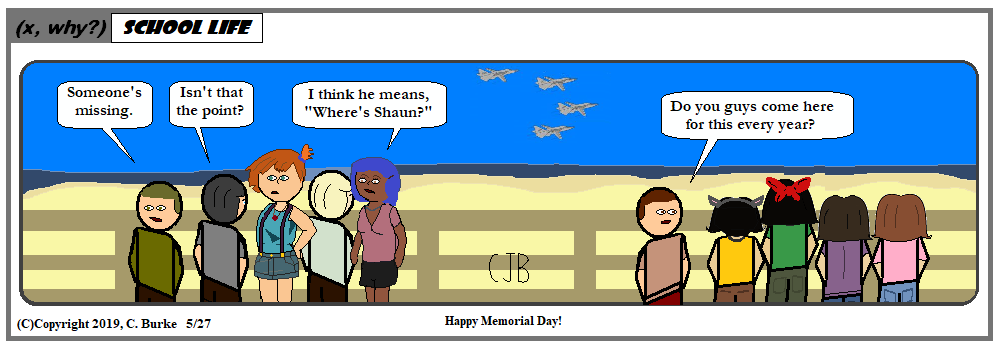
School Life #9: Memorial Day

(Click on the comic if you can't see the full image.)
-->
(C)Copyright 2019, C. Burke.

Happy Memorial Day!

Look at Shaun! Talking to girls now.
I was going to have one of the girls comment, "Isn't that an English teacher over there?" as a call back to Judy and Chuck on the beach back in this old comic, #321, which fell on the Fourth of July.


Come back often for more funny math and geeky comics.


Friday, May 24, 2019

Weird

(Click on the comic if you can't see the full image.)
-->
(C)Copyright 2019, C. Burke.

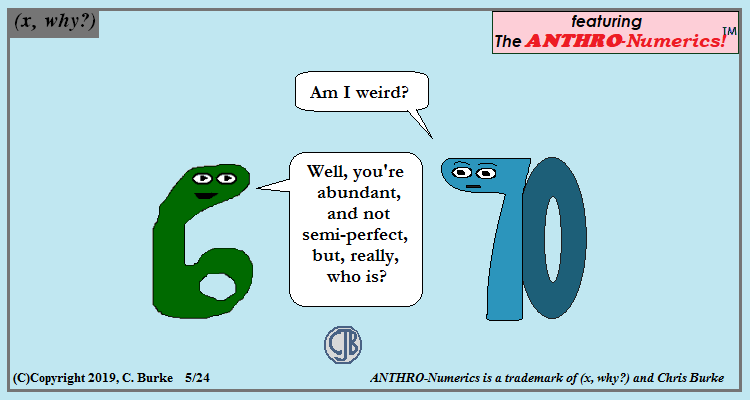
So, yes, you're weird!

Weird numbers are a subset of Abundant numbers.
In brief:
A perfect number is one where the sum of the number's factors, excluding the number itself, equal the number. Ex: 1+2+3 = 6.
An abundant number is one where the sum of the number's factors, excluding the number itself, is greater than the number. Ex: 1+2+3+4+6=16 > 12.
A semiperfect number is one where a subset of the number's factors have a sum equal to the number. Ex: 1+2+3+6 = 12.
A perfect number is also considered to be semiperfect, unlike my wife who is perfect and I would never consider to be semiperfect.
A weird number is abundant but not semiperfect: there is no subset of factors that add up to the number.
Ex: no combination of 1, 2, 5, 7, 10, 14, and 35 add up to 70, but the sum of the factors is 74.

I was familiar with semiperfect, but not the "weird" term until I was looking up what the prefixes for "abundant" numbers were.


Come back often for more funny math and geeky comics.


Algebra 2 Problems of the Day

Daily Algebra 2 questions and answers.
After a brief hiatus, the Algebra 2 Problems of the Day are back. Hopefully, daily.

More Algebra 2 problems.

January 2019, Part II

All Questions in Part I are worth 2 credits. Partial credit can be earned.


25. Justify why (x2y5)(1/3) / (x3y4)(1/4) is equivalent to x(-1/12)y(2/3) using properties of rational exponents, where x =/= 0 and y =/= 0.


Answer:
As noted above in the way I had to type out the question, the cube root is the same as (1/3) power, and the fourth root is the same as (1/4) power.
Multiply the exponents:

(x(2/3)y(5/3)) / (x(3/4)y(4/4))
Next subtract the exponents of the two x terms and the two y terms
x(2/3) - (3/4) y(5/3) - 1)
x(8/12) - (9/12) y(5/3) - (3/3)
x(-1/12) y(2/3)


26. The zeros of a quartic polynomial function are 2, -2, 4, and -4. Use the zeros to construct a possible sketch of the function, on the set of axes below.

Answer:
You needed to sketch something like what's below, with the end both pointing up or down. There should be three turning points (in this case 2 minimums and 1 maximum). Label the x-axis so that it's obvious that the zeroes are -4, -2, 2 and 4. The y-intercept isn't important but it should be a turning point.


Comments and questions welcome.

More Algebra 2 problems.

Thursday, May 23, 2019

Algebra 2 Problems of the Day

Daily Algebra 2 questions and answers.
After a brief hiatus, the Algebra 2 Problems of the Day are back. Hopefully, daily.

More Algebra 2 problems.

January 2019, Part I

All Questions in Part I are worth 2 credits. No work need be shown. No partial credit.


22. Consider f(x) = 4x2 + 6x - 3, and p(x) defined by the graph below

The difference between the values of the maximum of p and minimum of f is

(1) 0.25
(2) 1.25
(3) 3.25
(4) 10.25

Answer: (4) 10.25
The minimum point for f(x) occurs on the axis of symmetry, which is x = -b/(2a)
x = -(6)/((2)(4)) = -6/8 = -.75
The maximum of f(x) is f(-.75) = 4(-.75)^2 + 6(-.75) - 3 = -5.25
The maximum of p(x) is 5.
The difference is 5 - 5.25 = 10.25

If you had graph f(x), the minimum point wouldn't be in the table of values, but you could use the functions to find it. However, one you see that the minimum is below zero, there is only one possible answer because the other three are too small.


23. The scores on a mathematics college-entry exam are normally distributed with a mean of 68 and standard deviation 7.2. Students scoring higher than one standard deviation above the mean will not be enrolled in the mathematics tutoring program. How many of the 750 incoming students can be expected to be enrolled in the tutoring program?

(1) 631
(2) 512
(3) 238
(4) 119

Answer: (1) 631
68.27% percent of the data is within one standard deviation of the mean. That means 34.135% score within one standard deviation above as well as below. Since 50 + 34 = 84, 84 percent of the incoming students will be enrolled in the tutoring program.
.84135 * 750 = 631.
Depending upon the number of decimals you used, you may have gotten 630, which makes (1) the best choice.


24. How many solutions exist for 1 / (1 - x2) = -|3x - 2| + 5?

(1) 1
(2) 2
(3) 3
(4) 4

Answer: (4) 4
Fastest solution is to graph both the left and right side of the equation and check for the number of intersections.

End of Part I.


Comments and questions welcome.

More Algebra 2 problems.

Wednesday, May 22, 2019

Abundant

(Click on the comic if you can't see the full image.)
-->
(C)Copyright 2019, C. Burke.

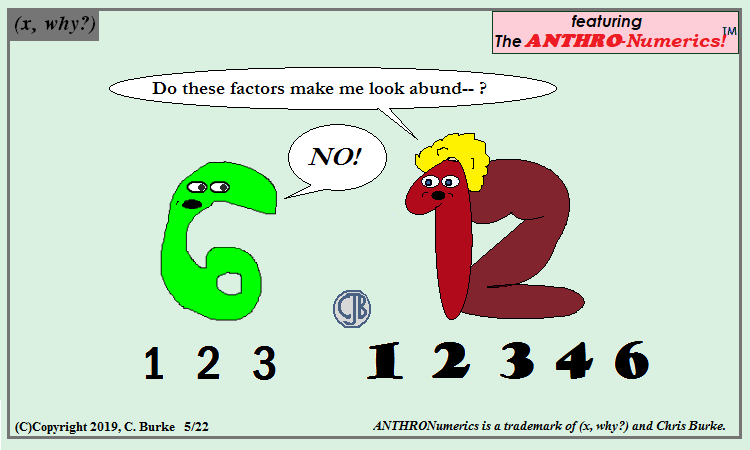
Good answer! Good answer! Incorrect, but good answer!

Unfortunately, 12 is not only abundant but superabundant. You could even go as far as to say colossally abundant, but I wouldn't go and say that, if I were you.


Come back often for more funny math and geeky comics.


Algebra 2 Problems of the Day

Daily Algebra 2 questions and answers.
After a brief hiatus, the Algebra 2 Problems of the Day are back. Hopefully, daily.

More Algebra 2 problems.
January 2019, Part I

All Questions in Part I are worth 2 credits. No work need be shown. No partial credit.


19. Which graph represents a polynomial function that contains x2 + 2x + 1 as a factor?


Answer: (1) see graph
Factor x2 + 2x + 1 into (x + 1)2.
This means that -1 is a both a zero on the graph and a turning point, which is shown in Choice (1).


20. Sodium iodide-131, used to treat certain medical conditions, has a half-life of 1.8 hours. The data table below shows the amount of sodium iodide-131, rounded to the nearest thousandth, as the dose fades over time.

Number of Half Lives12345
Amount of Sodium Iodide-131139.0069.50034.75017.3758.688

What approximate amount of sodium iodide-131 will remain in the body after 18 hours?

(1) 0.001
(2) 0.136
(3) 0.271
(4) 0.543

Answer: (3) 0.271
Note that the problem says that a half-life is 1.8 hours and that the top row of the table is the number of half-lives, not the number of hours.
There are 10 half-lives in 18 hours, because 18 / 1.8 = 10.
If you continue the table by entering 8.688 into your calculator and dividing by 2 five more times, you will get 4.344, 2.172, 1.086, 0.543, 0.271.

Also, you could put y = 139(1/2)x into your graphing calculator and check the Table of Values. Note: if you do this, you want to look at x = 9. Otherwise, you have to play with your original equation -- using 139 * 3 = 278 as the initial amount, or using (x - 1) as the exponent, with parentheses.


21. Which expression(s) are equivalent to (x2 - 4x) / 2x, where x =/= 0?

I. x / 2 - 2
II. (x - 4) / 2
III. (x - 1) / 2 - 3 / 2


(1) II, only
(2) I and II
(3) II and III
(4) I, II, and III

Answer: (4) I, II, and III
Test-taking tip: All four choices include choice II, so there is no need to check it. It's correct.
That being said, you can check to see if I or III are equivalent to II without using the original expression.

If you split the fraction (x - 4) / 2 = x / 2 - 4 / 2 = x / 2 - 2, which is I, so we can eliminate choices (1) and (3).
If you look at choice III, you can combine the fractions because they have a common denominator of 2:
(x - 1) / 2 - 3 / 2 = (x - 1 - 3) / 2 = (x - 4) / 2, which is II. II and III are the same.
So the answer is choice (4).


Comments and questions welcome.

More Algebra 2 problems.