Friday, September 03, 2021

Geometry Problems of the Day (Geometry Regents, August 2013)


Now that I'm caught up with the current New York State Regents exams, I'm revisiting some older ones.

More Regents problems.

Geometry Regents, August 2013

Part I: Each correct answer will receive 2 credits.


1.Given: ABD, BC is the perpendicular bisector of AD


Which statement can not always be proven?

1) AC ≅ DC
2) BC ≅ CD
3) ∠ACB ≅ ∠DCB
4) Triangle ACB ≅ Triangle DCB

Answer: 2) BC ≅ CD


The keywords are "Perpendicular" and "bisector".

Choice (1) is true because AD is bisected. Eliminate this.

Choice (2) can not be proven. There is no correlation between the bisector and the segement being bisected.

Choice (3) is true because of BC is perpendicular to AD, and therefore ∠ACB and ∠DCB are both right angles. All right angles are congruent.

Choice (4) is true because of SAS. AC ≅ DC (see above), BC %cong; BC becasue of the Reflexive Property and ∠ACB ≅ ∠DCB )see above). Eliminate this.


2. In the diagram of circle O shown below, chord CD is parallel to diameter AOB and the measure of arc CD = 110.


What is the measure of arc DB?

1) 35
2) 55
3) 70
4) 110

Answer: 1) 35


If two chords are parallel then the arcs they intercept are congruent. Since AOB is a diameter then arc AB is a semicircle of 180 degrees.

Therefore, AC + CD + DB = 180
So x + 110 + x = 180
and 2x + 110 = 180
2x = 70
x = 35

The measure of arc DB is 35.


3. Given the statement:

One is a prime number.

What is the negation and the truth value of the negation?

1) One is not a prime number; true
2) One is not a prime number; false
3) One is a composite number; true
4) One is a composite number; false

Answer: 1) One is not a prime number; true


The negation of statement A is not A. It is not Z.

What I mean by this is that the negation of "prime" is "not prime". It is not "composite". There are other possibilities.

Likewise, the negation of "Even" is not "Odd". It's "not Even". Depending upon the types of numbers you are working with, a number that isn't Even might not be Odd either. It could be a mixed number, for example.

Also, one is NOT a prime number because it only has one factor. Prime numbers have exactly two factors.


4. Triangle ABC has the coordinates A(1,2), B(5,2), and C(5,5). Triangle ABC is rotated 180° about the origin to form triangle A'B'C'. Triangle A'B'C' is
1) acute
2) isosceles
3) obtuse
4) right

Answer: 4) right


The fact that the figure is rotated means nothing. Rotating a triangle doesn't change its shape.

The other important piece of information here is that any isosceles triangle MUST ALSO be acute, obtuse or right. Therefore, Choice (2) cannot be correct because one of the other choices would have to be correct as well.

You can plot the points on the graph paper and look. Odds are if you graph it accurately on actual graph paper, you could likely trust your eyes.

Mathematically, the easiest thing to check is if its a right triangle, so start there.

Points A and B both have a y-coordinate of 2. Therefore, AB is a vertical line. Points B and C both have an x-coordinate of 5. Therefore, BC is a horizontal line. AB is perpendicular to BC, which means that angle B is a right angle. So it's a right triangle.


5. What is an equation of the circle with center (-5,4) and a radius of 7?

1) (x - 5)2 + (y + 4)2 = 14
2) (x - 5)2 + (y + 4)2 = 49
3) (x + 5)2 + (y - 4)2 = 14
4) (x + 5)2 + (y - 4)2 = 49

Answer: 4) (x + 5)2 + (y - 4)2 = 49


Once again, the formula for the equation of a circle is (x - h)2 + (y - k)2 = r2, where (h, k) is the center of the circle, and r is the radius. Note that there are MINUS SIGNS in the formula.

The radius is 7, and 72 is 49, not 14. Eliminate Choices (1) and (3).

Since there is a minus sign in the formula, subtracting -5 is the same as ADDING 5.


More to come. Comments and questions welcome.

More Regents problems.

I also write Fiction!


You can now preorder Devilish And Divine, edited by John L. French and Danielle Ackley-McPhail, which contains (among many, many others) three stories by me, Christopher J. Burke about those above us and from down below.
Preorder the softcover or ebook at Amazon.


Thursday, September 02, 2021

School Life #24: One-to-One and Onto

(Click on the comic if you can't see the full image.)

Bonus Panel

(C)Copyright 2021, C. Burke. "AnthroNumerics" is a trademark of Christopher J. Burke and (x, why?).

Same old stories: boys want girls to be into them, not onto them.

Ob Math: Originally the bonus panel was going to be the map of the relation, but then the Kyung idea occurred to me. When you have a relation of two sets of data, if each member of the input (domain) maps to one distinct member of the output (range), then it is a one-to-one relation. If every member of the output has an input mapped to it then it's "onto". If there's an extra element, then it's not onto. The first comic is one-to-one and onto. The bonus panel is one-to-one but not onto.

The one-to-one relation is mapped below:


I also write Fiction!


You can now preorder Devilish And Divine, edited by John L. French and Danielle Ackley-McPhail, which contains (among many, many others) three stories by me, Christopher J. Burke about those above us and from down below.
Preorder the softcover or ebook at Amazon.


Come back often for more funny math and geeky comics.


Geometry Problems of the Day (Geometry Regents, January 2014)


Now that I'm caught up with the current New York State Regents exams, I'm revisiting some older ones.

More Regents problems.

Geometry Regents, January 2014

Part IV: Each correct answer will receive 6 credits. Partial credit is possible.


38. In the diagram of circle O below, diameter RS, chord AS, tangent TS, and secant TAR are drawn.
[See images

below]

Complete the following proof to show (RS)2 = RA • RT

Answer:


For once, the Regents was looking for one specific proof. All the steps are provided and you only have to supply the reasons you can make these statements. It's not unusual to have to write the entire proof on your own.

Notice that there are six blanks. Each reason you give will be worth one or zero credits.

Let's go through all the statements one at a time.

The first line in any proof should be all the Given information. You won't necessarily get credit for listing it (when you have to write it) but you will definitely lose credit if you do not.

RS ⊥ TS: A tangent to a circle is perpendicular to the radius it intersects.

∠RST is a right angle: This is true of all pairs of perpendicular lines.

∠RAS is a right angle: An inscribed angle is half the size of the arc it intercepts. Half of 180 degrees (the diameter intercepts a semicircle) is 90 degrees.

∠RST ≅ ∠RAS: All right angles are congruent.

∠R ≅ ∠R: Reflexive Property. This shows up in SOOOOO many proofs because it's "obvious" and they don't have to state anything for you to get it. But you have to see it and state it.

Triangle RST ≅ Triangle RAS: AA Theorem. Two angles in each triangle are congruent.

RS/RA = RT/RS: The corresponding sides of similar triangles are proportional.

(RS)2 = RA • RT: Cross-multiplication. The product of the means = the product of the extremes. In the sample answers, just writing "multiplication" was ruled incorrect. I don't know if there would be an issue with just "cross-multiplication".

The last line of ANY proof should be the thing that you are trying to prove and the final Reason.


End of exam.

More to come. Comments and questions welcome.

More Regents problems.

I also write Fiction!


You can now preorder Devilish And Divine, edited by John L. French and Danielle Ackley-McPhail, which contains (among many, many others) three stories by me, Christopher J. Burke about those above us and from down below.
Preorder the softcover or ebook at Amazon.


Wednesday, September 01, 2021

The First Guy Asked for H20...

(Click on the comic if you can't see the full image.)
(C)Copyright 2021, C. Burke. "AnthroNumerics" is a trademark of Christopher J. Burke and (x, why?).

Get the second guy some hydrogren peroxide already! Water alone isn't going to clean that cut properly.

This is a callback to A Guy Walks Into a Bar just because I felt like revisiting that old comic with this new one. That comic was so old, it was saved at a Bitmap file. I thought I'd been using .jpg or .gif ("Jif") files before moving on the .png.

As noted recently, Ken is otherwise occupied at the moment.


I also write Fiction!


You can now preorder Devilish And Divine, edited by John L. French and Danielle Ackley-McPhail, which contains (among many, many others) three stories by me, Christopher J. Burke about those above us and from down below.
Preorder the softcover or ebook at Amazon.


Come back often for more funny math and geeky comics.


Geometry Problems of the Day (Geometry Regents, January 2014)


Now that I'm caught up with the current New York State Regents exams, I'm revisiting some older ones.

More Regents problems.

Geometry Regents, January 2014

Part III: Each correct answer will receive 4 credits. Partial credit is possible.


35. In the diagram of triangle BCD shown below, BA is drawn from vertex B to point A on DC, such that BC ≅ BA.

In triangle DAB, m∠D = x, m∠DAB = 5x - 30, and m∠DBA = 3x - 60. In triangle ABC, AB = 6y - 8 and BC = 4y - 2. [Only algebraic solutions can receive full credit.]

Find m∠D.

Find m∠BAC.

Find the length of BC.

Find the length of DC.

Answer:


You need to solve these problems algebraically. Unpack everything that you are given and label the diagram.

You are given algebraic expressions for each angle in triangle DAB. The sum of those angles is 180, so you have enough information to solve for x.

x + 5x - 30 + 3x - 60 = 180
9x - 90 = 180
9x = 270
x = 30

Since m∠D = x then m∠D = 30 degrees.

Angle BAC is supplementary to DAB, and m∠DAB = 5x - 30 and x = 30. Therefore, m∠DAB = 5(30) - 30 = 150 - 30 = 120.
m∠BAC + 120 = 180, so m∠BAC = 60

BC ≅ BA so solve the following equation:

6y - 8 = 4y - 2
2y - 8 = -2
2y = 6
y = 3
So BC = 4y - 2 = 4(3) - 2 = 10

If you got a negative answer for the length, then you know you made a mistake.

BC has a length of 3.

Since BA = BC, then BAC is an isoscles triangle. Since m∠BAC = 60, then m∠C = 60 because they are base angles. Since the two base angles are 60, then the vertex angle must also be 60 and BAC is an equilateral triangle. That means that angle DBC is 30 + 60 = 90 degrees, and it is a right angle.

Also, triangle DBC is a 30-60-90 degree right triangle.

You could write a trigonometric statement here, or you can note that the hypotenuse in a 30-60-90 triangle is twice the length of the side opposite the 30 degree angle. DC is 2 * BC = 2 * 10 = 20


36. The coordinates of the vertices of triangle ABC are A(-6,5), B(-4,8), and C(1,6). State and label the coordinates of the vertices of triangle A"B"C", the image of ABC after the composition of transformations T4,-5 ° ry-axis.

[The use of the set of axes below is optional.]

Answer:


The most important thing to remember here is that you need to do a tranlations OR THE reflection! The reflection must be done first before you translate it.

If you do it in the incorrect order, you will lose half credit, assuming the rest is correct.

You don't need to use the grid, but if you do, make sure that the intermediate graph is shown along with the final image. The final image needs to be labelled, including the coordinates.

To reflect over the y-axis (x = 0), change the sign of the x-coordinate.

A(-6,5), B(-4,8), and C(1,6) --->>> A'(6,5), B'(4,8), and C'(-1,6)

Next translate each point by adding 4 to each x-coordinate and subtracting 5 from each y-coordinate

A'(6,5), B'(4,8), and C'(-1,6) --->>> A"(10,0), B"(8,3), and C"(3,1)


37. In right triangle ABC below, CD is the altitude to hypotenuse AB. If CD = 6 and the ratio of AD to AB is 1:5, determine and state the length of BD.

[Only an algebraic solution can receive full credit.]


Answer:


If the ratio of AD to AB is 1:5, then label AD = x and AB = 5x. That makes DB = 4x.

According to the Right Triangle Altitude Thereom, the following is true:

AD / CD = CD / DB

(AD)(DB) = (CD)2

(x)(4x) = (6)2
4x2 = 36
x2 = 9
x = 3

If x = 3, then BD = 4x = 4(3) = 12.

Don't get thrown off by the ratio 1:5. Also, don't forget that DB is 4x, not x.


More to come. Comments and questions welcome.

More Regents problems.

I also write Fiction!


You can now preorder Devilish And Divine, edited by John L. French and Danielle Ackley-McPhail, which contains (among many, many others) three stories by me, Christopher J. Burke about those above us and from down below.
Preorder the softcover or ebook at Amazon.


Tuesday, August 31, 2021

Sub Pool

(Click on the comic if you can't see the full image.)
(C)Copyright 2021, C. Burke. "AnthroNumerics" is a trademark of Christopher J. Burke and (x, why?).

And if you didn't get the reference, really? And you're reading this?

I'm pretty sure most people got the reference to the math sub named Quinn Jonas as mentioned in TV Tropes.

As noted recently, Ken is otherwise occupied at the moment.


I also write Fiction!


You can now preorder Devilish And Divine, edited by John L. French and Danielle Ackley-McPhail, which contains (among many, many others) three stories by me, Christopher J. Burke about those above us and from down below.
Preorder the softcover or ebook at Amazon.


Come back often for more funny math and geeky comics.


Geometry Problems of the Day (Geometry Regents, January 2014)


Now that I'm caught up with the current New York State Regents exams, I'm revisiting some older ones.

More Regents problems.

Geometry Regents, January 2014

Part II: Each correct answer will receive 2 credits. Partial credit is possible.


32. A right prism has a square base with an area of 12 square meters. The volume of the prism is 84 cubic meters. Determine and state the height of the prism, in meters.

Answer:


The Volume of a prism is the Area of the Base times the height. You are given the Volume and the Area of the Base. Plug these in and solve.

84 = 12 h
7 = h


33. State whether the lines represented by the equations y = 1/2x - 1 and y + 4 = -1/2(x - 2) are parallel, perpendicular, or neither. Explain your answer.

Answer:


The lines are not parallel because they do not have the same slope. One line has a slope of 1/2 while the other has a slope of -1/2.

The liner are not perpendicular either. The products of their slopes is (1/2)(-1/2) = -1/4, not -1. The slopes are NOT inverse reciprocals.

The two lines are neither parallel nor perpendicular.

You need to include the word "neither" (not worth any points, but you will lose points if you don't state it) AND a reason why they are not parallel and why they are not perpendicular (each reason worth 1 credit).

If you just state "neither", you will earn zero credit.


34. A tree, T, is 6 meters from a row of corn, c, as represented in the diagram below. A farmer wants to place a scarecrow 2 meters from the row of corn and also 5 meters from the tree.

Sketch both loci.

Indicate, with an X, all possible locations for the scarecrow.

Answer:


Five meters away from the tree means a circle with radius of 5. Since the row of corn is 6 meters away, the circle will come close to the line but not touch it. This is a sketch, so it doesn't have to be perfect.

Two meters away from the line of corn means two parallel lines on either side of the line. Since the circle comes within one meter of the line of corn, one of the parallel lines will intersect the circle in two places. Put an X on both of those places.


More to come. Comments and questions welcome.

More Regents problems.

I also write Fiction!


You can now preorder Devilish And Divine, edited by John L. French and Danielle Ackley-McPhail, which contains (among many, many others) three stories by me, Christopher J. Burke about those above us and from down below.
Preorder the softcover or ebook at Amazon.


Monday, August 30, 2021

Geometry Problems of the Day (Geometry Regents, January 2014)


Now that I'm caught up with the current New York State Regents exams, I'm revisiting some older ones.

More Regents problems.

Geometry Regents, January 2014

Part II: Each correct answer will receive 2 credits. Partial credit is possible.


29. The diameter of a sphere is 5 inches. Determine and state the surface area of the sphere, to the nearest hundredth of a square inch.

Answer:


The formula for the Surface Area of a Sphere is in the back of the booklet: SA = 4πr2. The radius is HALF the diameter. To the nearest hundredth of a square inch means TWO decimal places.

SA = 4πr2 = 4 (3.141592...)(2.5)2 = 78.539...

The Surface Area is 78.54 square inches.

Note that if you didn't use enough accuracy for pi, such as only using 3.14, you will make a mistake.


30. Using a compass and straightedge, construct the perpendicular bisector of AB.
[Leave all construction marks.]


Answer:


To construct a perpendicular bisector, start at point A. Open you compass more than halfway to B. Make an arc centered on A. Move the compass to B without changing the size. Make an arc that overlaps the first arc. Use the straightedge to draw the perpendicular bisector.


31. The endpoints of AB are A(3,-4) and B(7,2). Determine and state the length of AB in simplest radical form.

Answer:


Use the Distance Formula, or Pythagorean Theorem. (They're related.) You can even make a sketch to find the distances between the x-coordinates and the y-coordinates.

d = SQRT ( (7 - 3)2 + (-4 - 2)2 )
d = SQRT ( 42 + (-6)2 )
d = SQRT ( 16 + 36 )
d = SQRT ( 52 )

You are asked for "Simplest Radical Form" so DO NOT give a decimal, not one rounded to two places, not one with 8 significant digits followed by three dots.

The prime factors of 52 = 2 * 2 * 13 = 22 * 13

SQRT (22 * 13) = 2 * SQRT (13)


More to come. Comments and questions welcome.

More Regents problems.

Sunday, August 29, 2021

Geometry Problems of the Day (Geometry Regents, January 2014)


Now that I'm caught up with the current New York State Regents exams, I'm revisiting some older ones.

More Regents problems.

Geometry Regents, January 2014

Part I: Each correct answer will receive 2 credits.


26. A circle with the equation (x + 6)2 + (y - 7)2 = 64 does not include points in Quadrant

1) I
2) II
3) III
4) IV

Answer: 4) IV


Once again, the formula for the equation of a circle is (x - h)2 + (y - k)2 = r2, where (h, k) is the center of the circle, and r is the radius. Note that there are MINUS SIGNS in the formula.

The center of the circle is (-6, 7) which is in Quadrant II, so eliminate that. The radius is equal to the square root of 64, which is 8. If you go 8 units to the right of (-6, 7), you will be at (2, 7), which is in Quadrant I. If you go 8 units below (-6, 7), you will be at (-6, -1), which is in Quadrant III.

You have eliminated Choices (1), (2) and (3), leaving only IV. But you can check this.

If the center stretches from quadrant II to quadrant IV, it has to go past the origin, and (0, 0) would be inside the circle at a distance less than the radius from the center. That would mean:

(0 + 6)2 + (0 - 7)2 < 64
and therefore 36 + 49 < 64

This is obviously not a true statement, so the circle does not extend in Quadrant IV.


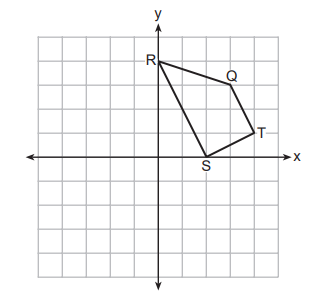
27. Trapezoid QRST is graphed on the set of axes below.


Under which transformation will there be no invariant points?

1) ry = 0
2) rx = 0
3) r(0,0)
4) ry = x

Answer: 3) r(0,0)


Invariant points are points on a line or shape which do not move when a specific transformation is applied. Under these transformations, if a point remains in the same place, it is invariant.

In Choice (1), y = 0 is the x-axis. Point S is on the x-axis and will reflect to itself.

In Choice (2), x = 0 is the y-axis. Point R is on the y-axis and will reflect to itself.

In Choice (3), (0,0) means a reflection about the origin. The only put that would remain in place is a point on the origin, but the trapezoid does not pass through the origin. This is the correction answer.

In Choice (4), y = x is a diagonal line through quadrants I and III. It goes through point Q and through an unlabeled point on line RS. Both of those points will reflect onto themselves.


23. How many common tangent lines can be drawn to the circles shown below??


1) 1
2) 2
3) 3
4) 4

Answer: 4) 4


A common tangent line means that the line will be tangent to both circles.

There will be one on top, one on the bottom, and two in-between making an "X". Look at the illustration below:

The radius is the distance from (1, 2) to (-1, 2), which is 2 units. So r = 2, and r2 = 4. Eliminate Choices (3) and (4).

Since there are minus signs in the formula, we want (x + 1) and (y - 2) in the equation. That means Choice (2).


More to come. Comments and questions welcome.

More Regents problems.

Saturday, August 28, 2021

The Biggest Bosses

(Click on the comic if you can't see the full image.)
(C)Copyright 2021, C. Burke. "AnthroNumerics" is a trademark of Christopher J. Burke and (x, why?).

Life isn't fair.

Think About It: Where in the diagram would you find the subset "Me"?

I also write Fiction!


You can now preorder Devilish And Divine, edited by John L. French and Danielle Ackley-McPhail, which contains (among many, many others) three stories by me, Christopher J. Burke about those above us and from down below.
Preorder the softcover or ebook at Amazon.


Come back often for more funny math and geeky comics.


Geometry Problems of the Day (Geometry Regents, January 2014)


Now that I'm caught up with the current New York State Regents exams, I'm revisiting some older ones.

More Regents problems.

Geometry Regents, January 2014

Part I: Each correct answer will receive 2 credits.


21. The coordinates of point P are (7,1). What are the coordinates of the image of P after R90° about the origin?

1) (1, 7)
2) (-7, -1)
3) (1, -7)
4) (-1, 7)

Answer: 4) (-1, 7)


First thing to remember is if you are given a rotation, but not a direction, then the directionis counterclockwise. That is to say, the rotation is in the same order as the Quadrants I, II, III, IV.

Forget the formulas. Picture it in your head, or make a scratch drawing of the problem.

Choice (1) is in Quadrant I like the original point. It is a reflection over the line y = x.

Choice (2) is is Quadrant III. It is a 180 degree rotation, or a reflection across the origin.

Choice (3) is in Quandrant IV. It is a 90 degree clockwise rotation.


22. Lines p and q are intersected by line r, as shown below.


If m∠1 = 7x - 36 and m∠2 = 5x + 12, for which value of x would p || q?

1) 17
2) 24
3) 83
4) 97

Answer: 1) 17


The lines will be parallel if and only if angles 1 and 2 are supplementary. That is, they add up to 180 degrees.

So

7x - 36 + 5x + 12 = 180
12x - 24 = 180
12x = 204
x = 17

They want to know x, not the size of either angle, so you are done.

Note that if you wrote the equation 7x - 36 = 5x + 12 (assuming the angles were congruent when the illustration suggests that they may not be), then you would have gotten x = 24, which is Choice (2), and you wouldn't have known you made a mistake.


23. What is the equation of the circle with its center at (-1,2) and that passes through the point (1,2)?

1) (x + 1)2 + (y - 2)2 = 4
2) (x - 1)2 + (y + 2)2 = 4
3) (x + 1)2 + (y - 2)2 = 2
4) (x - 1)2 + (y + 2)2 = 2

Answer: 1) (x + 1)2 + (y - 2)2 = 4


Once again, the formula for the equation of a circle is (x - h)2 + (y - k)2 = r2, where (h, k) is the center of the circle, and r is the radius. Note that there are MINUS SIGNS in the formula.

The radius is the distance from (1, 2) to (-1, 2), which is 2 units. So r = 2, and r2 = 4. Eliminate Choices (3) and (4).

Since there are minus signs in the formula, we want (x + 1) and (y - 2) in the equation. That means Choice (2).


24. In the diagram below, diameter AB bisects chord CD at point E in circle F.


If AE = 2 and FB = 17, then the length of CE is

1) 7
2) 8
3) 15
4) 16

Answer: 2) 8


If AE = 2 and FB = 17, then AF = 17 and EF = 15. This is obviously NOT drawn to scale.

The length of CE = the length of ED because the diameter bisects it. Also, when a diameter bisects a chord, it intersects it perpendicularly, meaning that it creates right angles.

Since you know that the radius FB is 17, you can draw CF and DF and know that they also each have a length of 17.

Now you have two right triangles with a leg of 15 and a hypotenuse of 17. If you don't know your basic Pythagorean Triples (and you should!), you can use the Pythagorean Theorem

152 + x2 = 172
225 + x2 = 289
x2 = 64
x = 8


25.Which quadrilateral does not always have congruent diagonals?

1) isosceles trapezoid
2) rectangle
3) rhombus
4) square

Answer: 3) rhombus


You could sketch these are see that it's obvious that the rhombus does not have to have congruent diagonals. When it does have them, the rhombus is a square.

If the other cases, you can show through SAS that the diagonals create two congruent triangles. And therefore, the diagonals will be congruent because corresponding parts of congruent triangles are congruent.


More to come. Comments and questions welcome.

More Regents problems.

Friday, August 27, 2021

Geometry Problems of the Day (Geometry Regents, January 2014)


Now that I'm caught up with the current New York State Regents exams, I'm revisiting some older ones.

More Regents problems.

Geometry Regents, January 2014

Part I: Each correct answer will receive 2 credits.


16. For which measures of the sides of tiangle ABC is angle B the largest angle of the triangle?

1) AB = 2, BC = 6, AC = 7
2) AB = 6, BC = 12, AC = 8
3) AB = 16, BC = 9, AC = 10
4) AB = 18, BC = 14, AC = 5

Answer: 1) AB = 2, BC = 6, AC = 7


The longest side in a triangle is opposite the largest angle, so for B to be the largest angle, it has to be across from the largest side. The side opposite angle B is side AC.

In Choice (1), AC is the longest side, so B is the largest angle.

In Choice (2), BC is the longest side, so A is the largest angle.

In Choice (3), AB is the longest side, so C is the largest angle.

In Choice (4), AB is the longest side, so C is the largest angle.


17. What is the measure of the largest exterior angle that any regular polygon can have?

1) 60°
2) 90°
3) 120°
4) 360°

Answer: 3) 120°


The sum of the exterior angles of a polygon is ALWAYS 360°. The more sides that a polygon has, the more exterior angles it has. The more exterior angles a regular polygon has, the smaller each individual exterior angle will be.

What you need is the polygon with the fewest sides, and that is a triangle. A regular triangle (an equilateral triangle) has three 60° interior angles. Therefore, the exterior angles will be 120° each.


18. As shown in the diagram below, a landscaper uses a cylindrical lawn roller on a lawn. The roller has a radius of 9 inches and a width of 42 inches


To the nearest square inch, the area the roller covers in one complete rotation is

1) 2,374
2) 2,375
3) 10,682
4) 10,688

Answer: 2) 2,375


They are asking for the lateral area of a cylinder. That is, if you imagine a soup can, they want the area of the rectangular label wrapped around it, but not that top or bottom of the can.

The area of a rectangle is length times width. The width is 42 inches. The length if the circumference of a circle with radius 9, with is 2 * pi * (9).

SA = 42 * 18 * 3.141592 = 2375.04...

This is a slighty EVIL question because if you used 3.14 for pi, the rounding error would give you 2,374 as an answer because you would not have used enough precision. Thankfully, your calculator should have a "PI" key.


19. In the diagram below, AC and BC are tangent to circle O at A and B, respectively, from external point C.


If m∠ACB = 38, what is m∠AOB?

1) 71
2) 104
3) 142
4) 161

Answer: 3) 142


AOBC is a quadrilateral and its interior angles sum up to 360 degrees. Angles A and B are right angles, 90 degrees each, because they are tangent to the circle.

So 38 + 90 + 90 + x = 360
218 + x = 360
x = 142

∠AOB is 142 degrees.

I don't see how they arrived at the incorrect choices. I don't see any obvious mistakes that might cause them, except that 71 is half of 142.


15. What is the perimeter of a square whose diagonal is 3 SQRT(2)?

1) 18
2) 12
3) 9
4) 6

Answer: 2) 12


Think about Pythagorean Theorem.

(side)2 + (side)2 = (diagonal)2

So 2x2 = (3 * SQRT(2))2
2x2 = 9 * 2
2x2 = 18
x2 = 9
x = 3

Since one side = 3, then the perimeter = 12.


More to come. Comments and questions welcome.

More Regents problems.