
This exam was adminstered in January 2026.
More Regents problems.
January 2026 Algebra Regents
Part I
Each correct answer will receive 2 credits. No partial credit.
1. A parabola is graphed on the set of axes below.
What are the equation of the axis of symmetry and the coordinates of
the vertex of this parabola?

(1) x = 3 and (3, -4)
(2) y = 3 and (3, -4)
(3) x = -4 and (-4, 3)
(4) y = -4 and (-4, 3)
Answer: (1) x = 3 and (3, -4)
The axis of symmentry is a vertical line that goes through the vertex of the parabola with an equation x = a, where a is the x-coordinate of the vertex.
The vertex is (3, -4) and the axis of symmetry is x = 3.
The correct answer is Choice (1).
2. The product of &sqrt;(25) and &sqrt;(2) will result in
(1) an irrational number
(2) a rational number
(3) a natural number
(4) an integer
Answer: (1) an irrational number
The product of &sqrt;(25) and &sqrt;(2) is &sqrt;(50), which is irrational because 50 is not a perfect square.
The product MUST be either Rational or Irrational, so Choices (3) and (4) could be eliminated because all natural numbers are also integers and all integers are rational numbers.
The correct answer is Choice (1).
3. When f(x) = |4x + 2| and g(x) = 3x + 5 are graphed on the same set of axes, for which value of x is f(x) = g(x)?
(1) 1
(2) 2
(3) 3
(4) 14
Answer: (3) 3
You can plug each choice into each function using the calculator, or just graph them. Or you can solve it.
4x + 2 = 3x + 5
x = 3
4x + 2 = -1(3x + 5)
4x + 2 = -3x - 5
7x = -7
x = -1
The two functions intersect at x = -1 and x = 3.
The correct Choice is Choice (3).
4. The expression x2 - 26x - 120 is equivalent to
(1) (x + 4)(x - 30)
(2) (x - 4)(x + 30)
(3) (x - 20)(x + 6)
(4) (x + 20)(x - 6)
Answer: (1) (x + 4)(x - 30)
The factors of the constant term, -120, have to add up to coefficient of the middle term, which is -26. This means that there will be one positive and one negative term and that the negative term must be bigger.
Choice (1) is the correct answer.
Choice (2) gives a middle term of + 26x. Choice (3) gives a middle term of -14x. Choice (4) gives a middle term of -14x.
5. The expression 3 - 2&sqrt;(5) + 6&sqrt;(5) is equivalent to
(1) 7&sqrt;(5)
(2) 7&sqrt;(10)
(3) 3 + 4&sqrt;(5)
(4) 3 + 4&sqrt;(10)
Answer: (3) 3 + 4&sqrt;(5)
You can only combine like terms. Imagine this was 3 - 2x + 6x. That would simply to 3 + 4x.
Now replace the x with &sqrt;(5). The radicand (the number under the radical) doesn't change in the same way that exponents don't change when you add terms with exponents.
The correct answer is (3).
6. Students were asked to write a polynomial given the following conditions:
• the degree of the expression is 3
• the leading coefficient is 2
• the constant term is -6
Which expression satisfies all three conditions?
(1) 4x - 6 + 3x2
(2) 3x2 - 6x + 4
(3) 4 - 6x + 2x3
(4) 4x2 + 2x3 - 6
Answer: (4) 4x2 + 2x3 - 6
The degree of the polynomial is the highest exponent. The leading coefficient is the number in front of the term with the highest exponent because when the polynomial is in standard form, the term with the highest exponent is goes first (that is, it's the leading term). The constant, which usually goes last, doesn't have any variable.
The only polynomial that fits the conditions is Choice (4).
Choices (1) and (2) have degree 2. Choice (3) has a constant of 4.
7. Which graph below represents a function?

Answer: (1) [See Image]
A graph is a function so long as no x value has two corresponding y values. In other words, it will pass the Vertical Line Test in that no vertical line can be drawn that goes through two points.
Choice (1) has no points that line up vertically. This is the Correct choice.
Choice (2) has two pairs of vertical points. Eliminate Choice (2).
Choice (3) has two values when x = 4. Eliminate Choice (3).
Choice (4) has portions of three vertical lines. It fails the veritcal line test spectacularly. Eliminate Choice (4).
What was the original price of the ring, in dollars?
8. The following function models the value of a diamond ring, in dollars,
t years after it is purchased:
(1) $108
(2) $460
(3) $500
(4) $540
Answer: (3) $500
The original price happens when t=0. At t=0, v(t) = 500. This is Choice (3).
9. The formula for the surface area of a cylinder can be expressed as S = 2πr2 + 2πrh, where r is the radius and h is the height of the cylinder. What is the height, h, expressed in terms of S, π, and r?
(1) h = (S - 2πr2) / (2πrh)
(2) h = S - r
(3) h = (2πr2 - S) / (2πrh)
(4) h = r - S
Answer: (1) h = (S - 2πr2) / (2πrh)
Use inverse operations:
S = 2πr2 + 2πrh
S - 2πr2 = 2πrh
(S - 2πr2) / (2πr) = h
The correct choice is Choice (1).
10. When solving the following system of equations algebraically, Mason used the substitution method.
2x + 5y = 1
Which equation could he have used?
(1) 2(3x - 10) + 5x = 1
(2) 2(-3x + 10) + 5x = 1
(3) 2x + 5(3x - 10) = 1
(4) 2x + 5(-3x + 10) = 1
Answer: (3) 2x + 5(3x - 10) = 1
Changing 5y to 5x is just DUMB. Eliminate Choices (1) and (2).
Rewrite the first question to solve for y and then substitute for y in the second equation.
3x - 10 = y
The correction substitution is Choice (3).
11. Which graph represents the solution to the inequality 4 + 3x > 9 - 7x?

Answer: (3) [See Image]
The quick way to get this answer is to check x = 2 to see if the two expressions are equal. Then check x = 0:
If x = 2, then 4 + 6 = 10 and 9 - 14 = -5. Those aren't equal so eliminate Choice (1) and (2).
If x = 0, then 4 + 0 > 9 - 0 is NOT a true statement. Therefore x = 0 is NOT in the solution to the inequality. Eliminate Choice (4).
The correct choice is Choice (3).
Doing the work:
10x > 5
x > 1/2
Choice (3) shows the graph of x > 1/2.
12. When solving the equation 3(2x + 5) - 8 = 7x + 10, the first step could be 3(2x + 5) = 7x + 18. Which property justifies this step?
(1) addition property of equality
(2) commutative property of addition
(3) multiplication property of equality
(4) distributive property of multiplication over addition
Answer: (1) addition property of equality
In the first step, 8 was added to both sides of the equation. This is Choice (1).
13. Which table of values best models an exponential decay function?

Answer: (2) [See Image]
A decay function will decrease with a constant ratio. It will NOT have a constant rate of change.
Choice (1) decreases with a constant rate of 3. Eliminate Choice (1).
Choice (2) decreases by 20 then 18, then 16, then 15.
-20/200 = -.1, -18/180 = -.1, etc. The function is decreasing by 10% (and rounded to the nearest integer). This is the correct choiuce.
Choice (3) is increasing, so it isn't a decay function. Eliminate Choice (3).
Choice (4) decreases and then increases again, so it isn't a decay function. Eliminate Choice (4).
The correct choice is Choice (2).
14. If f(x) = √(x + 1) + 5, then what is the value of f(3)?
(1) 9
(2) 7
(3) 3
(4) 10
Answer: (2) 7
Because careful entering this into a calculator that you don't accidentally evaluate √(x + 1 + 5).
√(3 + 1) + 5 = √(4) + 5 = 2 + 5 = 7
The correct choice is Choice (2).
If you used √(x + 1 + 5), you would've gotten 3 as an answer and wouldn't have realized your error.
15. Isabella wants to shift the graph of the function f(x) = (x + 5)2 - 2 left 3 units. Which function represents the shifted graph?
(1) g(x) = (x + 2)2 - 2
(2) g(x) = (x + 8)2 - 2
(3) g(x) = (x + 5)2 - 5
(4) g(x) = (x + 5)2 + 1
Answer: (2) g(x) = (x + 8)2 - 2
The vertex is at (-5, -2). If it is shifted left 3 spaces, the vertex of the new function will be (-8,-2). The y-coordinate will not change.
This means that the new function will be g(x) = (x + 8)2 - 2.
The correct choice is Choice (2).
16. What are the zeros of f(x) = x(x2 - 36)?
(1) 0, only
(2) 6, only
(3) 6 and -6, only
(4) 0, 6, and -6
Answer: (4) 0, 6, and -6
If you factor x2 - 36 into (x + 6)(x - 6), then you can see that the function has three terms with three distinct zeros, which are 0, -6 and 6.
Otherwise, you can graph the function, or you can substitute each of the three values to see what works.
The correct choice is Choice (4).
17. The point (x, -6) lies on the graph of a parabola whose equation is y = -x2 - x + 6. The value of x can be
(1) -3 or 2
(2) -4 or 3
(3) 3, only
(4) -4, only
Answer: (2) -4 or 3
Graph the equation, or substitute each value until you get a correct answer.
Or you can solve for x:
x2 - x + 6 = -6
x2 - x + 12 = 0
(x - 4)(x + 3) = 0
x - 4 = 0 or x + 3 = 0
x = 4 or x = -3
The correct choice is Choice (2).
18. The two-way frequency table below is a summary of concession stand sales for a football game.

Of the people making a purchase at the concession stand, what is the
relative frequency of them buying pizza and a water?
(1) 0.58
(2) 0.35
(3) 0.455
(4) 0.145
Answer: (4) 0.145
There were 58 people who bought water and pizza out of 400 people who made purchases.
To get the relative frequency, divide (but DO NOT make it a percentage):
58/400 = 0.145
The correct choice is Choice (4).
19. When Theodore was driving in Canada, his speed was 104 kilometers per hour. Theodore was asked to convert his metric speed to a different rate, using the following conversion:

Assuming he did all the work correctly, what would the units be for
Theodore’s rate?
(1) feet per second
(2) feet per minute
(3) seconds per foot
(4) minutes per foot
Answer: (1) feet per second
Units can be multiplied and divided just like any other factor.
Cancel out any units that appear once in the numerator (top) and once in the denominator (bottom).
You'll get this:

That leaves feet per second.
The correct choice is Choice (1).
20. Which expression is equivalent to (-2x2)3?
(1) -2x5
(2) -2x6
(3) -8x5
(4) -8x6
Answer: (4) -8x6
(-2x2)3 is equivalent to (-2x2)(-2x2)(-2x2).
(-2)(-2)(-2) = -8, and (x2)(x2)(x2) = (x6)
The correct choice is Choice (4).
21. The table below shows the amount of a radiactive substance that remained for selected years.

To the nearest tenth, the average rate of change, in grams per year, from 2000 to 2014 is
(1) 39.1
(2) 51.8
(3) -39.1
(4) -51.9
Answer: (4) -51.9
Ignore every column except 2000 and 2014. Find the rate of change for those two points.
First off, the rate of change is negative, so Eliminate Choices (1) and (2).
Calculate (25 - 750) / (2014 - 2000) = -725/14, or about 51.8.
The correct choice is Choice (4).
22. When 2x2 -3x + 4 is subtracted from x2 + 2x - 5, the result is
(1) x2 - 5x + 9
(2) x2 - x + 1
(3) -x2 + 5x - 9
(4) -x2 - x - 1
Answer: (3) $500
When subtracting the expression AFTER the "from" goes first.
x2 + 2x - 5
2x2 -3x + 4
-x2 + 5x - 9
The correct choice is Choice (3).
23. Which equation has the same solution as x2 - 6x = 24?
(1) (x - 3)2 = 24
(2) (x - 6)2 = 24
(3) (x - 3)2 = 33
(4) (x - 6)2 = 60
Answer: (3) (x - 3)2 = 33
When Completing the Square, the number in the parentheses will be half the amount of the coefficient of the x term in the original equation. Eliminate Choices (2) and (4).
It should be "obvious" that Choice (1) is incorrect, but just in case, let's work it out:
Half of -6 is -3, and -3 squared is +9, so 9 must be added to both sides of the equation.
x2 - 6x = 24
x2 - 6x + 9 = 24 + 9
(x - 3)2 = 33
The correct choice is Choice (3).
24. In a sequence, the first term is -2 and the common ratio is -3. The fourth term in this sequence is
(1) -162
(2) -11
(3) 24
(4) 54
Answer: (4) 54
You only need the fourth term, so skip the formulas and just work out the first four terms. Start with -2 and multiply each term by -3 to get the next term.
-2, 6, -18, 54.
The fourth term is 54. (The fifth term would be -162.)
The correct choice is Choice (4).
More to come. Comments and questions welcome.

MY NEWEST BOOK IS OUTBurke's Lore Briefs: Yesterday's Villains, the following to Tomorrow's Heroes is now available on Amazon and Kindle Unlimited. If Heroes who don't die live long enough to become the villain, what happens to Villains who live long enough? When do schemes of global conquest become dreams of a quiet place away from all those annoying people you once wanted to subjugate? And does anyone really want to rule over the world's ashes if it means we can't have nice things? | 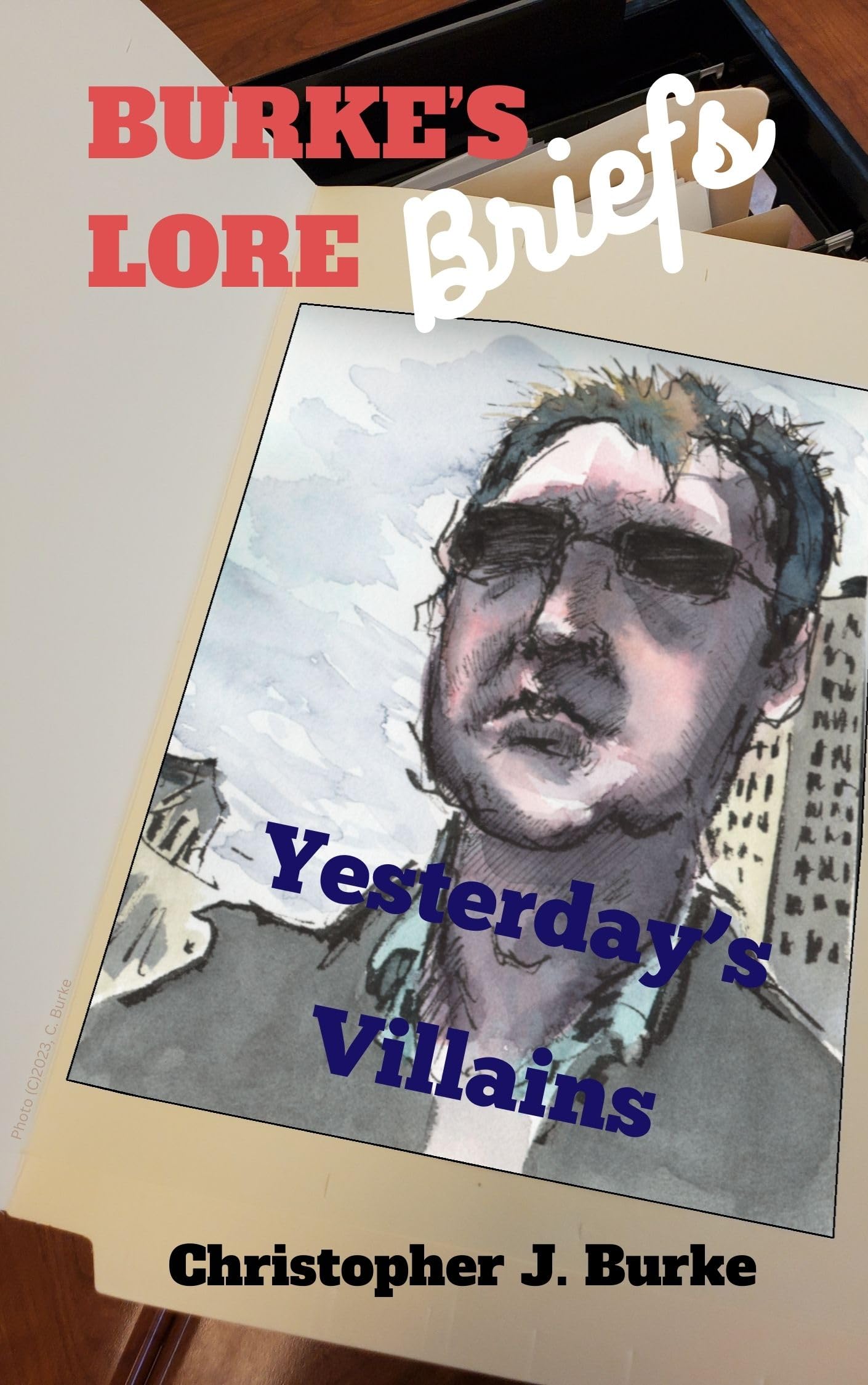 |
 |
|
My older books include three more books in my Burke's Lore Briefs series, and the anthologies A Bucket Full of Moonlight and In A Flash 2020. Vampires, werewolves, angels, demons, used-car salesmen, fairies, superheroes, space and time travel, and little gray aliens talking to rock creatures and living plants. Plus pirates, spies, horror, and kindergarten noir! If you enjoy my books, please consider leaving a rating or review on Amazon or on Good Reads. Thank you! |
 |
 |

|
 |
 |



No comments:
Post a Comment