Thursday, August 27, 2026

New Book: 7 Flashes of Science Fiction is now Available

As longtime readers know (as well as anyone who scrolls to the bottom of just about any post), I'm also a writer as well as math teacher.

My latest collection of short stories is 7 Flashes of Science Fiction, and since it's written by Christopher J. Burke, it's part of Burke's Lore. It can be found on Amazon at https://www.amazon.com/dp/B0HDKQH4P7.

However, as the saying goes ... But, wait! There's more!

As a "secret" bonus to regular readers checking out my page, the ebook will be free TODAY on August 27, 2026. One day only! So I hope you saw the message in time.

If not, it's only $1.99.

Thank you, everyone, for your support.

Thursday, August 13, 2026

Geometry Problems of the Day (Geometry Regents, June 2026 Parts III & IV)


This exam was adminstered in June 2026.

June 2026 Geometry, Part III

Each correct answer is worth up to 4 credits. Partial credit can be given. Work must be shown or explained.

32. As modeled below, Maria wants to determine the height of the building across the street from her position, M. The angle of elevation from M to the top of the building, T, is 36°. From M, the angle of depression to the base of the building, B, is 18°. The buildings are 80 feet apart.

Determine and state, to the nearest foot, the height of the building, TB, across the street from Maria.

Answer:


There are two right triangles. In both cases, you know the adjacent side and you are looking for the opposite side. You need to use the tangent ratio twice (once for each angle) and then add the two heights together.

tan 18 = x/80
x = 80 tan 18 = 25.99

tan 36 = x/80
x = 80 tan 36 = 58.12

TB = 25.99 + 58.12 = 84.11

The height is 84 feet.


33. An artist uses clay to make solid pyramids with a square base whose sides measure 12 cm, as modeled below.

The height of each pyramid is 8 cm, and the density of the clay is 1.25 g/cm3. If the artist has 15 kilograms of clay, determine and state the maximum number of pyramids that can be made.

Answer:


Find the Volume of one pyramid and use that and the density to find the mass of one pyramid. And then divide to find the number that can be made. Be careful with your units.

V = 1/3 (12)(12)(8) = 384.

m = VD = (384)(1.25) = 480 grams = .48 kg

15 / .48 = 31.25

A maximum of 31 pyramids can be made. Remember that you have to round down because there isn't enough clay to round up. (If you did the math correctly, you would've rounded down anyway.)

34. Given: Triangle ABC, AB ≅ AC, DE ⊥ BC, and HF ⊥ BC

Proce DE / BE = HF / CF

Answer:


Write a prove that shows that the two triangles are similar so that the corresponding sides of the similar triangles are proportional.
Statement Reason
1. Triangle ABC, AB ≅ AC, DE ⊥ BC, and HF ⊥ BC Given.
2. △ABC is isosceles. A triangle with two congruent sides is isosceles.
3. ∠B ≅ ∠C The base angles of an isosceles triangle are congruent.
4. ∠DEB and ∠HFC are right angles Definition of perpendicular
5.∠DEB ≅ ∠HFC All right angles are congruent.
6. △DEB ~ △HFC AA Theorem
7. DE / BE = HF / CF Corresponding sides of the similar triangles are proportional

June 2026 Geometry, Part IV

A correct answer is worth up to 6 credits. Partial credit can be given. Work must be shown or explained.

35. Triangle ABC has vertices whose coordinates are A(-3, 21), B(-5, 2), and C(-1, 8).

State the coordinates of point D such that quadrilateral ABCD is a parallelogram.
[The use of the set of axes on the next page is optional.]

Prove ABCD is a parallelogram.
[The use of the set of axes on the next page is optional.]

State the coordinates of point E, the midpoint of BC.
[The use of the set of axes on the next page is optional.]

Prove △ABE is an isosceles triangle. [The use of the set of axes below is optional.]

Answer:


If they give you a grid, use it. It counts as work, and the visual is helpful. It's easier to count boxes than to remember and apply formulas.

To show that find point A, look at the change in x and y from B to C. Apply the same changes from A to find D.

From B to C is 4 to the right and 6 units up. If you go 4 to the right and 6 units up from A, you get D(1,5).

You can prove that it's a parallelogram by showing that the opposite slopes are equal which makes the lines parallel.

Slope BC = 6/4 = 3/2
Slope AD = 6/4 = 3/2
Slope AB = 3/-2 = -3/2
Slope CD = -3/2
Two pairs of opposite sides have the same slope and are parallel. Therefore ABCD is a parallelogram.

The midpoint of BC is the halfway point between B and C. We already know that C is 4 to the right and 6 up from B. Point E is half of those distances, 2 to the right and 3 up. That puts the point at E(-3,5)

To prove △ABD is isosceles, you can use the grid instead of a formula to find the lengths of AB and BE. AE is 6.

AB = √(22 + 32) = √(13)

BE = √(22 + 32) = √(13)

ABE is an isosceles triangle because 2 sides are congruent.


End of Exam

How did you do?

Questions, comments and corrections welcome.

I also write Fiction!


The NEW COLLECTION IS AVIALABLE! A Bucket Full of Moonlight, written by Christopher J. Burke, contains 30+ pieces of short stories and flash fiction. It's available from eSpec Books!
Order the softcover or ebook at Amazon.

Vampires, werewolves, angels, demons, used-car salesmen, fairies, superheroes, space and time travel, and little gray aliens talking to rock creatures and living plants.

My other books include my Burke's Lore Briefs series and In A Flash 2020.

If you enjoy my books, please consider leaving a rating or review on Amazon or on Good Reads. Thank you!


Thursday, August 06, 2026

Geometry Problems of the Day (Geometry Regents, June 2026 Part II)


This exam was adminstered in June 2026.

June 2026 Geometry, Part II

Each correct answer is worth up to 2 credits. Partial credit can be given. Work must be shown or explained.

25. On the set of axes below, △DAN ≅ △MIK.

Describe a sequence of rigid motions that maps △DAN onto △MIK.

Answer:


Make sure your transformations go in the correct direction, in this case from the top left to the lower right.

You should see that the orientation has changed in that the triangle is facing in the opposite direction. This indicates that a reflection has taken place. After that, a tranlation will move the figure to its image.

A reflection over the y-axis moves the triangle to Quadrant I with point A' at (1,8). Point I is at (1,-3) with is 11 units down and 0 units left or right.

The reflection over the y-axis (ry-axis) is followed by a translation 11 units down. (T0,-11).

This sequence could be done in the reverse order and achieved the same result.


26. In parallelogram LEAD below, C is on DE and S is on DA such that SC ⊥ DE.

If m∠LED = 21°, determine and state the measure of ∠CSA.

Answer:


Fill in what you know: LED = 21, so CDA must be 21 degrees as well, and angle DCS = 90 because it's a right angle.

This means that by the Remote Angle Theorem, angle CSA = 90 + 21 = 111 degrees.

If you forgot that theorem, you could have found that CSD = 180 - 90 - 21 = 69, and then CSA = 180 - 69 = 111.


27. A section of tree trunk from a white pine tree can be modeled by a cylinder. The diameter of the trunk is 1.5 feet, and the height of this section is 8 feet. If white pine weighs 25 pounds per cubic foot, determine and state the weight of this section of the white pine tree, to the nearest pound.

Answer:


You need to find the volume of the cylinder first. Once you have the volume, you can use that and the density to the mass (weight) using the formula m = VD.

The volume formula uses radius, but we were given diameter. Cut that in half. r = 1.5/2 = .75.

V = π r2 h = π (7.5)2 (8) = 14.137...

Leave the number in the calculator, or write down at least three decimal places. DO NOT ROUND IN THE MIDDLE OF A PROBLEM.

m = VD = 14.137 (25) = 353.429...

The weight is 353 to the nearest pound.


28. In △ADC below, points B and F are on AC and AD , respectively, such that AB = 40, BC = 30, and BF is drawn.

If AF = 64, determine and state the length of FD that would prove BF || CD.

Answer:


If BF || CD then triangles ABF and ACD are similar and their corresponding sides are proportional. Conversely, if the corresponding sides are proportional, then the triangles are similar and those two sides must be parallel.

Solve the proportion AB / BC = AF / FD

40 / 30 = 64 / FD

40 FD = (30)(64)

FD = (30)(64)/(40) = 48

It is also easy to see that QUAD could be broken up into four congruent triangles, for which the area could be found.


29. In △CLM below, m∠C = 33°, CL = 8, and CM = 15.

Determine and state, to the nearest tenth, the area of △CLM.

Answer:
You have two options here. The first is the use the Law of Sines: A = 1/2 (a)(b) sin C. The second is the use the sine function to find the height of the triangle, and then use A = 1/2 b h. This is the same exact thing but doing it in two steps might make it seem easier to you.

The Law of Sines allows you to find the area of a triangle without knowing the height if you know the lengths of two sides and the size of the angles included between them.

A = 1/2 (8) (15) sin (33) = 32.678...

The area is 32.7.

If you tried to find the height, you could use sin (33) = h / 8, and then h = 8 sin (33) = 4.357...

Then A = 1/2 (15)(4.357...) = 32.678

Which is the same answer.


30. In the diagram of △ABC below, use a compass and straightedge to construct the angle bisector of ∠ABC. [Leave all construction marks.]

Answer:
Starting at point B, make an arc that intersects the two sides of the angle. (I made a circle because it's easier with my paint program, but it isn't necessary.) Make two more arcs at the points where the first arcs met the sides. These points will intersect on the bisector of the angle. Draw a line from the intersection of these two arcs to the vertex of the angle.


31. The diagonals of parallelogram GRAM intersect at P. If RP = 12 and GA = 24, explain why GRAM is a rectangle.

Answer: The diagonals of a parallelogram biset each other. Therefore, if RP = 12 than RM = 24, which makes it congruent to GA.

If the diagonals of a parallelogram are congruent, then the parallelogram must be a rectangle.


End of Part II

How did you do?

Questions, comments and corrections welcome.
More to come.


Welcome to BURKE'S LORE


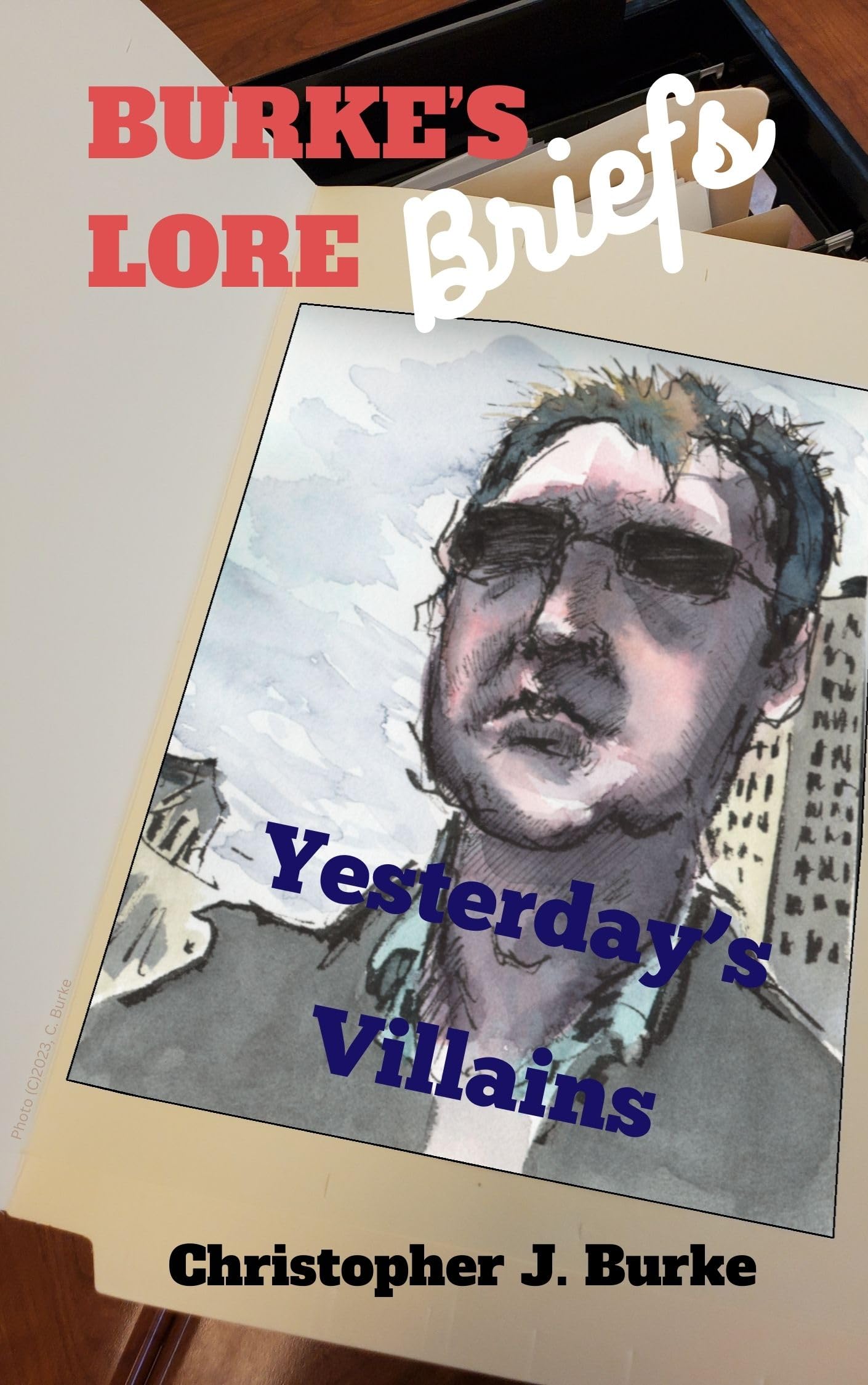
Burke's Lore Briefs: Yesterday's Villains, the follow-up to Tomorrow's Heroes is now available on Amazon and Kindle Unlimited.

If Heroes who don't die live long enough to become the villain, what happens to Villains who live long enough? When do schemes of global conquest become dreams of a quiet place away from all those annoying people you once wanted to subjugate? And does anyone really want to rule over the world's ashes if it means we can't have nice things?


My older books include three more books in my Burke's Lore Briefs series, and the anthologies A Bucket Full of Moonlight and In A Flash 2020.

Vampires, werewolves, angels, demons, used-car salesmen, fairies, superheroes, space and time travel, and little gray aliens talking to rock creatures and living plants.

Plus pirates, spies, horror, and kindergarten noir!

If you enjoy my books, please consider leaving a rating or review on Amazon or on Good Reads. Thank you!