Showing posts with label Article. Show all posts

Monday, January 18, 2016

How To Pass The Algebra Regents (Or At Least Score Several Points Higher)

Welcome. If you found this page while looking for answers to Common Core Algebra Regents answers, please read what this column has to say.
Or just review my Regents tab for more answers and reviews.

I am a New York City high school teacher and I have been grading Regents exams for about 15 years. I have put in overtime grading the exams and have gone to training about what is acceptable and what isn't (and what might be worth, say, 1 point instead of 0). The scorers have very little leeway in how they grade things, but one thing is certain: you cannot get full credit for any problem without a completely correct response with the work shown or graphs labeled.

Most of what is written below may seem to be common sense. My students tell me that it is, and yet they make these little mistakes time and again.

Scoring Higher on the Common Core Algebra Regents

It's simple really. There are two things that you have to do:

  1. Don't make silly mistakes
  2. Don't give away points by skipping questions

One piece of advice you need to forget: Just write something. No, do not just write something. Write something thoughtful. If you take two numbers and multiply them, most times, it will be incorrect. If you use the Quadratic Formula but it isn't a quadratic equation, it is "totally incorrect".

Now the positive things you should do:

Round Your Decimals Correctly

Rounding errors will cost you one point. For a two-point question, that's half the credit, regardless of how much work you did.

If the problem says to round to the nearest tenth, then you include one decimal place. If it says nearest hundredth, two decimal places, etc.

If the problem is money, then you have either two place or zero places (nearest cent or nearest dollar). Never write $2.5 as your answer. (I've seen it.)

If the next digit is 5-9, round up. If the next digit is 0-4, round down.

And DO NOT confuse TENTH with TEN and HUNDREDTH with HUNDRED. (Again, I've seen it.)

Final warning: DO NOT round in the middle of the problem. Wait until the end to round your numbers or errors will creep in.

If you round 1/3 to .3 in the middle of the problem and then multiply (.3)(60), you will get 18 instead of the correct answer 20. You just lost a point.

Use the Correct Formulas -- and Write Them Out

Some of the formulas are given to you, but not all of them. Don't expect the one you need to be there. Don't use one just because it is there. (Seriously, if you're in high school you should know that the Area of a rectangle is length times width and the Volume of a rectangular prism is length times width times height. I shouldn't see pi mentioned.)

Write the formula out. It isn't required, but it can't hurt. And it will help when you substitute for the variables that you have.

Calculator Issues: Use Parentheses

Calculators have a bunch of issues. Make sure you know how to use them and how to find the functions that you think you might need.

In particular, don't forget to use parentheses. Some of the biggest mistake involve parentheses.

Exponents: -32 is NOT the same as (-3)2.

Fractions: 4 + 5/6 - 7 is NOT the same as (4 + 5)/(6 - 7) or 4 + 5/(6 - 7)

Square Roots: SQRT(4 + 9 is NOT the same as SQRT(4) + 9.
I can't draw the root symbol, but the calculator will give you an open parenthesis. It doesn't require a close parenthesis. However, the syntax of your equation may DEMAND one.

Absolute Value: abs(-8 + 3 - 4 is NOT the same as abs(-8 + 3) - 4.
Same reasoning as with Square Roots. The close of the Absolute Value in the expression means close the parentheses in the calculator.

Don't Forget to Answer the Question

If you do all that work to figure out what x equals, make sure you go back and answer the question. Was x in the question or did you make it up (use it for the unknown in the problem)? Did the question ask you to find x, or did it ask to find some other expression that uses x?

If you found x, do you also need to find y, and state the answer as coordinates?

Whatever they ask, answer it. Don't stop and say, well, I did enough. "It's obvious." "It means the same thing." Why take a chance?

Answer in a Sentence

Write out your answer. Put it in a box. If you clearly defined your variables, you have half of a sentence already. Just put an = sign and the answer.

Make sure that your final solution can be found, especially if you have a lot of work on the paper. (Also, "a lot of work on the paper" is A Good Thing.)

Label Your Graphs

Along with labeling your answers to algebraic solutions, you need to label your graphs. If there are two equations or inequalities, you must label at least one of them. (Both would be better.) Again, it is NOT "obvious" which one is which. The scorer needs to know that you know. So tell them.

Furthermore, if it is a system of equations, label the point of intersection. If the lines do not meet at an integer point, you probably made a mistake. HOWEVER, if you cannot find a mistake that you made, estimate the answer as best as you can. You can get a point for a "consistent mistake" if you correctly label the intersection of two lines, even if one is incorrectly graphed.)

If you label a bunch of points when you graph -- e.g., (1, 3), (2, 5), (3, 7) ... -- then make sure you circle the solution to the system and label it as such. You won't get credit for having (3, 7) written if there are a bunch of other points labelled as well.

Speaking of Graphs -- DON'T SKIP THEM

Some students are intimidated by the graphs? Why? You have been doing them for a good part of the year. And you should have a graphing calculator at your disposal.

Using a calculator means that you may have to rewrite an equation to isolate y, so you can use the y= key.

Once you GRAPH it, look at the TABLE. You have all the points you need to plot the graph.

And, speaking of which, DRAW THE GRAPH FROM EDGE TO EDGE. Don't plot four points, connect the dots and stop.

The One Exception to this rule is if you are given a domain to use, such as, -4 < x < 4, in which case, DO NOT GO PAST THOSE NUMBERS and do NOT use ARROWS.

And, obviously, you won't be able to go to an edge in the numbers are outside of the domain of the function, such as with the square root function.

For inequalities, shade one inequality with lines going in one direction. Shade the other with lines going in a different direction. The criss-cross pattern is your solution. Put a big "S" in that section of the graph. Don't just scribble in three sections of the graph.

Look Below the Graph for Extra Questions

If there is a question below the graph, ANSWER IT. Don't ignore it. Don't say you didn't see it.

If they are for a point that is in the solution to a system of inequalities, remember that any point on a broken line, including the intersection point, is NOT in the solution.

EXPLAIN

If you are asked to "explain", then that's what you need to do. And you need to reference what is on the page and what mathematical concepts or principles are being addressed.

Take it from me, whatever B.S. you might put on your English essays will not work here. By the way, it doesn't work in English class, either.

Don't write, "I don't agree with Angelica's solution because she is wrong." That isn't an explanation to why Angelica isn't correct.

Trust Yourself and Succeed

Be careful. Look over your work with an eye for these "silly" mistakes. I say "silly" because students don't like when I say "STUPID" in class. They think I'm calling them "stupid" instead of the mistake.

A second read-through can find mistakes you missed the first time.

Follow these tips and you'll score a few extra points that you would've lost otherwise. Every point matters. You won't know what mistake will drop you below 65 or 75 or 90, or whatever your target grade is.

Just do your best, but remember that cutting corners and skipping questions is NOT doing your best.

Tuesday, May 19, 2015

Twitterati Challenge

So first a thanks to Gregory Taylor (@mathtans) of Canada -- I'll get you for this, even as five other educators are preparing to get me -- for including me in his list of five “Twitter Stars”, following his own nomination by Chris Smith (@aap03102) in Scotland. I'm in NYC, so we've crossed the pond and come down across the border, eh?

I first heard about this Challenge in Greg's tweet.

A little more about Greg: We first met when he stumbled across my webcomic, and he let me know about a project of his own, Taylor's Polynomials, which was something new. Not quite a comic, not quite a story serial. I admit, I didn't always keep up to date with it, but I liked the song parodies. ("Making a Graph! Making a Graph!") And, as noted above, he has a regular blog as well.

Greg has a very detailed post about the beginnings of the #TwitteratiChallenge hashtag, so I don't need to, er, rehash it. But I will repeat his link to the Teacher Toolkit post, explaining all of this.

So keeping it fun and without getting too introspective about this, I'll move along and play by the rules, sort of, maybe ...

INTRO: In the spirit of social-media-educator friendships, this summer it is time to recognize your most supportive colleagues in a simple blogpost shout-out. Whatever your reason, these 5 educators should be your 5 go-to people in times of challenge and critique, or for verification and support.

RULES

There are only 3 rules.
1. You cannot knowingly include someone you work with in real life.
2. You cannot list somebody that has already been named if you are already made aware of them being listed on #TwitteratiChallenge.
3. You will need to copy and paste the title of this blogpost, the rules, and what to do information into your own blog post.

WHAT TO DO

If you would like to participate with your own list, here’s how:
1. Within 7 days of being nominated by somebody else, you need to identify colleagues that you rely on, or go to for support and challenge.
2. You need to write your own #TwitteratiChallenge blogpost. (If you do not have your own blog, try @StaffRm.)
3. As the educator nominated, that means that you reading this must either: a) record a video of themselves in continuous footage and announce their acceptance of the challenge, following by a pouring of your (chosen) drink over a glass of ice.
4. Then, the drink is to be lifted with a ‘cheers’ before the participant nominates their five other educators to participate in the challenge.
5. The educator that is now newly nominated has 7 days to compose their own #TwitteratiChallenge blogpost (use the hashtag) and identify who their top 5 go-to educators are.

I'll cheat a little on 3 & 4, because the beverage of choice would likely be hot, and it'd be a waste to pour it over ice. Even to make a concoction such as the much-talked-about "iced coffee" would require steps that would be too boring to watch. And not every beverage goes with ice anyway. But for the sake of the rules, I suppose that this is some part of that whole "ice challenge video" meme leftover from last summer. But I digress.

FIVE TWITTERATI

Coming up with five was a little difficult. First, I had to scratch a few off because they were nominated by Taylor (or along with him). Then I wanted to be a little fair to others: there are some people who will be in the lists of one of those whom I've nominated. Why make it harder for them? And then I realized I wouldn't have as much trouble as I thought getting up to five ... it'd be getting down to five.

In no particular order, if you believe that a math teacher couldn't find some "order" to justify any combination or permutation:

Stacey Roshan (@buddyxo): I think I've "known" Stacey longer than anyone in this post, with the exception of the aforementioned-soon-to-be-gotten Mr. Taylor. I use "known" in the Internet sense of "we don't actually know each other, but we've had long distance communication". Stacey contacted me about using one of my comics in a presentation, which is something we're all supposed to do -- ask permission, not use my comics, but, yeah, that, too. But it's when I started following her on Twitter that things got interesting. Stacey is a champion of the flipped classroom, a concept which intrigues me, but one that I probably couldn't have gotten past my Assistant Principal a couple years ago. There would be implementation issues for the population I was teaching, but I think it would be a great thing if they gave it a real chance. I know this because I follow what she's doing even if it doesn't apply to me right now.

Samantha S. Bates (@sjsbates): I first found Samantha when she started following me. I'm bad about returning "follows" -- I don't do it automatically, and I usually want to find out about the person first. At this point, I believe at least a dozen people I follow also follow Samantha. One of the funny things about my involvement with Twitter was that even though I knew I could use it for help with teaching, I didn't want my Twitter feed to ever become a string of teacher tweets. Well, that all changed. Samantha, pretty much, introduced me to the concept of Twitter teacher chats. (Again, I don't know whether I'm passing along praise or blame at this point. Your mileage may vary.) When she participated in these chats, I became so intrigued by her half of the conversation, that I started searching for the questions or the responses. She also inadvertently, or maybe "advertently", led me to the next person on the list ... (okay, so maybe order does matter at this point)

Doug Robertson (@TheWeirdTeacher): Doug is the Weird Teacher. You know this because it follows the "@" symbol. And because it's written on his profile pic. Which is taken from the cover of his book. Which is so popular amongst teachers that it has its own weekly Book Club chat, as well as, not one, but *TWO* -- I'm a math teacher, I love to count, ah, ah, ah -- #WeirdEd chats each week. They're actually the same chat, at 7 pm PST and 7 pm EST, the latter for the East Coast teachers who find 10pm to be past their bedtimes, but who have managed to eat dinner by 7pm. (I seem to have one conflict or the other, but I make it when I can.) It's always a lively, fun discussion, and his weird sense of humor shines through every other day of the week in whatever random post he's, um, posting. If you think my humor is weird, remember that he has it in writing. So, Doug, I list you among the Top Five. (You're Welcome).

Michael Pershan (@mpershan): Michael may have the distinction of being the one person on this list that I've met. We were both at the NYC Math Teacher tweetup back in December 2014, with a bunch of other wonderful math people (a phrase that English teachers call "redundant"). Michael is a Geometry teacher, like I am. However, he teachers 3rd and 4th graders, which I don't -- I have HS Geometry. And yet, when he posts, I recognize the same of the (teaching) problems and situations and solutions and relate to them. Excluding my witty comments, I think I've replied to more of his posts with than any other teacher's, outside of chats. (But if you do exclude my witty comments, you're excluding 90% of my comments, for varying values of "witty".) Sidenote: the tweet-up was fun -- we need to do that again some time. I could use a night out.

Rosy Burke (@rosy_burke): I'm going to tell you two secrets about my little cousin: First, she's 238 years old in dog years. That's not actually a secret: he tweeted that one of her students came up with that. Doesn't look a day over 237, if you ask me, right? Second, she's not my cousin. That just came up in a chat, and we went with it. No one questioned it. Rosy is another teacher of younger grades, but that doesn't mean that I can't apply her tweets to an older audience. And, hopefully, with teachers like Rosy in the younger grades, I'll have more ready, more capable students in the upper grades. (You know, if they move across the country and just happen to find my school, whichever one that is.)

So that's my list, and now that I'm done, I realize that it could've been a lot longer.

And here's some other stuff that I'm including because Greg did, and I'm stealing it without asking permission. Shame on me, but I know he doesn't mind. (And I've already linked to his post.) Now, for the purists, the backtrack blogs:
-To me, from Gregory Taylor@mathtans
Via @aap03102
Via @mathsjem,
via @aegilopoides
via @KDWScience,
via @Chocotzar,
via @heatherleatt,
via @MaryMyatt,
via @cherrylkd, From SOURCE (TeacherToolkit, above).

You can also find @Sue_Cowley’s May 11th compilation here, and I've seen @JillBerry102 often pop up in association with the hashtag.

Thursday, April 09, 2015

A Young Pickpocket Learns A Valuable Lesson

Something happened a couple weeks back while I rode the Bay Parkway bus one weekday afternoon shortly after school let out. The bus was crowded as it usually is even before it got to my stop, by the train station. Naturally, it's a transfer point where many commuters are making a connection.

For those who haven't ridden a bus in New York City (and I haven't ridden elsewhere, but I imagine it's similar), you get on through the front door, the driver says move on back so more people can get on, and generally, people ignore him after moving about 10 feet. Resistance is met with surrender -- if you can't get past two people who refuse to move, you'll likely stop and add to the problem.

I do try to move back as far as I can. For one thin, plenty of people exit through the rear door, so if you can break through the logjam, there's usually breathing room in the back (and sometimes a seat with a bag on it that you can shame someone into removing).

There are a couple of semi-valid reasons for not moving toward the back of the bus. First, you are with someone who managed to get a seat, so you wish to stand near them, which requires you to sway out of the way of people pushing past. (Note: this is difficult to do if you are oblivious to the fact that you are wearing a bulky backpack sticking straight out into the "aisle", which is basically inches wide. Take it off!) Second, you have packages or a bag on wheels with a handle, either of which would be difficult to navigate through crowds.

On this day, there was an older woman with a travel bag with the handle extended immediately to her left, and she also had a sizable pocketbook hanging from left shoulder. I had my briefcase in my left hand, with its strap still on my left shoulder. I was also wearing a pair of earbuds with the wire running down to and disappearing into the right pocket of my jacket. Everything inside my pocket was secure; it always is. I was basically sidestepping through the crowd, leading with my bag to wiggle through, saying "Pardon me, excuse me, pardon me" like an old Bugs Bunny cartoon. My right hand was grasping and moving along the overhead bar because the bus pulled away from the curb rather abruptly. (Schedules!) I noted both of her bags and was being careful.

Now there is an alternate explanation about the events which happened next: it is possible that the wire could've caught on either of her bags. It is possbile that the woman shifted and her elbow caught the wire. It's possible that this was just an odd occurrence. But not likely in the slightest.

This is why: I have had the wire to my earbuds snag on things before. The result is always the same -- the earbuds are pulled from my ears. Action/reaction. I think that there was one time that the wire came loose on the other end. However, the path of least resistance, the weakest link in the chain, is the connection to my ears, not to my pocket. Never -- I repeat, NEVER! -- has any snag yanked anything out of my pocket. (Like a little boy's, a grown man's pockets run deep, and they collect many things.)

Here is what I believe really happened. Someone, likely a school-aged individual, saw an opportunity. They saw the wire disappearing into my pocket and my right arm raised over my head, giving them a clear path. They either thought that they could easily lift my phone out of my pocket by the wire, or maybe that if they pinched the wire, my motion to the back of the bus would lift it out on its own. Their objection, I suppose, would be to yank the wire free, palm the phone and swing about in their seat, essentially disappearing into the crowd, leaving me without anyone to accuse. It's not like a cop would stop the bus and search all the passengers, right?

But the little sticky-fingered bandit didn't get away with it. Like Snidely Whiplash with two binomials, his plan was foiled because he hadn't counted on something. There was something he hadn't expected and probably never would have before now.

And so my little pickpocket friend, you have now learned a valuable lesson.

You now know what a Sony Walkman looks like.

Tuesday, March 24, 2015

(blog) Burke, the Virus Killer!

Okay, maybe that's a little over-dramatic and teensy bit overblown, but I did get hit with a virus at work which I thought had irrevocably scrambled my flash drive, rendering my files -- including my just-finished grades spreadsheet, which was due about an hour later -- irretrievable. Never saying die, I was determined to fix my drive. And I did. When I tweeted my sigh of relief, I was asked to make a blog post of it to explain to others, in case it happens to them.

Keep in mind, this will only solve your problems if you're hit with this specific virus.

"Help! My Directories Have Turned to *.LNK files!"

So here's the story, in brief: I was using the computer in the school's Teachers Room. It's probably the oldest machine on the floor, or close to it. (There are newer machines, but by comparison -- well, in actuality, too -- this one is a relic.) It's so old that the Windows Paint I used to make comics had a copyright date of 2000. But it has MS Excel on it, which could read the EGG file, which is the spreadsheet teachers enter student grades into. I used Excel last week to update the file, inserting comments for some of the students, particularly those with failing grades. After I saved the spreadsheet, that's when the errors started. I had opened a Notepad file while I was working, but I couldn't save it. I didn't realize what had gone wrong at the time. (Little did I know.)

This computer also has a second problem: since the last break, it hasn't had wifi. Therefore, I had to track down a different computer to email this. I found my colleague had arrived and opened the lab. When I tried to attach the file to a spreadsheet, that's when I found out something had happened to the drive.

The folder, which was named 2015 Spring, along with another named 2014 Fall had the wrong icons. There were arrows on the icons, which you would see if they were shortcuts to other folders or files. When I clicked on 2015 Spring, instead of opening the folder and showing all those files, I got an error message about a corrupted picture file (where the *.LNK was apparently pointing).

Long story shorter (sorry, it was so brief after all): My directories were gone and I couldn't access anything that was in them. Only a couple of files in the root directory. About 75% of that disk was in use. Most, but not all, of the files were backed up at home. But the grade file was nowhere to be found.

I Googled it. (And Binged it as well.) I found others who this had happened to, and saw instructions about going into regedit or other system commands and tinkering with Things Users Were Not Meant to Know -- even if I was once a programmer.

Have you ever been struck by lightning from out of the blue?

After two periods of reading and fretting, something occurred to me. I'd seen this before. It had happened before.

Taking a guess, I'd probably say it was 8-10 years ago and my first flash drive. Like I said, this was an old PC -- maybe the virus has been waiting there all this time. What had happened to my drive wasn't as malicious as it appeared. It was just an illusion, but an illusion that might get me to reformat my drive to "fix" something that wasn't broken in the way I had though it had been.

The *.LNK files were NOT the remains of my directories. They were bogus files with the SAME NAMES as my directories. Here's the kicker: My directories were just fine. They hadn't been touched! (At least, as far as I can tell now, they haven't been.)

The virus had changed the system attributes of the directories to make them all both HIDDEN and SYSTEM files. Hidden made them invisible to normal viewing in Windows. System just made it that much more of a Pain In The Neck (with a capital "A") to undo this.

One frustrating little thing: I used to know how to make Windows show you all hidden and system files. Apparently, I don't anymore. Maybe the options aren't in the same place. I searched for procedures online, found some and they still didn't work. So I did what any former programmer would do. I threw away the GUI Interface, shut the Windows and then I got Down and DOS-y with it.

I opened an MS-DOS command box and fixed it Old School!

Typing the DIR command showed my nothing except my root files, the fake *.LNK files and an AUTORUN.INF file, which curiously had a timestamp equal to the viral infection. (Hmmmmmmmm.) Typing DIR /AH ordered the computer to show me the Hidden files -- and there were all my directories.

Next up was the ATTRIB command, where I found out that they both Hidden and System attributes had been turned on for those files. This is what I meant by System making it more difficult: I had to go back and read up on the ATTRIB command because it wasn't working. I kept getting an error.

Basically, you can't unhide a system file and you can't unsystem a hidden file. You have to undo them both together. So one at a time, I had to enter commands of ATTRIB -H -S ("directory name").

I got my directories back. They were visible and accessible and the files were still there.

I also deleted that AUTORUN.INF file, which is a Windows file, which may be useful for some things, but is open to corruption and misuse, as was the case here. There was no reason for it to be on my flash drive.

Everything is back to normal. I have warned a few people about that computer, but no one else has had a problem with it. In fact, I've used it before without nasty side effects. The only difference I can point to is using MS Excel this time. The virus is probably buried in some macro, out of my field of expertise. And it's probably been there for years (considering the last time I saw this particular attack). Since I'm not Admin, there isn't much else I can do other than avoid the computer and warn others, but at least if it strikes someone else, I'll have an idea what to do.

Thursday, March 12, 2015

Thoughts About Inscribed Angles and Arcs

In the past year and a half or so, I've been assigned to team teach with several different math teachers. I've been assigned to different schools in Brooklyn, with different pacing calendars. Because of this, I have happened to be in Geometry classes with three other teachers as they covered the various topics relating to circles: diameters, radii, chords, tangent, secants, arcs and angles. This past week, something occurred to me as I watched and assisted in another lesson.

When presenting the initial definition of inscribed angles and stating the relationship between the inscribed angle, the central angle and the intercepted arc, I generally see the same initial image.

This is a fine place to start, with a dart-shaped object inside the circle, somewhat similar in form to the insignia of Star Fleet. (Well, that's why I like it.) But teachers have to make sure that they address possible misconceptions.

  • Note that angle AOB is formed by two radii, which by definition are congruent. Angle ACB is formed by two chords? Is chord AC congruent to BC? They look that like or at least look close enough that the student might believe that the teacher meant to draw them that way. In truth, they might be congruent, but they don't have to be.

  • Does the vertex of the inscribed angle have to be somewhere "behind" the center of the circle? The problem with the dart-like figure is that the center of the circle is situated between the two chords. This doesn't have to be true. Inscribed angles can have their vertex anywhere on the circle, with the exception of inside the intercepted arc being considered. If can be to the side so that the chords intersect the radii. It might be closer to the intercepted arc than the center of the circle. Points like this should be shown, although, admittedly, some points would be difficult to illustrate.


  • Another point rarely made: after covering that the central angle equals the intercepted arc and that the inscribed angle is half the size of the intercepted arc, the next logical step doesn't get taken. Compare multiple inscribed angles intercepting the same arc. What is their relationship? Why?


Finally, there's a Special Case, which doesn't have to be presented as such -- at least, not the first time they see it. I see the special case just given that if an inscribed angle intercepts a semicircle, usually marked off by a diameter, then the inscribed angle is ________. STOP! Don't tell them. Ask them to figure it out using the rule for inscribed angles. Remind them, if necessary, that a diameter is also a straight angle with the center of the circle as its vertex. What is the measure of a straight angle?


What kind of angle does it have to be? Will it always be that for every inscribed angle intercepting a semicircle? Why or why not? What kind of triangle is inscribed in the circle? What do we know about the other two angles (taken together)?

With a little more variation in the foundation of the material, students will be better prepared for more complicated problems with "busier" images with criss-crossing chords or inscribed triangles and quadrilaterals.

Sunday, February 15, 2015

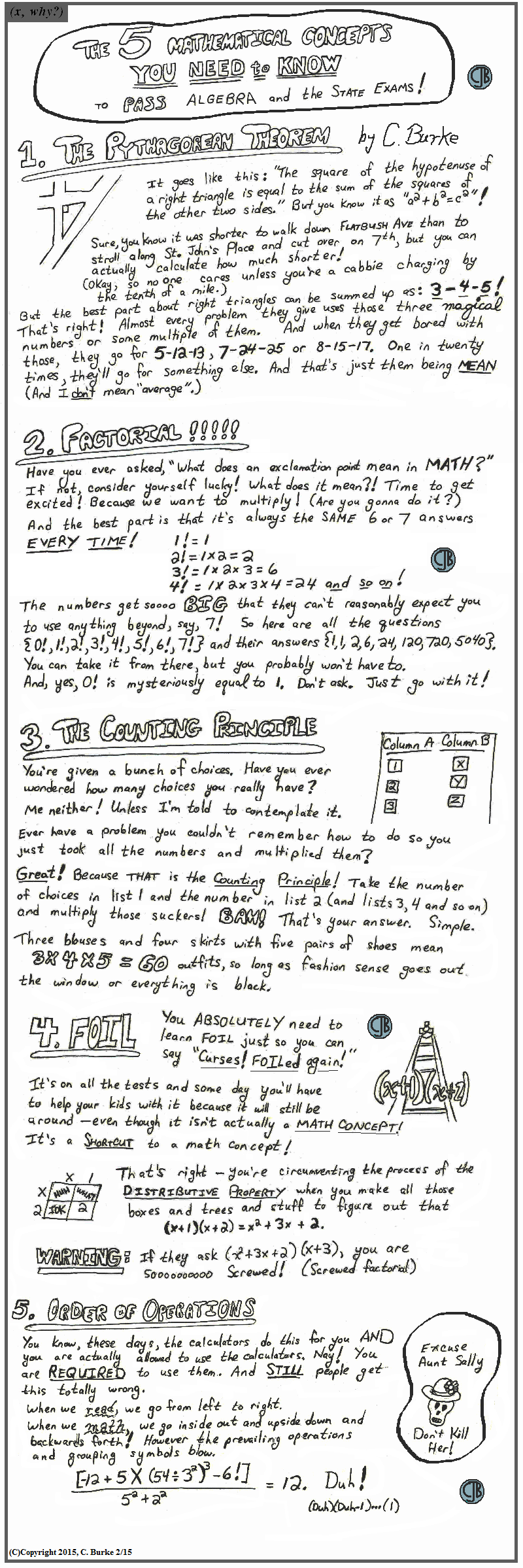
Five Things You Need to Know About Algebra, ONE BIG POST

(Click on the comic if you can't see the full image.)
(C)Copyright 2015, C. Burke.

I thought I could do all this in one day???


Thursday, February 05, 2015

Speaking of Polygons

Today's comic had its genesis in a class a couple weeks back on finding the Measure of Interior Angles of Regular Polygons. As I have done in the past, the instructor (facilitator) informed the students that they wouldn't have to memorize the names of the polygons to answer questions, such as "Which polygon has seven sides?", but they would have to recognize the name of the polygon when they saw it and know how many sides it contained.

The majority of problems of this nature tend toward 5, 6, 8, 10 and 12-sided figures. (That's pentagon, hexagon, octagon, decagon and dodecagon for those of you playing along at home.) This could be because those are the easiest numbers to work with when it comes to the number 360 (yes, and 9, too, but...), and after five-sided pentagon, it's easier to draw regular shapes with even-numbered sides. (At least, that's my experience.)

Heptagon and nonagon were given, not just for the sake of completeness, but because they do turn up, even if not as often. After asking about how many they had to learn, one student asked "How many names are there?" A reasonable question. There are classifications for larger polygons, but they can default to n-gon, where n is the number of sides. And n can be 10 or 11 or 12, if we wanted it to be, but would more likely be 15 or 18 or 20, a larger number but one that would be easier to work with.

This had me wondering about the prefixes themselves. We had names for them up to 12, which corresponds to English words for numbers. We have a base 10, but we have names going up to 12 (which makes sense given imperial units). At thirteen, we start with "three and ten", then "four and ten", etc. However, in high school Spanish I, we had to learn names up to 15 -- once, doce, trece, catorce and quince -- (Yes, I remembered them, but I did double-check the spellings.) -- before we get to "ten and six", "ten and seven". So it's an arbitrary designation.

Years ago, at the request of a different student (obviously, as it was years ago), I looked up more names and found that an eleven-sided polygon was an undecagon. This made sense to me, as it was "one and ten", the way that dodecagon was "two and ten". And the pattern continued after that.

So when a student asked this class's instructor, "What about 11 sides?", I was a little surprised when she said, "A girl in my other class just looked that up. It's a hendecagon."

What?

Yes, I not-so-immediately, slightly nonchalantly, started typing on a computer in the corner. You learn new things. What did I learn?

Eleven in Greek is hendeka but in Latin it's undecim. The form undecagon is, therefore, a hybrid construction while the "cleaner" hendecagon is not.

This does lead to a problem with thirteen. The hybrid 13-sided name is tridecagon while the all-Greek variation would be triskaidecagon, which, while familiar to anyone who has heard of triskaidekaphobia, is nowhere nearly as easy to spell.

Hendecagon comic.

Saturday, December 06, 2014

Blog: How Do We Make a Scatterplot?

I was going through a shoebox of stuff in my basement. I found a handful of paperbacks I'd started, some old stubs and statements and, underneath all that, some pages ripped from both spiral and composition notebooks. Most of them appeared to be random questions and answers to homework assignments from April, 2012 (not too bad), but with them was a lesson plan dated December 8, 2004, almost exactly 10 years ago. It was my first year teaching high school, and only my second full year teaching. I remember the students enjoyed the activity, but in my morning class and my afternoon class. However, I don't think I ever did it again. A few reasons I can think of -- I spent the next few years teaching Geometry, teaching Special Ed, and switching gears from Math A to Integrated Algebra. Every year, it seemed, the ninth grade curriculum was being rewritten or reordered. And, frankly, some groups of students were better than other when it came to activities (try to close an activity and bring the class together for a summary without half of them packing their bags!), and some times of the year lend themselves to this sort of thing more than others.

So, basically, this is the sheet of paper I kept. I'm sharing it with you and, thus, keeping it electronically, so I can throw this scrap away.

December 8, 2004

Aim: How do we make a scatterplot?

SWBAT make a graph comparing numbers of words spoken per second/minute.

Activity: Students will break into groups. Each will have a sports article. Their task is to take turns "auditioning" for a sports announcer job (like "Ron" on "G-Unit Radio")

Note: Ron was a school aide who did the morning announcements with a little bit of a flair, and he referred to it as "G-Unit Radio", the "G" for the school name and "Unit" for "Family" ... and having nothing at all to do with a similarly-named hip-hop group from Jamaica, Queens.)

Each article is marked off at 10-word intervals (for easier counting). One group member will be the timer, another the recorder. Students will take turns talking for 10, 15 20 and 30 seconds and then counting the words. After the data is recorded, data will be graphed.

Q: Is there a relationship between time and # of words?

HW: Finish the graph based on the data.
Work on December HW packet.


I remember when making groups, one of the keys decisions in grouping was how many of them had a watch. This was before everyone has a phone as well.

I also remember being told to come up with a Christmas vacation assignment. I hate those, and some of my students would be traveling (some outside the country) and did I really want them to bring books along? So I make a packet of HW for the month of December and told them it was due the day after the day we got back because everyone always forgets it the first day back. (Some of them were doing the entire packet the day we got back, which might explain we I haven't done that since.)

I hope you enjoyed my trip down memory lane. Try the activity yourself, and let me know how it works. FYI: I was in the middle of a free six-week trial subscription of Sports Illustrated, courtesy of whatever store I had started my Christmas shopping in, and I pulled an article from there. The sports pages work, too, especially if your school is listed in them!

Wednesday, November 12, 2014

Perimeter, Right Triangles and Radicals

In my Algebra class today, we were reviewing the process for adding and subtracting radical numbers. Previously, we simplified irrational numbers, such as the square of 80, which becomes 4 times the square root of 5.

To give them a more thoughtful question than just what is the sum of SQRT(75) + SQRT(48), where the only "thought" is to get past thinking that it's SQRT(123), I decided to pull out Right Triangles and that Old Favorite, the Pythagorean Theorem. Now, I didn't want them to just simplify the irrational number, I wanted some kind of addition in the problem. That brings us to Perimeter of a Right Triangle.

There are basically two types of problems you can offer up for consideration: problems with one radical number, and problems with two radical numbers. Three is just being mean, and overly complicates things -- on the other hand, it could make it interesting. Give the students the length of the legs (the base and the height), establish that there is a right angle between them, and let them go to work.

In the first kind of problem, you can pick any two numbers and you'll most likely have an irrational hypotenuse. Okay, but boring. It's more interesting if you make one of the legs irrational in such a way to make the hypotenuse rational. Surprise them.

It keeps it interesting when you consider these two problems, which look very similar, but are very different.

Consider the square root of 13 triangle first. If we square 6, we get 36. If we take the square of the square root of 13, we get 13. 36 + 13 = 49, which is the square of the hypotenuse. Therefore, the hypotenuse is 7.

Finding the perimeter is as simple as adding the three sides, which in this case means combining the like terms, which would be the integers 6 and 7. The perimeter is 13 + root 13.

In the square root 12 problem, the numbers had to be carefully selected. In this case, there will be two irrational numbers. If anything is to be combined, then the radicals have to simplify to the same radicand. Otherwise, the exercise is pointless.

If we square 6, we get 36 again. If we take the square of the square root of 12, we get 12, of course. 36 + 12 = 48, which is the square of the hypotenuse. Therefore, the hypotenuse is root 48.

We can't add any of the numbers as they are written, but we can simplify both of the radicals, as shown:

Both of the radicals have the square root of 3 in simplest form, and their coefficients can be added. The perimeter is 6 + 6 square root 3.

Interestingly, in both examples I wrote for lessons today, a double number appeared in the answer. This is actually something else to be careful about. Some students might see that as a co-incidence. Others might see it as a pattern and come to expect it.

There is an easy solution to that: give them some more problems to work on!

Saturday, September 06, 2014

How Many Colored Tetrominoes?

Question: How many different colored tetrominoes are there if we allow only four colors total?

Second question: What the heck is a tetromino?

Dominoes are a great game with rectangle tiles, composed of two adjacent squares with certain numbers of pips on them. A tetromino is a group of four adjacent squares, each sharing at least one side with at least one other square. In other words, those little falling shapes made popular in the game Tetris, and all of its knock-off variations, as seen below:

There are five basic arrangements, if you allow for reflection. (That is, if you allow for picking a piece up and flipping it over.) If you only allow for rotation, then there are seven shapes, each of which can be designated a letter of the alphabet to describe it.

In most games, the shapes are different colors because a) it's a great visual, and b) it's a clue to the player that, say, a "J" is falling not an "L". Ditto for the "S" and "Z" pieces.

As with any successful game, there have been many imitations and variations. Even games that are somewhat unrelated produce their own variations, which are suddenly similar to Tetris. I've seen a few of these where the pieces, for a multitude of reasons, are multicolored instead of monocolored, as shown below:

This lead me to thinking about the number of possible colored blocks that could fall in the game of varying shapes and color schemes. My only arbitrary limit was that each block had to contain each of the same four colors. (Naturally, I picked red, yellow, green, and blue, pretty much by default.)

First instinct is to use the Counting Principle: the number of shapes times the number of four-color arrangements. That would give us (7) X (4!), or 7 X 24 = 168.

Unfortunately, first instincts may put you on the right track, but they sometimes leave things out. In this case, we can't forget about rotational symmetry.

The I piece (the line) has rotational symmetry of Order 2. If you rotate it 180 degrees, it looks the same. That makes it the same twice in one 360-degrees rotation. The S and Z pieces also have Order 2 symmetry. The O piece (the square) has rotational symmetry of Order 4. If you rotate it 90 degrees, it looks the same. That makes it the same four times in one 360-degrees rotation.

So we have 3 shapes with 4! color variations, 3 with 4!/2 variations and 1 with 4!/4 variations: 3 X 24 + 3 X 12 + 1 X 6 = 72 + 36 + 6 = 114 possible tetrominoes.

For some reason, I feel better knowing this, and maybe it won't distract me so much next time I play one of these games on the train where I have no wifi. (A Tetris Offensive, perhaps?)

(As always, you're free to correct my math. In the event of an actual mistake, I'll edit my work and pretend I have no idea what you're talking about.)

Sunday, August 24, 2014

What Makes the Golden Ratio so Golden?

Now that I’ve concluded my Golden Ratio-themed comic serial, I wanted to get into a little what the Golden Ratio actually is. Just saying that it’s some number that’s approximately 1.618, doesn’t quite do it justice. What’s so special about that number? And what makes that a ratio?

Second point, first. A ratio is a comparison of two numbers, so it can cause confusion if only a single number is written, even if “to 1” is implied.

What makes it so special is what is being compared. Look at these two images, for example. They are basically the same thing, only the notation for the lengths are different.

Suppose we wanted to find a ratio of the length of the square to the length of the rectangle, and we wanted that ratio to equal the ratio of the length of the smaller rectangle to that of the bigger one, what value of x would accomplish that?

It terms out that we could set up the problem in either of these two ways (and many more, besides!). On the left, the square has a length of 1, the smaller rectangle has a width of x, so the bigger rectangle has a total length of x + 1. One the right, the square still has a length of 1, but the bigger rectangle has a total length of x, so the smaller rectangle has a length of x – 1.

Setting up the proportions and cross-multiplying we find:

In either case, we get the same quadratic equation: x2 – x – 1 = 0.
That’s not something easily factorable, so we have to use Ye Olde Quadratic Formula, after which we discover that the roots are

If we take the positive value, we get x = 1.618033988749894848204586... But what about the negative value? If we subtract root 5 from 1 and divide by 2, we get x = -0.618033988749894848204586...

Look at the decimal portion. They are the same! Keep in mind, that we’re dealing with irrational numbers here, which aren’t supposed to conform to patterns, but this one is just brilliant. And, yes, there is a reason for it.

Take a look at that second proportion, above, on the right, with the removable 1 in the denominator.

This is saying that one less than the number is the reciprocal of that number! If you divide 1 by 1.618033988749894848204586..., you will get 0.618033988749894848204586..., the same as if you just subtracted one.

This works for the negative value as well: If you divide 1 by -0.618033988749894848204586..., you will get -1.618033988749894848204586..., the same as if you just subtracted one.

One last point, and a hat tip to William Ricker for mentioning it, how else can we write the reciprocal of x, 1/x? What exponent gives us the reciprocal of x? An exponent of -1. That means that this equation, this proportion, can be written as:

Absolutely brilliant. And quite Golden, if I say so myself.

Tuesday, August 12, 2014

Math Isn't Everything. It Isn't Even the Only Thing.

Math isn't everything. It isn't even the only thing.

That may sound shocking coming from me, but theoretical math (you know, a lot of that Algebra stuff) needs to be applied to real life using real life conditions, which sometimes (most times?) take you out of the scope of any classroom problem. This is why some people don't think they're using algebra (when, in fact, they are), or why they think it isn't really practical.

A quick example of what I mean: there's a joke floating around that goes something like this: only in a math class can you buy 36 oranges and 25 apples and not be thought crazy.

Here's a different example (not a joke). Each weekend in August, the Miller family barbecues six hot dogs. Buns come in packages of eight. Over four weekends, how many packages of buns should they buy?

Don't scroll down until you're ready for the answer.

The "correct" answer is four packages.

Now, wait a minute, you protest! The cook 24 franks, they need 24 buns, and you get 24 buns in three packages of eight.

That is certainly true. On the second weekend, you still have 2 buns leftover from the prior weekend. This brings the next question -- the real world question -- who gets the stale buns? Probably the shy, quiet one who doesn't speak up for himself. Or the youngest one who doesn't know any better. Most likely, Mom, who who sacrifice for her children, giving them the food from her mouth if need be, assuming she wanted two hot dogs to begin with. (Take better care of Mom, she's been good to you!)

In the real world, even if the bread hasn't reached it's expiration date, those leftovers still won't be as fresh as new rolls will be. Moreover, consider the fourth weekend. All of the bread is leftover, and no one gets a fresh roll. If you're not on a really tight budget, buy new bread each week.

What do you do with the extra bread? Feed the birds. Make breadcrumbs. Have a really funky looking sandwich on Monday.

What do I know? I'm a math teacher, not a cook.

Thursday, August 07, 2014

N-RN.2 (Real Number System) - More Rational Exponents

Continuing my post from Tuesday, on the Real Number system and rational exponents, let's move on to Standard N-RN.2, which reads Rewrite expressions involving radicals and rational exponents using the properties of exponents.

There's a lot to consider under this standard, so I'll continue with rational exponents, i.e., fractions. What if we wanted to evaluate an expression like this?

We need to recognize that the radical 5 is the same as 51/2, so

The rules for exponents say to multiply the 1/2 and the 4, giving us 52 or 25.

We can take this further. Suppose we had

The cube root is the same as 1/3 power. So

We can evaluate 63 as 6 * 6 * 6 = 216.

One more example: How would we handle

The fourth root becomes the 1/4 power.

Now we can get a little fancy with and deal with the multiplication of two fractions:

One final note: The answer doesn't always have to be a rational number. You may exchange one rational power for another, one root for a different one. Consider:

Problems could contain any combination of roots and improper fractions, which may or may not have a simple rational answer. But keep the calculator handy just in case you need to know the sixth root of 117,649. Showing your work, of course.

Tuesday, August 05, 2014

N-RN.1 (Real Number System) - The Meaning of Rational Exponents

While I'm trying to update every day in August, I might as well start taking a closer look at the Common Core standards, which have now been in place for one year in high school Algebra 1 classes in New York. The first standard I find is N-RN.1. The first N stands for Number and Quantity. Unfortunately, the RN stands for Real Number System and not Registered Nurse because the latter would be helpful when you got sick of all this! I could have helped that telling that joke -- I chose to tell it any way, if only because I had to look up what the letters meant, particularly the first "N".

The entire standard reads as follows: Explain how the definition of the meaning of rational exponents follows from extending the properties of integer exponents to those values, allowing for a notation for radicals in terms of rational exponents.

It then has two components, one for Algebra 1, the other for Algebra 2. The Algebra 1 component is Evaluate integers raised to rational exponents (Algebra 1 - V.9). Don't ask me about the "V.9", I've done enough searching for this column.

I used to start teaching each year with Order of Operations, something that all the students should have seen before, and yet seemed to forget about. They know an acronym, such as PEMDAS, but don't know what it means. Oh, they know what the six letters mean, but they don't get the concept. And even when they can explain the concept, when push comes to shove and the pressures on (and they're taking a quiz), you find them calculating from left to right as if they hadn't learned anything. I had to change that when we started welcoming calculators into the lesson (even before we started requiring them). The calculators were down the work for them, so they didn't have to learn it, right? Wrong. I just adapted the problems. I started added more operations within fractions and adding exponents, forcing them to pay attention to what they put into their calculator. For instance, you need explicit parentheses to group things in a calculator because the numerator and denominator are implicitly grouped.

But Common Core changes that. They have to learn it much earlier, so they're ready for Algebra by the time they get to high school. Yeah, right. I'm still doing it. But wait, there's more.

After parentheses, come the exponents. Some students know the concept of exponents, and some just press buttons on the calculator. They know (or they'll learn!) that they are multiplying the factor some number of times. What they haven't seen before is a fraction as an exponent. What do you do when you see a fraction? Hide under the desk, usually. Wait for it to be over. I'm not exaggerating much.

First, I have to teach the concept that exponent 1/2 means take the square root, as stated in the gem. And then see how well they know they're square roots, either with or without a calculator. (I try to get them to learn up to 256, with some success.)

Second, I have to teach them that exponent 1/3 means take the cube root. This usually entails explaining what a cube root is, and where to find it on the calculator. Maybe reviewing what "cubing" means, and possibly through in Volume = length X width X height somewhere, just so I can spiral back to it when that comes around again. Depending on the results, I could try to conquer the concepts of fourth and fifth roots. Seriously, a practice webpage asked me (729)(1/6).

At this point, I'm asking: are they getting it, or are they pushing buttons? I don't mind the button pushing if they understand the concept, because then they'll start recognizing patterns and will be smarter about their button pushing.

Okay, so the next step is the real doozy: explaining exponents of 2/3 or 3/5. The students have to deconstruct the fraction. That is, they need to know that 2/3 = (2)X(1/3), so they need both to square it and then take the cube root. And then I'll suggest that you take the cube root first, so that they're dealing with smaller numbers. Sometimes this makes sense to them.

Finally, there's the kicker: improper fractions. If fractions are Dr. Frankenstein, improper fractions are his monster. They're a whole new level of scary, and the first thing they want to do is turn them into mixed numbers. Or decimals. No! Wait! Stop!

Taking the (5/2) power of 16 is as simple as taking the fifth power of the square root of 16. Okay, read that again like you're a ninth grader.

No, it's not that difficult to do once the concept is learned, but it's something they haven't seen before, and they're learning it earlier. I can't remember exactly when the first time I was required to find a third or fourth root. I was probably using logs to do it. But then, I didn't have the calculators that they have today on their phones. They'll have the answers at their fingertips, but I'll make them show the work so I know they get the idea behind it.

Sunday, August 03, 2014

Checks and Balances: No, Seriously, Check Your Balances

This country, as you should be aware, has a system called Checks and Balances, which simply put states that each branch of government serves as a check on the others, so that one branch cannot become more powerful than the others, and everything remains in balance. Whether or not these checks are always applied and whether or not the balance is usually (or even "currently") maintained, is a matter of debate for the Social Studies departments (and, I guess, the Debate teams).

Today, I'm more concerned with a different type of checks and balances, specifically, your bank account. I just taught a year of Financial Algebra, a.k.a., "Math you actually will use for the rest of your life", and being able to manage and balance a checkbook is an early part of it. It's frightening when you see statistics about the number of people who can't (or don't) balance their checkbooks regularly, not to mention the ones who don't seem to have a problem with their inability. Maybe it's because of their ATM card usage or their online bill-paying when they don't have their check registers in front of them, noting everything down, but it's a poor habit to get into.

The leading explanation I can find is that everyone figures that the computers are doing everything know and the computers don't make mistakes. As a former computer programmer, I will attest to this: computers do NOT make mistakes. On the other hand, the humans interacting with them sometimes do. I know this because it just happened to me.

Don't Worry!: This is NOT a Rant. A minor inconvenience, but it looks like it will be resolved quickly.

One of the topics in the Checking Account chapter of Financial Algebra is balancing your checkbook and making corrective entries when it doesn't balance. What I found odd were the number of questions that contained a "bank error" that the student had to find. I guess that this was to make them aware that this could possibly happen, even though it rarely does. At the very least, it is less likely than the number of questions might indicate.

But mistakes can happen and I was lucky that I discovered mine as quickly as I did. My statement, containing an error, hasn't even arrived in the mail yet. What happened was this: I have direct deposit, and I went online to make sure that my paycheck had been posted and to double-check the exact amount as it varies (by a few cents). I noticed that the last two checks posted were for $20.00 and $25.00. Now, I rarely use checks any more as I pay most bills online. Generally, checks are for donations to charities and co-payments to doctors' offices that bill through the mail. Out of all of that, I couldn't remember anything that was $25.00.

Clicking on the entry brought up an image of the check. The title had the posted date and the posted amount of $25.00. The check clearly stated in words "Twenty dollars" along with the numeric amount $20.00. There was no way that it could be misinterpreted. (For what it's worth, I worked in a bank in college where I learned that even if the "0" looked liked a "5", it wouldn't matter because the amount written in words is what counts.)

I contacted the bank through email and they responded within twelve hours, which actually surprised me because it was the weekend. They are looking into it and correcting the situation. Way to go. Thank you. Accidents do happen, so I can't be too upset.

BUT ... imagine I was one of those people that rarely balanced my account. Suppose I just had a general idea of how much I had in there and I only took the bank's word for it whenever I checked at an ATM? I'd be out five dollars. Not much now, but if one mistake can happen, couldn't a bigger mistake happen?

And what about when I did get around to balancing my checkbook and found that I was off by $5.00 -- and let's hope that it was only that five dollars I was off by! -- how long would it have taken me to find the mistaken entry? How many times would I have double-checked the math in my register before noticing that one of the amounts were different. And then I'd have to find a copy of the check to find out just who was mistaken here. Did I write it out incorrectly? Did I record it incorrectly?

So not being capable -- or worse, not being willing -- to balance a checkbook is not something to laugh about. Innumeracy -- numerical illiteracy, basically -- isn't anything to be proud of.

Sunday, July 06, 2014

Stating the Case: When is a Parallelogram Not Also a Rhombus?

When is a Parallelogram not also a Rhombus? That's not a riddle, although if I think of a good punchline for it, I could make a comic out of it.
No, this is a serious Geometry question. In fact, it was the proof on the June 2014 Geometry Regents exam.

Specifically, question 38 read as follows:

The vertices of quadrilateral JKLM have coordinates J(-3,1), K(1,–5), L(7,-2), and M(3,4).
Prove that JKLM is a parallelogram.
Prove that JKLM is not a rhombus.
EDIT: Co-ordinates fixed.
EDIT: Link added -- June 2014 Geometry Regents, question 38.
Additionally, a grid was provided, but its use was optional. What wasn't given was enough space to write the answer, unless you thought to flip to the following page. The good news was that you did NOT have to write a two-column proof, but you did have to show your work and give the details.

This is a question my students should be able to answer easily. They probably didn't, but they should have. There are reasons why I say this.

When I approach any question that contains the word "Prove", I try to get the students to think of any TV show courtroom drama they've ever scene. (Sit-coms are a totally different animal, here.) Few of them might know what it's like to be in a real courtroom, so I settle for the simplified version. Each side will give an opening statement, and they will state what they are setting out to prove. They were present their evidence and build a case out of all the evidence they bring forward. There isn't one magic witness or exhibit that will hand-wave the case away. (If there were, the case likely would never have been brought.) Then, in the end, there are summaries, which include the lawyers' conclusions based on the evidence that they've presented, and they implore the jury to reach the same conclusion.

Students are different. Students, who a year earlier in Algebra would have me solve a five-step problem in 17 steps, and repeat the solution and check twice because they still weren't "getting it", will look at a Geometry "proof" and say, "It's true because, you know, Math."

They're not sure what the "Math" is, but the Math is there, so it must be true.
The point is that they need to be sure.

This led to some interesting discussions online about the test question. How do you know, for example, if you gave enough information for only 2 points and not for 4 points?

Let's get to the basics

Parallelograms and Rhombuses

Prove that JKLM is a parallelogram. Prove that JKLM is not a rhombus.

How do you prove that a quadrilateral is also a parallelogram?

You have several choices: if the opposite sides are parallel, or if the opposite sides are congruent, or if the diagonals bisect each other, then the figure is a parallelogram.
This statement, whichever one or ones you use, has to be your conclusion, but you have to back those up with evidence:

  • To prove opposite sides are parallel, you need to find the slopes of the four sides
  • To prove that the opposite sides are congruent, you need to find the lengths of the four sides
  • To prove that the diagonals bisect each other, you have to find the midpoints of both diagonals.

Any of those are easy to do, although I'd say that slopes and midpoints are quicker to find than the lengths. Which one you do is up to you, but you can save time if you keep the second part of the question in mind. Using the slopes for the parallelogram is fine, but it won't help you with the rhombus.

That being said, I'd probably find the slopes first just because it's pretty much second-nature to me to do that first.

How do you prove that a quadrilateral is rhombus?

You have a couple of choices: if all four sides are congruent, or if the diagonals perpendicularly bisect each other, then the figure is a rhombus.
This statement, whichever one or ones you use, has to be your conclusion, but you have to back those up with evidence:

  • To prove that the opposite sides are congruent, you need to find the lengths of, at least, two consecutive sides. If you know it's a parallelogram, then you know that the opposite sides are congruent. It would've helped if you did the distance formula before now, instead of slopes, but you aren't penalized for doing extra work.
  • To prove that the diagonals perpendicularly bisect each other, you have to find the slopes of the diagonals. If you know it's a parallelogram, then you know that the diagonals bisect each other. You don't need to prove this, even if you didn't show it earlier.

So how much work is actually required for this problem?

Believe it or not, you could have solved this problem simply by finding the lengths of the four sides. Is that worth 6 points? No, that was worth 2 points. The rest of the points came from you conclusions and your reasons. Just because you found the lengths, you haven't (and this isn't meant to be a plotting reference) you haven't connected the dots yet. You haven't given a conclusion, nor stated under what rules this proves your case.

JKLM is a parallelogram because the opposite sides are congruent. (Work is shown for this.) JKLM is NOT a rhombus because all four sides are NOT congruent.

or

JKLM is a parallelogram because the diagonals bisect each other. (Work is shown for this.) JKLM is NOT a rhombus because the diagonals are not perpendicular. (Work is shown for this.)

Either of these would be complete answers good for full credit.

By contrast "They're parallel." ... well, just isn't.

As you can see, the slopes of the sides aren't needed for the problem, but it isn't incorrect to find them. Other work left for the reader: find the lengths of the sides, and the midpoints and slopes of the diagonals.

Tuesday, June 03, 2014

June 2014 Common Core Algebra 1 Regents Exam, Part 2

Update: I now have a Common Core Regents Review books available on Amazon.

Today was the first ever New York State Common Core Algebra 1 Regents. No one knew what to expect. Sure, math is math, and Algebra is Algebra. What questions could they ask, right? Well, it’s not just a matter of knowing the material. Some of this was covered nearly a year ago and not revisited. Not everything in the course scaffolds into new topics; not every new topic spirals back into the old.

And then there’s the question of presentation. You can do practice problems until the kids’ pencils are worn to nubs, but if the test problems are suddenly presented in a different -- particularly in an odd – way, a young teen might freeze up and yield the opportunity to work it out.

A lot of the test came down to vocabulary, and not necessarily math vocabulary, and reading comprehension. If you could figure out what they were asking, you could figure out what the answer might be. Or should I say “is”. It should be “is”, but who can be sure?

Once again, I’ll be reviewing the test. I’m starting with the open-ended. We’ll spiral back to the multiple-choice in the coming days. Part 1 is shorter than the older test and Part 2 makes up for it. Big Time.

Note: I won’t even pretend to guess at how many points you’ll get for writing what, other than to say if it’s perfect, you’ll get full credit. But who can be sure what “perfect” means?

Algebra 1 (Common Core), Part 2

25. Draw the graph of y = SQRT(x) – 1.

If you put this in your calculator, you had to be sure to close the parentheses after the x. Otherwise, the “- 1” would be part of the expression beneath the radical.

The trick to remember here is that the domain is x > 0. You can’t use negative numbers. The y-intercept is (0, -1). You should have, at the least, plotted the points (0, -1), (1, 0), (4, 1) and (9,2) before drawing a curve through them. There should be an arrow on the right side of the curve because it continues to the right. There is no arrow on the left because the line starts with (0, -1).

26. The breakdown of a sample of a chemical compound is represented by the function p(t) = 300(0.5)t, where p(t) represents the number of milligrams of the substance and t represents the time, in years. In the function p(t), explain what 0.5 and 300 represent.

I don’t know just how specific an answer they are looking for here.

  • 0.5 is the rate of decay of the substance. It is the base in the exponential function.
  • 300 is the initial amount of the substance. It is the y-intercept of the function and the co-efficient of the base.

27. Given 2x + ax – 7 > -12, determine the largest integer value of a when x = -1.

Confused? Don’t feel bad. Make sure you use x = -1 and not a = -1.
Plug is -1 for x and simplify the inequality before you do anything else.
2(-1) + a(-1) – 7 > -12
-2 – a – 7 > -12
-a – 9 > -12
-a > -3
a < 3
Remember to flip the inequality symbol when you divide by -1. If a < 3, then the largest integer value of a will be 2.

28. The vertex of the parabola represented by f(x) = x2 - 4x + 3 has coordinates (2, -1). Find the coordinates of the vertex of the parabola defined by g(x) = f(x -2). Explain how you arrived at your answer.

The notation for this is confusing. And when my students see this, I know that they’ll want to solve something because of the equal sign, but it’s a definition, not an equation.

Others will look at this and think it’s a recursive function because we just reviewed those a few days ago. Sigh.

For every value of x, g(x) will have the same value that the f() function had when x was 2 less than it is now. So the entire parabola will shift two places to the right. That means that the coordinates of the vertex with be (4, -1).

There are more complicated ways of achieving the same result, which, for 2 miserable points, I hope that they aren’t looking for.

29. On the set of axes below, draw the graph of the equation y = (-3/4)x + 3. Is the point (3, 2) a solution to the equation? Explain your answer based on the graph drawn.

This seems to be the easiest, most straightforward question, so far. Okay, so it’s a graph. Do the graph. You have a calculator to help you, if you need it. The y-intercept is (0, 3). The slope is -3/4 – down 3, 4 to the right, make another point, down 3, 4 to the right, make another point, … when you’re at the end of the graph, go back up the other direction. LABEL THE LINE

(3, 2) is not a solution. How do you show this using the graph? Put the point on the graph at (3, 2). Label it (3, 2). Respond: (3, 2) is not on the line so it is not a solution to the equation.

Do NOT plug (3, 2) into the equation to check. That’s not what they asked for, so they won’t give you points for it.

30. The function f has a domain of {1, 3, 5, 7} and a range of {2, 4, 6}. Could f be represented by {(1, 2), (3, 4), (5, 6), (7, 2)}? Justify your answer.

This one led to a bit of a discussion in the Math Department. One side was quite sure of their superiority of knowledge, and the other side still wasn’t satisfied with the explanation. To put it plainly: I think I know what they are asking, but I’m not entirely sure. And I’ve learned in the past, you can’t always go for what you think they want – sometimes, you have to go with what they ask.

The argument boils down to semantics, really. Or maybe it’s syntax. I don’t know. I’m not an English teacher. However, I have a problem with the word “could”. Seriously.

Is this question asking if the relation they gave fits the domain and range of f? If so, the answer is YES. Or is this question asking if the relation is the ONLY POSSIBLE FUNCTION f? If that’s the case, it’s NO. We don’t know how f is defined. There is no mapping function. It could be that this relation represents f, but it might not be. Is that what it’s asking? Literally, yes, that is what it says, word for word. And yet I’m still not sure if that’s what they mean, and I’m not sure that my students will catch that meaning as well. Nuance? I don’t know. Maybe I’m overthinking it.

Another way for me to put it is like this: Could A represent B if A is only a subset of B?

Unfortunately, not all my students are native speakers, so I hope there isn’t a problem.

One thing I know: “Yes” or “No” without a good explanation will be worth nothing.


UPDATE: I spoke with a teacher who has been to training on how to grade these exams, and he had an answer key with sample responses and their point values. Basically, the answer is YES for reasons given above. When I explained my concerns about the wording, he thought I was splitting hairs. To be honest, I agree with that. That said, the Regents has been know to split hairs in the past.


31. Factor the expression x4 + 6x2 - 7 completely.

They changed it up a bit. Usually, a “factor completely” question has a Greatest Common Factor (GCF) component to it.

x4 + 6x2 - 7 factors into (x2 + 7) (x2 - 1). If you think that this seems a little simplistic for “factor completely” instead of “factor into two binomials”, you are not wrong.

That’s because using the Difference of Squares Rule (x2 - 1) can be factored into (x – 1)(x + 1), making the final answer:

(x2 + 7) (x – 1)(x + 1)
Note that (x2 + 7) has no real roots and cannot be factored further.

32. Robin collected data on the number of hours she watched television on Sunday through Thursday nights for a period of 3 weeks. The data are shown in the table below. … Using an appropriate scale on the number line below, construct a box plot for the 15 values.

Note: A picture of the table will be added later.

Put the 15 data values in order. The appropriate scale would be start at 1 and increment by .5.

The data are: 1, 1.5, 1.5, 2, 2, 2.5, 2.5, 3, 3, 3, 3.5, 4, 4, 4.5, 5.
Note: if you don’t have 15 values, you left something out. Also, your calculator will do all this for you -- but copy it ALL down on your paper anyway!

Your five-number summary is as follows: Min: 1, Q1: 2 (4th value), Median: 3 (8th value), Q3: 4 (12th value), Max: 5. Number the scale from 1 to 5, counting by .5. Plot these five points. Draw a box using Q1 and Q3, with a vertical line through the median. Draw whiskers from Q1 to min and Q3 to max.

Done.

And that will do it for Part 2, which is much longer than the Integrated Algebra Part 2.

Sunday, June 01, 2014

Hey, Internet: Where's My Picture of Me and Ann B. Davis?

The news of the death of actress Ann B. Davis was a bit of a shock. For those of a certain age, she was "Schultzy" on the The Bob Cummings Show. I'm NOT that age, having grown up instead in the golden age of first-run episodes of The Brady Bunch. Totally tangential, and not to make light of her passing because it does sadden me, but a burning question has been brought once again to the forefront of my noggin from the deep recesses where it had been locked away for many years:

Where is my picture of me and Ann B. Davis

There's a short story here, but I'll be quick about it:

Sometime back in 1993 -- Who am I kidding: it was May 11! I have the ticket stub right next to me! -- I won tickets to a Brady Bunch Reunion Cruise, sponsored by WPLJ-FM radio (95.5 FM, NYC) and The Spirit of New York. The announced guests on the cruise were Barry Williams, Susan Olsen and Ann B. Davis, aka "Greg", "Cindy" and "Alice", respectively, if you grew up on a different planet.

It was a little of an odd evening for me. My wife couldn't make the cruise, and as I would be traveling home late by subway, I didn't want to ask anyone I'd feel obligated to take home at that hour of the night. Especially if there might be by alcohol involved.

I briefly contemplated asking some young lady standing around waiting to get a glimpse of "Greg" by the gangway if she wanted to go dancing, but I found two problems with this. First, there was no guarantee I wouldn't be deserted the moment she got on board (or five moments after we would attempt polite dinner conversation). Second, they keep the gawkers far away from the ship out by South Street and well away from the pier. (Pier 11, if I remember correctly, down by Wall Street.)

Getting back to the story, I was on line alone, listening in to other people's conversations as we waiting to get our passes and board. I finally got mine, except it was someone else's -- they just checked my name of a list and gave me the next ticket. A photographer waited for each couple to start up the gangway to snap a souvenir picture. He asked the couple ahead of me, "Are you three together?" I nodded no, but the woman asked, "Would you like to be together?"

An interesting offer, but I declined, and I had a picture taken on my own. I don't remember if they'd waited for me, or we were just assigned seats for dinner, but the three of us shared a table for dinner. The "couple" turned out to be a mother and son. The guy's name was Dean, and he was around my age. She was Marcy; I don't know her age, but she looked like she'd been a young mother. Not that there's anything wrong with that. Dean and I each thought the other looked familiar. Having both grown up in Brooklyn with two million other people, it was possible. However, we only came up with one mutual acquaintance, and we couldn't think of a time we'd been together with him. (And it was only an acquaintance of mine, not a close friend or anything.)

Soooo ..... BRADY BUNCH! CRUISE!

The Spirit of New York is a nice dinner cruise ship, sailing from South Street along the East River, around the tip of Manhattan and into the Hudson River. The crew was friendly and professional. There were hors d'oeuvres to be eaten, drinks to be drunk, and views to be taken in. The ship sailed, and we went on deck to feel the sea breeze in our faces as we sang The Brady Bunch theme song with total strangers and a drag queen with a microphone as a second one -- a brunette wearing a green dress and carrying a videocamera the size of a small Buick on his (her?) shoulder -- filmed the merriment. They walked about the entire ship the entire evening, at one point being chased up from below decks. Honest mistake.

After dinner, the dancing started on one deck and the celebrities were signing autographs on the deck below. The line never got any shorter. Not until we got on it. A couple of girls got on line behind us and then that was in for the following hour of the cruise. I could've stayed on the dance floor and possibly Electric Slided (electically slid?) into newswoman Naomi DiClemente and had essentially the same place in line an hour later. But conversation with strangers is something New Yorkers do best. That is, when we're not totally ignoring total strangers, which we're pretty good at, too.

So I didn't have a camera on me (or if I did, it wasn't working), but I did have a journal on me. Back then, I had a mini-notebook on me all the time, and I tried to write in it every day. Usually, I was writing while riding home on the subway. I'm sure my poor penmanship suffered, but it's when I had the most solitude to write -- on crowded, evening rush hour subway trains. I worked far enough uptown that I usually had a seat, except when I had to give up a seat for a mother-to-be or the elderly. (Watch out for the Wednesday matinee crowd!)

When we finally got to meet them, Ann B. Davis, Alice, was at the first table. I asked her to sign my journal, opening it to a fresh page. She was impressed that I had a journal. At that point, Marcy asked if I wanted a picture with Ann. C'mon now: Who could say "no" to a picture with Ann B. Davis? Ann was obviously used to this, and had probably posed for dozens of pictures already that night. There's a table between us, so I leaned back and Ann leaned forward. Apparently, we weren't close enough because Ann pulled me back to narrow the gap as Marcy took the picture. (Or maybe she told Dean to take the picture? Could be.)

We met Barry and Susan. Marcy points out all the blank pages in the journal to "Cindy" and says that she needs to write her life story. Susan declines and adds a note in my journal that she's already written her life story. (Thanks, Marcy -- I had a thing for Cindy when I was, like 12 -- go and ruin it for me. Well, there was still Naomi ...)

The rest of the evening was fun ... and short because we really were on line a long time. When we pulled back into port, Marcy insisted that they give me a lift home, from lower Manhattan all the way out to Bensonhurst, my first apartment after I got married. I gave them my address, and they promised to send me a copy of the picture. Well, it never came. It's been twenty years, and still nothing. Granted, I moved out of that apartment within three years, so maybe it's sitting in a Dead letter pile at Bath Beach Station.

However, in the intervening years, the Internet has evolved, and who knows, maybe this will go viral and someone will see it. Maybe that someone will know a Dean who has a mother named Marcy. Maybe Marcy still has that picture of some oddball they met on a cruise, sitting someone in a shoebox with other pictures in the bottom of a closet behind from old mixtapes. Maybe the Internet can finally answer the question for me:

Where is my picture of me and Ann B. Davis?