Showing posts with label Pythagorean Triples. Show all posts

Wednesday, December 11, 2019

Books: Math Recreations (Kraitchik) Part 6: Pythagorean Triples... Again

I have more old math books than I'll ever read or need. This is just a fact. I would collect them, and sometimes read through parts of them, but never finish any of them. ...

Day 6: Pythagorean Triples... Again

If you're a math teacher, and you like numbers, there's no way to avoid Pythagorean Triples, set of three rational numbers which can form a right triangle. I started musing about them when this blog was young -- and blog writing still new to me -- back with this post more than ten years ago. What started that was a curiosity born out of desire to find new numbers to use in math problems. Seriously, almost every triangle was 3-4-5 (or multiple), with the rare exception being 5-12-13 or 8-15-17.

Not that I've ever corrected my main line of reasoning, but I was originally caught up with primitive triples where the hypotenuse was either one or two more than the longer leg. I had Kraitchik's book back then -- there's a page scribbled with notes that's been a bookmark since then. In fact, this is probably where the idea to investigate triples with consecutive legs came from. I hadn't (to my memory) encountered any examples of those before. Surprisingly, but not too much, those pairs were related to the square root of 2. This much I reasoned: the legs are nearly congruent, and if they actually were the same, then the hypotenuse would be radical 2. However, because there are only close to being equal, the hypotenuse would come from an approximation to radical 2. With that in mind, I was able to get through the section on using expanded fractions for the square root of two to get possible triples.


Chapter 4: Arithmatico-Geometrical Questions

I read this chapter (and another book in my collection) back then, but at the time, the notation -- one again -- got to me. In particular, it uses x2 + y2 = z2, instead of the now familiar a2 + b2 = c2. (Ironically, the older version would have made the realization about the formula of a circle so much more obvious, once upon a time.) Moreover, a and b are used for calculating values of x and y. (I've seen m and n used in different sources.) And u and v get toss in for good measure to show the relationship between a and b.

On my own, a long time back, I discovered that instead of looking at the two longest sides, I should have been looking at the two odd numbers in the triples. And once I did that, I saw that the leg was always the hypotenuse minus 2n2. While that didn't give me the triples themselves, it told me that I needed to be looking at pairs of numbers with a difference of 2, 8, 18, etc. (I also came to the conclusion that part of the way I looked at the problem came from the fact that the triples I generally used were relatively small, so I just didn't come across some of them.)

At some point -- as this was me, not any book -- I worked out that for a counting number n, 2n + 1 is the leg of a triple and 2n + 1 + 2n2 is the hypotenuse. The other leg, was the square root of c2 - a2, and I was fine with that. And then I realized b2 = (c - a)(c + a), so I don't have to subtract bigger numbers in my head if I don't want to. And then when I started to work out a table:

n2n + 12n22n + 1 + 2n2c - ac + ab2
13252816
25813818144
3718251832576
. . .

... I started seeing some of the same numbers showing up. It reminded me of a quiz I gave (special ed class, if I recall correctly) where one student got four out of five problems correct when he used an incorrectly-remembered formula. The four problems he got "right" were all primitive triples. The only that was incorrect was a multiple.

Kraitchik gets into more of the calculation, which I won't repeat here beausee they're likely in so many places on the web (as "helpful" people told me back in 2009), and there, of course, are copyright concerns. After this, there are discussions of Trigonometric Ratios and Heronian Triangles. Thankfully, both are brief and the chapter short. I don't think I would have gotten through something more complex, particularly if it moved in higher dimensions.

Moving on...

I'll likely skip commenting on the next couple of chapters. The chapter on the Calendar was moderately interesting but calculating the day of the week for any day in history isn't something I'm likely to work out with a ruler. There are perpetual calendars and simple apps for that type of thing. The chapter on Probability just isn't all that interesting. There's history, and then there's coin flipping and gambling and Gambler's Ruin. (Side note: it is the one source that says you could win at Roulette, but only because it leaves out the possibility that you will run of money or hit the table limit before you finally win one, which you inevitably will.)

Wednesday, December 04, 2019

Books: Math Recreations (Kraitchik) Part 3

I have more old math books than I'll ever read or need. This is just a fact. I would collect them, and sometimes read through parts of them, but never finish any of them. ...

Day 3: Chapter 3 -- Triangular and Polygonal Numbers

I'm still in Chapter 3, Numerical Pastimes, and it touches on some interesting topics. Among those triangular numbers and polygonal numbers. (These are referred to as "figurate numbers", a term I'm less familiar with, in the text.)

Triangular numbers are of interest because they are the sums of consecutive numbers. And, of course, square numbers are exactly what it says on the tin. After that, pentagonal, hexagonal, etc, are (to me) more curiosities and fun little number puzzles than sums of series of numbers. I'm sure there are uses -- many of which will cause "Aha!" moments at the time -- but they aren't readily obvious as I type this.

The text is quick and dry, but it got my mind thinking. (So that's good, right?)

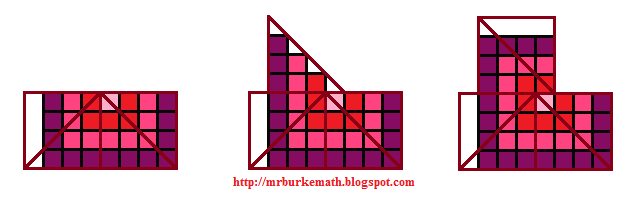
Personally, rather than go into a bunch of tables, which then derive formulas -- something I could totally do at the end of this blog post, if I'm so inclined -- I wanted to look at these types of numbers visually.

Triangular stack up like a triangle (naturally), so I thought I would build a triangle out of squares, instead of numbers, each with an area of one square unit.

On the right I overlayed a right isosceles triangle, with legs equal to N units (which is this example is 4). The area of the triangle is 1/2 b h, but since the base and the height are both N, the area of the triangle is 1/2 N2. In this example, the triangle has an area of 1/2 (4)2 = 1/2(16) = 8 square units.

But there are little blue bits sticking out of the triangle. There are half triangles that were cut out, and the number of these little triangles is equal to N, because there is one in every row. Collectively, there are N (1/2) (1) (1) = 1/2N, which has to be added to the bigger triangle.

So the total area of the N rows is 1/2 N2 + 1/2 N, or 1/2 (N2 + N), which can also be written as 1/2 (N)(N + 1), or "one-half of the number times the next higher number".

In this example, that becomes 1/2 (4)2 + 1/2 (4) = 8 + 2 = 10, which is the fourth triangle number.

Why would I do all this? BECAUSE I'M HAVING FUN DOING IT!

Yes, I could have copied the triangle, flipped it over, made a rectangle and then noticed that the rectangle was one unit longer than it was wide, and so the rectangle would have an area of (N)(N + 1), and then the triangles would be half as much ... but everyone does that, and you don't need to come here for that, right? (I am, of course, assuming that anyone comes here, other than me, and a couple of friends and relatives who humor me.)


Moving on from triangular numbers to square numbers should show no surprises:

The first time you see this is mind-blowing. I've seen adults caught off-guard by this. When given, as a puzzle, a set of sequences of numbers, and asked to find the next one, the sequence 0, 1, 4, 9, 16, ... is easy, but perhaps not for the reason it should be. There is a pattern: +1, +3, +5, +7 ... and the pattern is +2 to the previous number that was added to the number before that -- it's like two patterns in one. It was taken to the next level ... like to another dimension.

Then point out, "You know that those numbers are all perfect squares, right?" Say what, now? Oh, yeah, they are.

Why should adding odd numbers result in squares? The first time I saw the illustration, it made a lot more sense. Side note: This also makes it easier to find Pythagorean Triples because you are adding something to a perfect square and getting another perfect square. If the number being adding -- for example, 9 or 25 -- is a perfect square, the result is a Pythagorean Triple -- such as 4-3-5 or 12-5-13 because 16 + 9 = 25 and 144 + 25 = 169.

Obviously, the area of the square is length times width, which is N times N, or N2. But the square is made up of two triangles. Looking at it in terms of triangular numbers -- the area would be 2 * (1/2 N2 + 1/2 N) or N2 + N. But in doing this, we counted the diagonal twice, so we need to subtract N from that formula: N2 + N - N or just N2.

Keep with me, I'm going somewhere. I might be lost when I get there, but it will still be somewhere.

Pentagonal numbers are the next extension, and they can be visualized with this:

The problem here is that pentagons don't tessellate, and making a useful, compact figure that maintains this shape is little problematic. On the other hand, I can translate this model into the previous triangle version, as follows:

So the first thing that I noticed: a pentagon can be split into three triangles -- this is how we know that the sum of the interior angles is 540 degrees. And I could split the first pentagonal image into triangles, but it wouldn't helpful. For one thing, they wouldn't be right triangles, so finding the base and height would be impossible. But with this representation, right triangles aren't a problem. I expected three of them. However, instead of getting three triangles with extra half units, like in the first triangular numbers, this image is actually missing those N triangles.

In other words: 3 (1/2 N2) - (1/2 N) or 1/2 (3 N2 - N).
Not exactly what I might have expected when I started. Okay, so my hypothesis was incorrect. That's why we do experiments.

Before moving on, the image looks like a trapezoid, which has an area of 1/2 (b1 + b2) h.
In this example, that becomes (1/2) (N + 2N)N but we have to subtract 1/2N for the missing blocks.
This becomes (1/2) (3N)(N) - 1/2N = 1/2 (3N2) - 1/2n = 1/2 (3N2 - N)


Okay, I realize this is rambling too long. If you ever sit down with me for a conversation, you'll likely feel the same way.

For simplicity, I combined hexagonal, heptagonal and octagonal numbers into one image using the same format. (Obviously, this format would self-destruct in two more iterations.)

Hexagon numbers give us a rectangle. Octagonal numbers look like 3/4 of a square, but are actually more than that -- they're actually a smaller rectangle on top of the bigger rectangle.

Superimposing the right triangle, we can see that we're still losing space.

The hexagonal numbers create a rectangle with a width of N and a length of 2N - 1, as can be seen in the "missing" column. So it has an Area of N(2N - 1) = 2N2 - N. So the hexagonal numbers are double the square numbers but subtracting N.

After this, I ran into a problem. Do I line up my triangles with the missing columns, or should I shift it over. It seemed obvious that I should shift them -- why deal with both "extra" and "missing" pieces in the same problem?

In brief, heptagonal numbers are hexagonal numbers plus a triangle missing space, just as the pentagonal were missing space. This gives us the following:
Area = 2N2 - N + (1/2 N2) - (1/2 N)
Area = (2 1/2)N2 - (1 1/2)N = (1/2)(5N2 - 3N)

Heptagonal looks similar to pentagonal, which differed from triangular because of the sign. But this is where an Aha!! happened. In these three formulas, the first coefficients were 1, 3, and 5. The second coefficients are +1, -1, and -3. Both numbers are sequences. (I know, not surprising -- but I like seeing it visually.)

Moreover, as we can see that octagonal follows hexagonal, which follows square as a pattern: N2, 2N2 - N, 3N2 - 2N, etc. But this is actually the same pattern if we double all of the coefficients and put a leading multiplying of 1/2.

Now that there's only one pattern, I can come up with a single formula for all of this which -- WHICH will likely be the same expression that was presented in the book with little comment or explanation, and which likely caused my brain to freeze up and reach to turn the page. (Actually, the fact that book took it to the third, fourth and nth dimensions caused the brain freeze.)

Yes, notation can be my downfall in mathematics. It's very precise, but decoding it and understanding it can be as bad as translating and understanding any foreign language. And math is definitely a language of its own.

This entry is excessively long at this point, so I'll leave out the table showing the progression. Maybe another day.

However, I can end with the formula. N will which number in the sequence we're looking for, and S will refer to the number of sides in the type of polygon that the sequence is named for.

This means that the Nth S-type number is (1/2)((S-2)N2 - (S-4)N)

And, yes, I do feel better having worked it out myself.

Tuesday, August 15, 2017

Happy Pythagorean Triple Day!

(Click on the comic if you can't see the full image.)

(C)Copyright 2017, C. Burke.

This is the first one this century that didn't happen during the school year, unless you count 8/6/10.

I was teaching for 3/4/5, 6/8/10, 5/12/13, and 9/12/15 (and their permutations), although I'd have to check which of those were actually school days and not weekends or holidays.

The ones that we have left to go in this century are 12/16/20, 7/24/25 and 10/24/26. Sadly, I won't be retired by then.


Come back often for more funny math and geeky comics.


Monday, February 09, 2015

Five Things You Need to Know About Algebra, Part I

(Click on the comic if you can't see the full image.)
(C)Copyright 2015, C. Burke.

Unless they want the third side rounded to the nearest tenth or expressed in simplest radical terms -- then you're on your own!

By the way, every multiple of the 3-4-5 right triangle has the same exact shape. They are similar figures so there angles are the same. And those angles will be 53 degrees (across from the "4" side) and 37 degrees (across from the "3" side). But show your Trigonometry work anyway like you didn't already know the answer in advance.


Sunday, May 12, 2013

Mothers Day 2013: In Geological Terms

(Click on the cartoon to see the full image.)
(C)Copyright 2013, C. Burke. All rights reserved.

I'm relearning Patience. Which I never mastered in the first place.

You know who has a lot of Patience? The doctor.

Edit:Remember, it isn't Patience = Virtue. It's Patience is an element of Virtue.

Edit 2:As was pointed out to me, besides having a Happy Mothers Day, also have a Happy Pythagorean Triple Day!
5 - 12 - 13


Saturday, March 12, 2011

Pythagorean Triples: Rides Again!

Yes, my friends and relatives think I'm crazy, but this is what I do....

Recently, in the comments to my post Pythagorean Triples: An Easier Way, blogger Keith issued a friendly challenge involving primitive triples with the same hypotenuse.

I have to be honest here: it never occurred to me that two primitive triples would have the same hypotenuse for two reasons: first, I hadn't really looked at numbers that went that high (and I'm certainly not using them in class); second, they didn't fit my three models for Pythagorean Triples: a, b, b+1; a, b, b+2; and a, a+1, c.

I explained why b+3 didn't work, but I never pondered if b+9 or b+18 would work. And, I know now, it would have.

Basically, I wanted to investigate this myself, just for fun. So I didn't use the formulas I knew about, namely pick an m and n and calculate a=m2-n2, b=2mn, and c=m2+n2.

That will give you every triple there is, primitive or not, with lots of repeats, in a very disorganized manner. (For one thing, b will always be the even number, not the middle number.)

But since I didn't use it, and despite the graphic I generated in this comic, I omitted the following triples from my original list of Pythagorean Triples (3-50):
33, 56, 65 and 36, 77, 85


This, of course, got me to wondering why some hypotenuses would have more than one. Well, that's kind of obvious, depending on whose lists of numbers you look at. But, of course, I'm more interested in seeing if there's any pattern to be found.

In the meantime, here's an updated list:
Pythagorean triples, sorted by the shortest side, from 3 to 50.


LegPrimitiveNon-Primitive
33,4,5 --
4 -- --
55,12,13 --
6 -- 6,8,10
77,24,25 --
88,15,17 --
99,40,419,12,15
10 -- 10,24,26
1111,60,61 --
1212,35,3712,16,20
1313,84,85 --
14 -- 14,48,50
1515,112,11315,20,25; 15,36,39
1616,63,6516,30,34
1717,144,145 --
18 -- 18,24,30; 18,80,82
1919,180,181 --
2020,99,101; 20,21,2920,48,52
2121,220,22121,28,35; 21,72,75
22 -- 22,120,122
2323,264,265 --
2424,143,14524,32,40; 24,45,51; 24,70,74
2525,312,31325,60,65
26 -- 26,168,170
2727,364,36527,36,45; 27,120,123
2828,195,19728,96,100
2929,420,421 --
30 -- 30,40,50; 30,72,78; 30,224,226
3131,480,481 --
3232,255,25732,60,68; 32,126,130
3333,56,65; 33,544,54533,44,55; 33,180,183
34 -- 34,288,290
3535,612,61335,84,91; 35,120,125
3636,77,85; 36,323,32536,48,60; 36,160,164; 36,105,111
3737,684,685 --
38 -- 38,360,362
3939,760,76139,42,65; 39,252,255
4040,399,40140,96,104; 40,75,85; 40,198,202; 40,42,58
4141,840,841 --
42 -- 42,56,70; 42,144,150
4343,924,925 --
4444,483,48544,240,244
4545,1012,101345,60,75; 45,108,117; 45,200,205;45,336,339
46 -- 46,528,530
4747,1104,1105 --
4848,575,57748,64,80; 48,90,102; 48,140,148;48,286,290
4949,1200,120149,168,175
50 -- 50,120,130; 50,624,626

Sunday, June 27, 2010

More on Pythagorean Triples

For those that have read my posts (and related comics) dealing with Pythagorean Triples, the blog Theorem of the Week has an entry about them.

Monday, January 18, 2010

Pythagorean Doubles

(Click on the cartoon to see the entire image.)
(C)Copyright 2009, C. Burke. All rights reserved.


Bet you were expecting a lame tennis joke when you saw the title ... hey, waitaminute ....

Math and abstract art can go together sometime.
Don't be surprised if a portion of this gets used for a night sky in a future strip.
Or for celestrial railroad tracks.

If any further explanation is needed, this is a graph of all (x, y) values such that x and y are 2/3 of a Pythagorean Triple.


Wednesday, May 06, 2009

List of Pythagorean Triples (3-50)

After a break, it's back. The last page of this section of my journal was a list of the primitive triples of each of the three basic types, but I think I've had enough of that. So here's a handy reference list for use in math class when creating problems for tests or classwork. It lists all the primitive and non-primitive Pythagorean triples, sorted by the shortest side, from 3 to 50.

UPDATE 4/25/19: Greeting to all who have recently found this old blog post of mine. Welcome. It has not been updated since June 2012 (except for this notice), and it likely will not be any time soon. However, feel free to leave comments, especially if there's another primitive triple missing from the list.


LegPrimitiveNon-Primitive
33,4,5 --
4 -- --
55,12,13 --
6 -- 6,8,10
77,24,25 --
88,15,17 --
99,40,419,12,15
10 -- 10,24,26
1111,60,61 --
1212,35,3712,16,20
1313,84,85 --
14 -- 14,48,50
1515,112,11315,20,25; 15,36,39
1616,63,6516,30,34
1717,144,145 --
18 -- 18,24,30; 18,80,82
1919,180,181 --
2020,99,101; 20,21,2920,48,52
2121,220,22121,28,35; 21,72,75
22 -- 22,120,122
2323,264,265 --
2424,143,14524,32,40; 24,45,51; 24,70,74
2525,312,31325,60,65
26 -- 26,168,170
2727,364,36527,36,45; 27,120,123
2828,195,19728,96,100
2929,420,421 --
30 -- 30,40,50; 30,72,78; 30,224,226
3131,480,481 --
3232,255,25732,60,68; 32,126,130
3333,544,54533,44,55; 33,180,183
34 -- 34,288,290
3535,612,61335,84,91; 35,120,125
3636,323,32536,48,60; 36,160,164; 36,105,111
3737,684,685 --
38 -- 38,360,362
3939,760,76139,52,65; 39,252,255
4040,399,40140,96,104; 40,75,85; 40,198,202; 40,42,58
4141,840,841 --
42 -- 42,56,70; 42,144,150
4343,924,925 --
4444,483,48544,240,244
4545,1012,101345,60,75; 45,108,117; 45,200,205;45,336,339
46 -- 46,528,530
4747,1104,1105 --
4848,575,57748,64,80; 48,90,102; 48,140,148;48,286,290
4949,1200,120149,168,175
50 -- 50,120,130; 50,624,626


Now, some of you may be thinking that I have too much time on my hands. Some of you know better. Had I had more time, I could have compiled this sooner. And it might've gone up to 100. And it might have been correct.

Well, I think it's correct, but typos and inadvertant omissions do happen.

Okay, I think I'm done now.

Tuesday, April 21, 2009

Pythagorean Triples: An Easier Way

Almost done. Promise

There Has to Be an Easier Way


Continued fractions are a pain (to be kind), and my first attempts resulted in errors that were compounded in later steps. (I had 84, 85, 119 at one point. Not quite.)
However, I noticed that the numerators and denominators of the convergents of the continued fraction of follow a pattern
P
Q
1
0
2
1
5
2
12
5
29
12
70
29
169
70
408
169
985
408
2378
985

P1 = 1, Q1 = 0, Qn+1 = Pn, Pn+1 = 2 X Pn + Qn

To follow my method, calculate 1 + Q/P as an improper fraction.
As in my prior post, this will give you a triple in the form (a+b)/c, where b = a + 1.

This method was "easier" for me than what Kraitchik (1953) wrote, but it required more iterations to get each Pythagorean Triple.

Kraitchik offers a shortcut, which is essentially:
a = 2PQ and b = P2 - Q2, which yields numbers such that
| a - b | = 1

For example:
a = 2(2)(1) = 4, b = (2)2 - (1)2 = 3, c = 5
a = 2(5)(2) = 20, b = (5)2 - (2)2 = 21, c = 29
a = 2(12)(5) = 120, b = (12)2 - (5)2 = 119, c = 169
etc.


The same triples were reached in half the steps. The downside is that these numbers get so big as to be unusable. We didn't use calculators when I was in high school, so it is not surprising that I never saw these:

a = 2(29)(12) = 696, b = (29)2 - (12)2 = 697, c = 985
a = 2(70)(29) = 4060, b = (70)2 - (29)2 = 4059, c = 5741
a = 2(169)(70) = 23,660, b = (169)2 - (70)2 = 23,661, c = 33,461
a = 2(408)(169) = 137,904, b = (408)2 - (169)2 = 137,903, c = 195,025
a = 2(985)(408) = 803,760, b = (985)2 - (408)2 = 803,761, c = 1,136,689
a = 2(2378)(985) = 4,684,660, b = (2378)2 - (985)2 = 4,684,659, c = 6,625,109

Last two notes about patterns:
First, notice that every value for c later shows up as P and Q. Keep expanding the list if you don't believe me. I dare you.
Second, notice that the value of b - a alternates between -1 and +1 for each step. What does that mean? I don't know. I just found it curious.

References:
Kraitchik, Maurice (1953). Mathematical Recreations, Second Revised Edition, Dover Publishing.

Saturday, April 18, 2009

Pythagorean Triples: Consecutive Legs

Almost done now. Honestly. Maybe one more entry after this one. Maybe two.

On page 100 of Mathematical Recreations, by Maurice Kraitchik, Second Revised edition, Dover Publishing, 1953, the author poses this question:

Find a right triangle whose legs are consecutive integers


The answer is not the 3 - 4 - 5 triangle (again!), but an infinite set of such triples (of which 3-4-5 is a member). I have to admit that I didn't follow the logic the first time through and had to re-read the entire section, but I could sum it up with my own method once I discovered that was involved, along with the fraction:
, which converges on .

It made sense to me that would be involved with Pythagorean triples because of the numbers association with right isosceles triangles. As the legs of the triangle increase in size, the ratio of two consecutive numbers comes closer to 1:1.


Followed by:
99/70 and 239/169
If you look at the fractions with the odd denominators, you have a Pythagorean Triple in the form of
(a+b)/c, where a and b are consecutive numbers (i.e., b = a + 1)

7/5 gives you 3, 4, 5.

41/29 gives you 20, 21, 29

239/169 gives you 119, 120, 169


There has to be an easier way to find these triples!

There is ... and that's on the next page of my journal.

Thursday, April 16, 2009

Pythagorean Triples: Are There Other Forms?

continuing my little self-indulgent trip through my math journal...

a2 + b2 = (b + 3)2


My original notes (not in my journal) had a mistake or an omission in them, but my discovery in part:

a2 + b2 = b2 + 6b + 9 and
a2 = 6b + 9 = 3(2b + 3)


So a2, and therefore a, is a multiple of 3.
The omission is proof that b (and therefore c, which is 3 more than b) is also a multiple of 3.
This would mean that the triple can be reduced.
All examples that I can find in this form can be reduced. That isn't proof. I need a new approach to showing that this is always the case.

a2 + b2 = (b + 4)2


This one is actually easier to show than the previous one.

a2 + b2 = b2 + 8b + 16 and
a2 = 8b + 16 = 8(b + 2)


Solving for b yields
b = (1/8)a2 - 2
c = b + 4, so
c = (1/8)a2 + 2


The only way for (1/8)a2 to be a whole number is if a is a multiple of 4.
If a = 4n then
(1/8)a2 = (1/8)(4n)2 = (1/8)(16n2 = 2n2,
which is even.
So a is even, b, which is 2 less than an even number, must be even and c, which is 2 more than an even number, must be even.
Therefore, any Pythagorean Triple in this form can be reduced by a factor of 2.

I am content to believe at this point that checking any Pythagorean Triple of the form
a2 + b2 = (b + n)2,
where n is a Natural Number and n > 2

would be a waste of time. Particularly because I've crunched hundreds of numbers on an Excel spreadsheet. Not proof, naturally. But if any triples exist, they will be so high as to be useless on an Algebra test.

However, I am not quite done. There is one more kind of triple that I hadn't been aware of until (relatively) recently. And I found it in a fifty-year-old book. I guess I never encountered triangles like these when I was in school because I think I would have remembered!

For my students


Can you guess what the next set of right triangles will look like?
Maybe your previous teachers taught you more than mine did.

Tuesday, April 14, 2009

Pythagorean Triples: a2 + b2 = (b + 2)2

continuing my little self-indulgent trip through my math journal...

Once I knew that 8, 15, 17 was a Pythagorean Triple, I knew that there had to be others waiting to be found. And, naturally, 4, 3, 5 was just a little too obvious for me to notice. The flip side of this was if, for example, I wanted a triangle where the shortest side was 12, could I find the other sides easily.

a2 + b2 = (b + 2)2
a2 + b2 = b2 + 4b + 4
a2 = 4b + 4
a2 = 4(b + 1)
b=a^2/4 - 1
c = b + 2
c = (1/4)a2 - 1 + 2
c = (1/4)a2 + 1
c=a^2/4 + 1

Because a is even, a2 is even and a multiple of 4. (2n)2 = 4n2.
Therefore (1/4)a2 is a Whole Number.
This works for every value of a that is an even number. However, when (1/4)a2 is an odd number, b and c will also be even numbers. That means that they are not relatively prime and can be reduced by at least a factor of 2.

Only multiple of 4 produce reduced triples.

Since a is a multiple of 4, then a = 4n and
c=a^2/4 + 1
I prefer the latter form it is easier to halve and square then to square a bigger number and then divide by four.

If I see __, 63, 65, I know that I can start with 64, take the square root (which is 8) and double it to get 16.

Granted, I'm not really solving any of these. I'm just looking for problems for my students to solve the old-fashioned way.

What about triples in the form of a, b, b+3 or a, b, b+4 or higher?
That will be the next installment.

Saturday, April 11, 2009

Pythagorean Triples: a2 + b2 = (b + 1)2

So I wanted to find a quick way to find the Pythagorean Triples for right triangles, which had the smallest leg 9, 11, 13, etc. Simply substituting (b+1) in the Pythagorean Theorem in place of c, I could solve for b in terms of a. Then adding 1 to the expression of b yields an expression for c.

a2 + b2 = (b + 1)2
a2 + b2 = b2 + 2b + 1
a2 = 2b + 1
b=(a^2-1)/2
c = b + 1
c = (1/2)(a2 - 1) + 1
c = (1/2)(a2 + 1)
c=(a^2+1)/2

Look at the eqaution a2 = 2b + 1 again.

This spurred my curiosity. Or rather it was the result that I was looking for after a student used an incorrect procedure and yet solved three out of five right triangle problems correctly.

When given a leg and the hypotenuse, the student knew that to find the other leg, squaring and subtraction were involved, but didn't have the idea down pat.

To solve 5-__-13, he squared 5, getting 25, and subtracted 13, getting 12, which is the correct answer, He did the same thing for four other problems.

The "method" works for triangles in the form a2 + b2 = (b + 1)2, when looking for b or b + 1.

If b = a2 - c (which was the method used)
b = a2 - (1/2)(a2 + 1
and therefore
b=(a^2-1)/2
which is the condition that must be true for the method to work.

Okay, I admit, I'm rambling a bit, but when the "method" worked 3 out of 5 times, I needed to know why it had worked then and under what conditions it would work again. And given what I know now, it would be hard to fault the "logic" behind it if one recognized the pattern in the numbers. I'm fairly certain that the student didn't see any pattern here, which explains the two wrong answers, but it did point me back in the direction of finding better examples to use to better ascertain if they understood the work.

Tuesday, April 07, 2009

Pythagorean Triples: Introduction

Sometimes I get a bug in my head about something and it won't go away until I write it down and work it out. This time I recorded it in a journal, so I decided to upload it here on a non-comic days. Comments are welcome, especially from my students.

A few years back, I got tired of every right triangle problem involving a 3-4-5, 6-8-10, 30-40-50 or 5-12-13 triangle. I started creating a list of other triples that I could use when avoiding irrational numbers.

First discovery: Triples are either E2 + O2 = O2 or E2 + E2 = E2
(where E is an even number, and O is an odd number), and the latter form could always be reduced to the first form. For need of a term, let's say that the triples that are reduced are in the simplest form, which means that the numbers are relatively prime.

Second discovery: Many (a, b, c) triples could be reduced to (a, b, b + 1), when a was odd, or (a, b, b + 2), when a was even. (There are some that don't fit either, but those will have to wait.)

Squares can be made by summing consecutive odd numbers. When that addend is a perfect square, the result is a Pythagorean Triple.
9 = 32 ==> 32 + 42 = 52
25 = 52 ==> 52 + 122 = 132

Was there a quicker way to find the triples for 7, 9, 11, etc?
I'll get to that.

Also notice that 31 + 33 = 64, which is 82, so 82 + 152 = 172.
And it had been under my nose all the time that 42 + 32 = 52.
The simplest Pythagorean Triple of them all, fits both these models.

(to be continued)

Questions for my students

Extra credit for answering or for participating in the discussion.

  1. Can you explain in your own words what I meant by "relatively prime"? What do you know about prime numbers that might give you a hint?

  2. Can you find Pythagorean Triples where the smallest side is 9, 11, and 13?
    Remember: 9-12-15 doesn't count. It can be reduced to 3-4-5.

  3. Why can't there be any Triples of the form: Even2 + Even2 = Odd2?