
This exam was adminstered in June 2026.
More Regents problems.
June 2026 Geometry Regents
Part I
Each correct answer will receive 2 credits. No partial credit.
1. Which transformation would result in the area of a rectangle's image being different from the area of its pre-image?
(1) a reflection over the y-axis
(2) a translation 4 units to the right
(3) a rotation of 90° counterclockwise about the origin
(4) a vertical stretch of scale factor 3 with respect to y = 0
Answer: (4) a vertical stretch of scale factor 3 with respect to y = 0
Reflections, translations and rotations are preserve the shape of the rectangle, and thus its Area (which is length times width).
A vertical stretch would change at least one of those dimensions.
The correct answer is Choice (4).
2. In the diagram below of /ABC, points D and E are the midpoints of CA and CB, respectively.

Which statement must always be true?
(1) DE = 1/2 AB
(2) DE = 1/2 AC
(3) AD = 1/2 AB
(4) AB = 1/2 DE
Answer: (1) DE = 1/2 AB
A midsegment of a triangle (a line connection the midpoints of two of the sides of a triangle) must be parallel to the third side and half of that sides length.
Choice (1) is the Correct answer. DE is half of the length of AB.
Choice (4) has this relationship in reverse. AB is twice the length of DE, not half.
In Choice (2), there is no relationship between the lengths of AC and DE. Eliminate Choice (2).
In Choice (3), there is no relationship between the lengths of AD and AB. Eliminate Choice (3).
3. In triangle RJM below, m∠R = 90° and MR = 7.25 inches.

If the measure of angle M is 35°, what is the length of MJ, to the nearest hundredth of an inch?
(1) 4.16
(2) 5.94
(3) 8.85
(4) 12.64
Answer: (3) 8.85
Since MJ is the hypotenuse of the triangle, it is the longest side. Therefore, Choices (1) and (2) can be eliminated.
The adjacent side to the angle is given, so we need to use the COS function.
Cos 35 = 7.25 / x
x Cos 35 = 7.25
x = 7.25 / Cos 35
x = 8.85
The correct answer is Choice (3).
4. A fish tank in the shape of a rectangular prism with a length of 35 cm, width of 17 cm, and a height of 25 cm is shown below.

If the fish tank is filled with water to a height 3 centimeters from the top, how many liters of water are in this tank, to the nearest liter?
[1 liter = 1000 cubic centimeters]
(1) 10
(2) 13
(3) 15
(4) 17
Answer: (2) 13
Volume equals length times width times height. However the height is reduced by three.
V = (35)(17)(22) = 13090
Convert to liters by dividing by 1000: 13.09 liters.
Choice (2) is the correct answer.
5. Triangle ACE is drawn below. Triangle ACE is mapped onto triangle AXE after a reflection over side AE. Triangle AXE is then mapped onto triangle LXE after a reflection over side XE.

Which side of △LXE is the image of AC?
(1) LE
(2) AX
(3) XE
(4) LX
Answer: (4) LX
Sketch the transformations in your booklet.
When reflecting over AE, AC maps onto AX.
When reflecting over XE, AE maps onto LX.
This is Choice (4).
6. The lines whose equations are represented by y = -1/2 x + 2 and x + 2y = 8 are
(1) parallel
(2) perpendicular
(3) the same line
(4) neither parallel nor perpendicular
Answer: (1) parallel
Check the slopes to see if they could be parallel or not.
The slope of the first line is -1/2.
To find the slope of the second line, rewrite the equation.
2y = -x + 8
y = -1/2 x + 4
The slopes are the same but the y-intercepts are different. Therefore they are parallel and not the same line.
Choice (1) is the correct answer.
What is the volume of the three-dimensional object formed by continuously rotating △ABC about AB?
7. Right triangle ABC below has legs whose lengths are 6 and 8.

(1) 96π
(2) 128π
(3) 288π
(4) 384π
Answer: (2) 128π
Rotating about AB will create a cone with height AB (or 6) and radius BC (or 8).
V = 1/3 π (8)2 (6) = 128π
Choice (2) is the Correct choice.
8. In △ABC below, CE is the perpendicular bisector of AEB.
Which statement is always true?
(1) AC ≅ BC
(2) AE ≅ CE
(3) ∠EAC ≅ ∠BCE
(4) m∠A + m∠B = 90°
Answer: (1) AC ≅ BC
Through SAS, we know that triangles CAE and CBE are congruent. Therefore AC ≅ BC, which is Choice (1).
In Choice (2), AE is congruent to BE, but not necessarily to CE. Eliminate Choice (2).
In Choice (3), angle EAC is congruent to angle EBC, but not to BCE. Eliminate Choice (3).
In Choice (4), angle A is congruent to angle B. They are not necessarily complementary unless they are both 45 degree angles. Eliminate Choice (4).
9. In right triangle ABC below, AB = 9, BC = 12, and altitude BD is drawn to hypotenuse AC.

Which equation is always true for BD?
(1) cos A = BD / 9
(2) sin C = BD / 12
(3) tan A = BD / 9
(4) sin C = BD / 15
Answer: (2) sin C = BD / 12
Know your rules for sin, cos, and tan, which are abbreviated SOH CAH TOA.
In Choice (1), cosine requires an adjacent side, but BD is opposite angle A. Eliminate Choice (1).
In Choice (2), sine requires the opposite side, which BD is, and the hypotenuse, which has a length of 12. This is the correct answer.
In Choice (3), tnagent requires the opposite and the adjacent, but 9 is the length of the hypotenuse in the triangle that has BD as a side. Eliminate Choice (3).
In Choice (4), 15 is the hypotenuse of triangle ABC, which doesn't have BD as a side. Eliminate Choice (4).
10. Which regular polygon, when rotated about its center, carries onto itself after both a 120° rotation and a 180° rotation?
(1) triangle
(2) square
(3) hexagon
(4) octagon
Answer: (3) hexagon
Which polygon is the same if rotated half of a complete rotation and one third of a complete rotation?
An equilateral triangle (not any triangle) is the same after 120 degrees, but not 180. Eliminate Choice (1).
A square is the same after 180 degrees, but not 120. Eliminate Choice (2).
A hexagon has six sides. It will be the same every 360/6 = 60 degree rotation. Both 120 and 180 are divisible by 60. This is the correct choice.
An octagon has eight sides. It will be the same every 360/8 = 45 degree rotation. However, 120 is not divisible by 45. Eliminate Choice (4).
h(-1) = (-1)2 − 3(-1) + 1 = 1 + 3 + 1 = 5
The correction answer is Choice (3).
11. The coordinates of the endpoints of PA are P(3,-6) and A(-2, 9). If point C is on PA, what are the coordinates of C such that PC:CA = 1:4?
(1) (-1, 6)
(2) (0, 3)
(3) (1, 0)
(4) (2, -3)
Answer: (4) (2, -3)
The ratio 1:4 means that CA is 4 times bigger than PC, and since 4 + 1 = 5, then C is 1/5 of the way from P to A.
The distance from 3 to -2 is -5, and 1/5 of -5 is -1. Subtract 1 from 3 to get 2, which is the x-coordinate of C. This eliminates all points except Choice (4), which is correct.
The distance from -6 to 9 is 15, and 1/5 of 15 is 3. Add 3 to -6 to get -3, which is the y-coordinate of C. This eliminates all points except Choice (4), which is correct.
12. On the set of axes below, △BLU is the image of △RED after a dilation.
What are the scale factor and the coordinates of the center of dilation of this transformation?

(1) 2 and (0,0)
(2) 1 and (1,0)
(3) 3 and (0,0)
(4) 3 and (1,0)
Answer: (4) 3 and (1,0)
Notice that point B is directly over point R. If the origin were the center of dilation, that wouldn't be possible. Both B and R must be directly above the center of dilation, which must be (from the choices) point (1,0). Eliminate Choices (1) and (3).
R is located at (1,3) and B is located at (1,9), which is three times farther away from (1,0). Therefore, the correct answer is Choice (4).
13. What are the coordinates of the center and the length of the radius of the circle whose equation is x2 + y2 = 45 + 4x?
(1) center (2, 0) and radius 7
(2) center (-2, 0) and radius 7
(3) center (2, 0) and radius 49
(4) center (-2, 0) and radius 49
Answer: (1) center (2, 0) and radius 7
Just looking at the choices, I "know" that the radius will be 7 and not 49, but "just knowing" is not how we do things here. (Usually.)
Rewrite the equation in standard form. You'll need to Complete the Square.
x2 + y2 = 45 + 4x
x2 - 4x + y2 = 45
x2 - 4x + 4 + y2 = 45 + 4
(x - 2)2 + y2 = 49
(x - 2)2 + y2 = 72
The equation for a circle is (x - h)2 + (y - k)2 = r2, where (h,k) is the center of the circle.
Since the minus sign is already in the formula, h is 2, not -2. And the radius is 7, which we now actually know.
Choice (1) is the correct answer.
14. In right triangle EFG below, altitude ET is drawn to hypotenuse FG.

If EF = 17 and FT = 15, what is the length of TG, to the nearest tenth?
(1) 3.8
(2) 4.3
(3) 8.0
(4) 9.1
Answer: (2) 4.3
There are two ways to calculate this.
First, the three right triangles you see are have corresponding sides that are proportional. Therefore, the ration of the long leg / hypotenuse will be the same. That means that FT / EF = EF / FG.
So 15 / 17 = 17 / (15 + TG)
225 + 15 TG = 289
15 TG = 64
TG = 64 / 15 = 4.266
TG = 4.3, which is Choice (2).
The second way to do this is to see that EFT is a right triangle, in the form x-15-17. You really, really, really should recognize that x = 8, but if you didn't recognize this Pythagorean Triple, you could use the Pythagorean Formula to get it.
Once you know that ET is 8, then you can use the Right Triangle Altitude Theorem, which says that FT/ET = ET/TG.
15 TG = 64
TG = 64 / 15 = 4.266
We got the same answer.
15. In trapezoid ERJT, sides ER and TJ are parallel.
If m∠R = (2x + 15)° and m∠J = (3x- 40)°, what is m∠J?
(1) 125°
(2) 97°
(3) 83°
(4) 55°
Answer: (3) 83°
sides ER and TJ are parallel, then angles R and J must be supplementary because they are same-side interior angles on a transversal of parallel lines.
2x + 15 + 3x - 40 = 180
5x - 25 = 180
5x = 205
x = 41
The measure of angle J is 3(41) - 40 = 123 - 40 = 83 degrees, which is Choice (3).
16. In isosceles right triangle ABC, the length of hypotenuse AC is 14. What is the length of BC, to the nearest tenth?
(1) 7.0
(2) 8.1
(3) 9.9
(4) 19.8
Answer: (3) 9.9
In a right isosceles triangle, the length of the hypotenuse is the length of one leg times √(2).
√(2) s = 14
x = 14 / √(2) = 9.899...
Each leg is approximately 9.9 in length.
The correct choice is Choice (3).
17. In circle T below, tangent AS and secant ELS are drawn.

If SL = 8 and LE = 10, the length of AS is
(1) √(18)
(2) √(80)
(3) 9
(4) 12
Answer: (4) 12
The Tangent-Secant Rule is that the square of the tangent is equal to the product of the length of the secant times the length of the segment outside of the circle.
That is, (SA)2 = (SL)(SE)
(SA)2 = (8)(18) = 144
SA = 12
The correct choice is Choice (4).
18. Parallelogram MERT has diagonals that intersect at I. Which additional statement is sufficient to prove MERT is a rhombus?
(1) ∠ERT ≅ ∠RTM
(2) ∠MEI ≅ ∠RTI
(3) m∠TIM = 90°
(4) ME ≅ RT
Answer: (3) m∠TIM = 90°
The diagonals of a rhombus bisect each other and are perpendicular. The correct answer is Choice (3).
In Choice (1) if angles ERT and RTM are congruent, then MERT is a rectangle but not necessarily a rhombus.
In Choice (2) if angles MEI and RTI are congruent, then MERT is a parallelogram but not necessarily a rhombus.
In Choice (4) ME are RT are opposite sides which will always be congruent if in any parallelogram.
19. For the acute angles in right triangle ABC, sin(3x)° = cos(x + 10)°. What is the measure of the smallest angle in △ABC?
(1) 5°
(2) 15°
(3) 30°
(4) 60°
Answer: (3) 30°
The smallest angle in a right triangle cannot be 60 degrees. Eliminate Choice (4).
The sine of an angle is equal to the cosine of 90 minus that angle. So:
sin(3x)° = cos(x + 10)°
cos(90 - 3x)° = cos(x + 10)°
90 - 3x = x + 10
80 = 4x
20 = x
One angle is 3(20) = 60 and the other is (20) + 10 = 30, which is the smaller angle.
The correct choice is Choice (3).
20. Which two-dimensional shape below can not be a plane section of a rectangular prism?
(1) triangle
(2) octagon
(3) pentagon
(4) trapezoid
Answer: (2) octagon
The rectangular prism has six faces. If the plane section touches every side, the polygon with the most sides that can be created is a hexagon.
An octagon cannot be the result.
The correct choice is Choice (2).
21. Points A, B, and C are on circle D below such that DA = 12 and m∠ADB = 150°.
The length of AB is
(1) 5π
(2) 10π
(3) 24π
(4) 60π
Answer: (2) 10π
The length of the arc is 2πr times times the central angle / 360.
AB = (150 / 360) * (2) * (π) * (12) = 10π
The correct choice is Choice (2).
22. The lengths of two sides of a triangle are 12 and 30. The length of the third side could be
(1) 12
(2) 18
(3) 28
(4) 42
Answer: (3) 28
The Triangle Inequality Theorem says that the sum of the lengths of two sides of a triangle must be greater than the length of the third side.
The third side must be greater than 30 - 12 = 18 and less than 30 + 12 = 42.
The only choice with such a value is Choice (3).
23. In the diagram below, AC and ED intersect at B, and AE || CD.

If AB = 6, BC = 2, CD = 3, and BD = 4, what is the perimeter of △ABE?
(1) 9
(2) 18
(3) 21
(4) 27
Answer: (4) 27
The triangles are similar because of alternate interior angles and the vertical angle, and therefore the corresponding sides are proportional. Since AB corresponds to BC then we can calculate the scale factor of 6/2 = 3.
This means that because BCD has a perimeter of 9, then ABE must have a perimeter of (9)(3) = 27, which is Choice (4).
24. On the coordinate plane, a line is dilated by a scale factor, centered at a point on the line. The image of the line has
(1) the same slope and the same y-intercept as the original line
(2) the same y-intercept but a different slope as the original line
(3) the same slope but a different y-intercept as the original line
(4) a different slope and a different y-intercept than the original line
Answer: (1) the same slope and the same y-intercept as the original line
When a line is dilated and the center of dilation is a point on the line, the image will be the same line, which will by definition have the same slope and same y-intercept.
If the center of dilation is NOT on the line, the image would be a parallel line with the same slope by a different y-intercept.
This is Choice (1).
The other two choices are not possible with a dilation.
More to come. Comments and questions welcome.

MY NEWEST BOOK IS OUTBurke's Lore Briefs: Yesterday's Villains, the following to Tomorrow's Heroes is now available on Amazon and Kindle Unlimited. If Heroes who don't die live long enough to become the villain, what happens to Villains who live long enough? When do schemes of global conquest become dreams of a quiet place away from all those annoying people you once wanted to subjugate? And does anyone really want to rule over the world's ashes if it means we can't have nice things? | 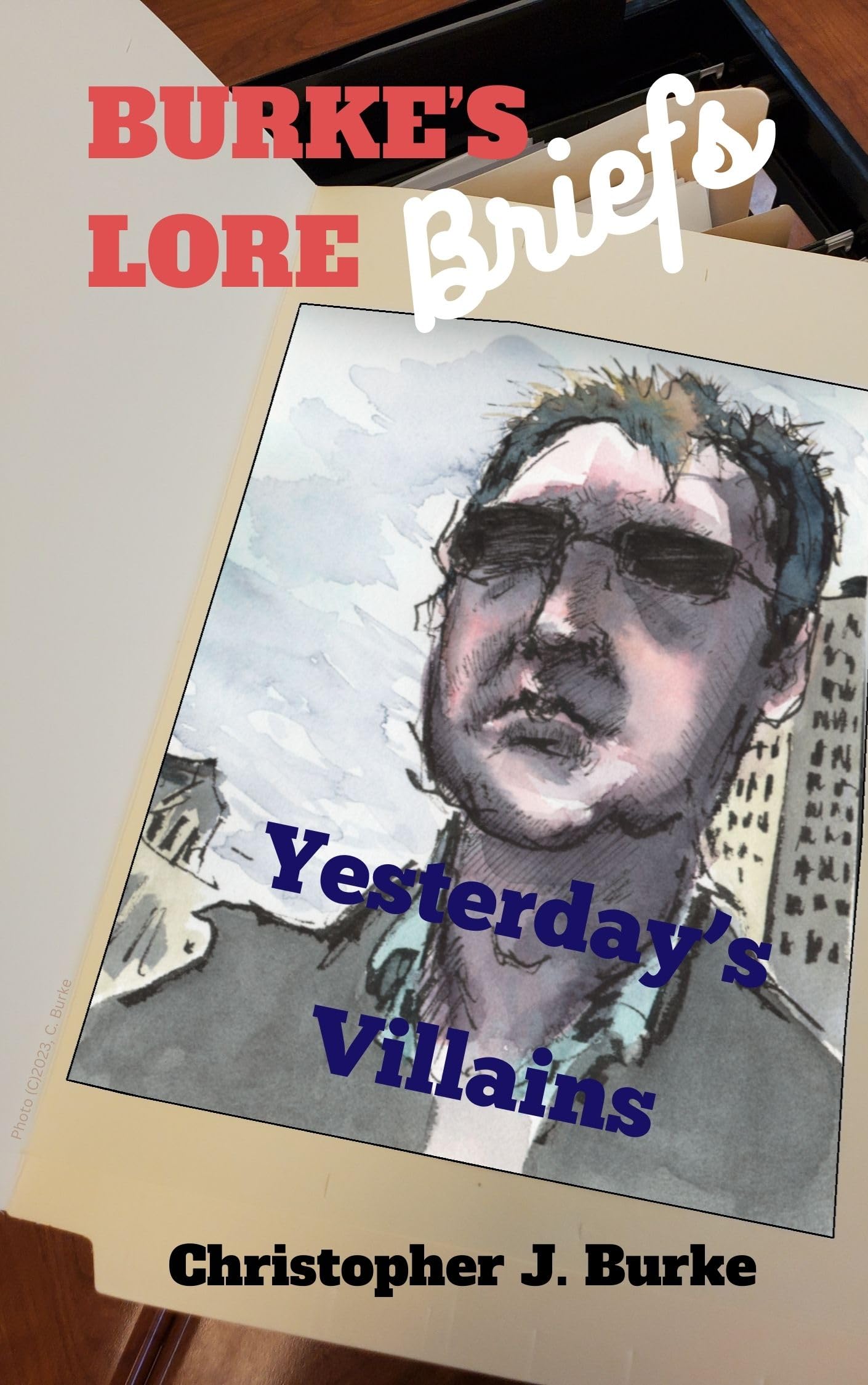 |
 |
|
My older books include three more books in my Burke's Lore Briefs series, and the anthologies A Bucket Full of Moonlight and In A Flash 2020. Vampires, werewolves, angels, demons, used-car salesmen, fairies, superheroes, space and time travel, and little gray aliens talking to rock creatures and living plants. Plus pirates, spies, horror, and kindergarten noir! If you enjoy my books, please consider leaving a rating or review on Amazon or on Good Reads. Thank you! |
 |
 |

|
 |
 |



No comments:
Post a Comment