Saturday, June 11, 2016

Daily Regents: Area of a Sector of a Circle (June 2015) Geometry

I'll be reviewing a New York State Regents Exam Question every day from now until the Regents exams next week. At least, that is the plan.

Common Core Geometry, June 2015, Questions 29

29. In the diagram below of circle O, the area of the shaded sector AOC is 12*pi in2and the length of OA is 6 inches. Determine and state m<AOC.

As shown in the illustration below, the ratio of the area of the sector of a circle to the whole circle is proportional to the measure of the central angle to 360 degrees.

In other words, whatever fraction of the area is shaded in, multiply that same fraction times 360 degrees to get the measure of the central angle of the sector.

Since area is pi*r2, the area of the circle is (6)2pi or 36pi. The sector is 12pi. (12 pi) / (36 pi) = 1/3. The shaded sector is 1/3 of the circle.
Multiply 1/3 times 360, and the central angle is 120 degrees.


Any questions?


If anyone in Brooklyn is looking for an Algebra or Geometry Regents Prep tutor, send me a note. I have a couple of weekly spots available between now and June.


Friday, June 10, 2016

Daily Regents:Trigonometric Ratios (June 2015)

I'll be reviewing a New York State Regents Exam Question every day from now until the Regents exams next week. At least, that is the plan.

Geometry, June 2015, Questions 28

27. The diagram below shows a ramp connecting the ground to a loading platform 4.5 feet above the ground. The ramp measures 11.75 feet from the ground to the top of the loading platform.

Determine and state, to the nearest degree, the angle of elevation formed by the ramp and the ground.

A trigonometric ratio problem. The height of the platform is opposite the angle. The ramp is the hypotenuse. This means we have the sine ratio for the angle.

sin x = (4.5 / 11.75)


Any questions?


If anyone in Brooklyn is looking for an Algebra or Geometry Regents Prep tutor, send me a note. I have a couple of weekly spots available between now and June.


Thursday, June 09, 2016

Daily Regents: Coordinate Geometry (June 2015)

I'll be reviewing a New York State Regents Exam Question every day from now until the Regents exams next week. At least, that is the plan.

Geometry, June 2015, Questions 27

27. The coordinates of the endpoints of AB are A(-6, -5) and B(4, 0). Point P is on AB.
Determine and state the coordinates of point P, such that AP:PB is 2:3.
[The use of the set of axes below is optional.]

You could solve this by graphing or algebraically. (Algebra shows up in Geometry all the time!)

A ratio of 2:3 means 2/5ths and 3/5ths of the line.
The difference in the x-coordinates is 10. Two-fifths of 10 is 4, and -6 + 4 is -2, the x coordinate for P.
The difference in the y-coordinates is 5. Two-fifths of 5 is 2, and -5 + 2 is -3, the y coordinate for P.

P is at (-2, -3).

See image below for details.


Any questions?


If anyone in Brooklyn is looking for an Algebra or Geometry Regents Prep tutor, send me a note. I have a couple of weekly spots available between now and June.


Wednesday, June 08, 2016

Daily Regents: Parallelograms (June 2015) Geometry

I'll be reviewing a New York State Regents Exam Question every day from now until the Regents exams next week. At least, that is the plan.

Geometry, June 2015, Questions 26

26. The diagram below shows parallelogram LMNO with diagonal LN, m<M = 118o, and m<LNO = 22o.
Explain why m<NLO is 40 degrees.

The opposite angles of a parallelogram are congruent. Therefore, m<O = 118o.
Triangle LNO has 180 degrees, so m<NLO + m<LON + m<LNO = 180
m<NLO + 118 + 22 = 180
m<NLO + 140 = 180
m<NLO = 40 degrees.


Any questions?


If anyone in Brooklyn is looking for an Algebra or Geometry Regents Prep tutor, send me a note. I have a couple of weekly spots available between now and June.


Tuesday, June 07, 2016

Daily Regents: Systems of Inequalities (August 2014)

I'll be reviewing a New York State Regents Exam Question every day from now until the Regents exams next week. At least, that is the plan.

August 2014, Questions 37

37. Edith babysits for x hours a week after school at a job that pays $4 an hour. She has accepted a job that pays $8 an hour as a library assistant working y hours a week. She will work both jobs. She is able to work no more than 15 hours a week, due to school commitments. Edith wants to earn at least $80 a week, working a combination of both jobs.
Write a system of inequalities that can be used to represent the situation. Graph these inequalities on the set of axes below.

Determine and state one combination of hours that will allow Edith to earn at least $80 per week while working no more than 15 hours.

If one job pays $4 per hour and she works x hours, she makes 4x dollars. If the other job pays $8 per hour and she works y hours, then she makes 5y dollars. The total is 4x + 8y, which must be greater than or equal to $80, so
4x + 8y > 80

If the total number of hours worked about both jobs must be less than or equal to 15 hours, then
x + y < 15

That is the system of inequalities to graph. Both lines will be solid. The one for her pay will be shaded above. The one for her hours will be shaded below.

You can graph these by finding the x- and y-intercepts, or by re-writing them in y-intercept form and putting them in the graphing calculator.

4x + 8(0) = 80
4x = 80
x = 20, (20, 0)
4(0) + 8y = 80
8y = 80
y = 10, (0, 10)
x + (0) = 15
x = 15, (15, 0)
(0) + y = 15
y = 15, (0, 15)

The answer to the second part varies. You can pick any part in the double-shaded region, S. Since the lines are solid, those boundary points are good as well.
So 0 hours babysitting and 10 hours at the library, or 3 hours babysitting and 9 hours at the library.

See image below.


Any questions?


If anyone in Brooklyn is looking for an Algebra or Geometry Regents Prep tutor, send me a note. I have a couple of weekly spots available between now and June.


Monday, June 06, 2016

Daily Regents: Rational Plus Irrational (January 2015)

I'll be reviewing a New York State Regents Exam Question every day from now until the Regents exams begin next month. At least, that is the plan.

January 2015, Questions 25

36. Ms. Fox asked her class “Is the sum of 4.2 and SQRT(2) rational or irrational?” Patrick answered that the sum would be irrational.
State whether Patrick is correct or incorrect. Justify your reasoning.

The sum of any rational and irrational number is always irrational.
An irrational number has a non-repeating, non-terminating decimal. Adding .2 to the decimal would not make it repeat or terminate.

4.2 + 1.4142135623746.... = 5.6142135623746....


Any questions?


If anyone in Brooklyn is looking for an Algebra or Geometry Regents Prep tutor, send me a note. I have a couple of weekly spots available between now and June.


Sunday, June 05, 2016

June 2016 Integrated Algebra Regents, Part IV

On June 2, 2016, New York State gave a special Integrated Algebra Regents exam, which only seniors and "super seniors" were eligible to take. Those were the students who entered high school prior to the implementation of Common Core. This test follows the older curriculum.

I am currently scoring exams, and while I cannot talk about that specifically, I do have a copy of the questions. The work you see below is mine, written on photocopies of the pages that they gave me for scoring purposes.

A cleaner, fuller (and possibly more clear) explanation of the problems may come at a future date. However, this is likely the last time that this test will be administered. Then again, they have said that before.

Part IV

All questions in this section were open-ended and worth 4 points. A computational, graphing or rounding error cost 1 point. A conceptual error (e.g., using the wrong formula) cost 2 points.

37. On the set of axes below, solve the following system of equations graphically for all values of x and y. State the coordinates of all solutions.

y = x2 - 4x - 5
y + 3x = 1

You can put the first equation in your graphing calculator to get the table of values for the parabola.
To put the linear equation into the calculator, you first had to subtract 3x from both sides of the equation. This gives you y = -3x + 1.

The graph is shown below. The points of intersection are (-2, 7) and (3, -8).

See image below:

38. Express in simplest form: (x2 + 5x + 6)/(x2 - x - 12) : (x2 + x - 6)/(2x - 10)

First, flip over the second fraction and change the problem to a multiplication problem.

I worked out the rest on the test paper. This is too complicated for markup language.
Either answer is acceptable: the factored answer or the multiplied answer.

See image below:

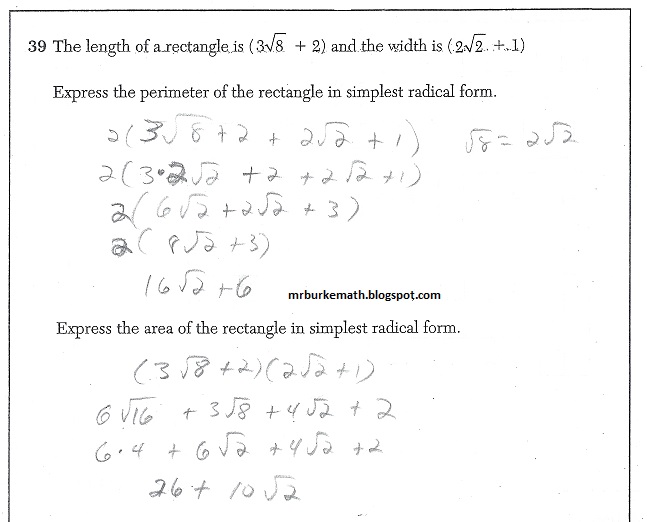
39. The length of a rectangle is (3*SQRT(8) + 2) and the width is (2*SQRT(2) + 3).
Express the perimeter of the rectangle in simplest radical form.
Express the area of the rectangle in simplest radical form.

A few notes, and then I'll leave the work to the image.
Perimeter is 2L + 2W or 2(L + W).
Area is L * W.
SQRT(8) is simplest radical form is SQRT(4*2) = SQRT(4)*SQRT(2) = 2*SQRT(2).
Terms with SQRT(2) in them can be added just as terms with 'x' could.

See image below:


How did you do?

Any questions?


If anyone in Brooklyn is looking for an Algebra or Geometry Regents Prep tutor, send me a note. I have a couple of weekly spots available between now and June.


Saturday, June 04, 2016

June 2016 Integrated Algebra Regents, Part III

On June 2, 2016, New York State gave a special Integrated Algebra Regents exam, which only seniors and "super seniors" were eligible to take. Those were the students who entered high school prior to the implementation of Common Core. This test follows the older curriculum.

I am currently scoring exams, and while I cannot talk about that specifically, I do have a copy of the questions. The work you see below is mine, written on photocopies of the pages that they gave me for scoring purposes.

A cleaner, fuller (and possibly more clear) explanation of the problems may come at a future date. However, this is likely the last time that this test will be administered. Then again, they have said that before.

Part III

All questions in this section were open-ended and worth 3 points. A computational or rounding error cost 1 point. A conceptual error (e.g., using the wrong formula) cost 2 points. One of each cost all 3 points, and the answer -- despite the amount of work -- is worth 0. (There are exceptions, where the rubric states a point is awarded for finding a specific checkpoint in the middle of the problem and then not having any correct work afterward.)

34. Ryan bought three bags of mixed tulip bulbs at a local garden store. The first bag contained 7 yellow bulbs, 8 red bulbs, and 5 white bulbs. The second bag contained 3 yellow bulbs, 11 red bulbs, and 6 white bulbs. The third bag contained 13 yellow bulbs, 2 red bulbs and 5 white bulbs. Ryan combined the contents of these three bags into a single container. He randomly selected one bulb, planted it, and then randomly selected another and planted that one. Determine if it is more likely that Ryan planted a red bulb and then another red bulb, or planted a yellow bulb and then a white bulb. Justify your answer.

You needed to find the compound probabilities of two dependent event (without replacement) and compare the two.
There was no guideline in the rubric, and it didn't come up in our discussion, if you only found the number of outcomes and compared the two with the proper justification.

When added together, there were 23 yellow, 21 red and 16 white for a total of 60 bulbs. There would only be 59 when drawing the second bulb.

P(R then R) = (21 / 60) * (20 / 59) = 420/3540
P(Y then W) = (23 / 60) * (16 / 59) = 368/3540
Therefore, it is more likely that he would get red then red.

Note: some students did write these numbers are decimals or percents. Their math was checked for accuracy (no rounding needed), and then the comparison.

See image below:

35. A particular jewelry box is in the shape of a rectangular prism. The box is advertised as having an interior length of 20.3 centimeters, an interior width of 12.7 centimeters, and an interior height of 10.2 centimeters. However, when a customer measures the interior of the box, she finds that the interior height is actually 6.3 centimeters. Upon further examination, she discovers that the bottom of the interior of the box lifts up to reveal a hidden compartment. Find the volume of this hidden compartment to the nearest cubic centimeter.

Rounding matters. The right formula matters.

I was ready to go off on a rant (and I did, on Twitter) because so many students lost 2 of the 3 points because they used the formula for Surface Area. This meant that they had to do a lot more work -- and do it perfectly -- to get a single point. A rounding error and it would be zero.

Why did so many students do Surface Area? My guess: the formula is in the back of the book. Volume = Length X Width X Height is not, likely because it's so easy that every student should know it. But for whatever reasons, these students didn't.

The height of the hidden compartment was 10.2 - 6.3 = 3.9. Volume = 12.7 X 20.3 X 3.9 = 1005.459 = 1005 cm3.
Rounding before you multiplied was a 1-point error.

Alternatively, you could have calculated Volume = 12.7 X 20.3 X 10.2 = 2629.662 and Volume = 12.7 X 20.3 X 6.3 = 1624.283 and then subtracted to get the same answer. More work, but not incorrect.

See image below:

36. Solve algebraically for all values of x that satisfy the equation: x / (x + 4) = 3 / (x + 2)

Cross-multiply the numerators and denominators. Use the Distributive Property.
This gives you x2 + 2x = 3x + 12
Subtract everything from the right side to get: x2 - x - 12 = 0. (This was good enough for 1 point.)
Factor: (x - 4)(x + 3) = 0
x - 4 = 0 or x + 3 = 0
x = 4 or x = -3

Note: If you made a computational error, you probably had a problem factoring. However, if you used the Quadratic Formula and followed through to get an answer, however complicated it might have been, it would only be a 1-point error. We had a couple of these.

See image below:


How did you do?

Any questions?


If anyone in Brooklyn is looking for an Algebra or Geometry Regents Prep tutor, send me a note. I have a couple of weekly spots available between now and June.


Friday, June 03, 2016

Yoda, Math Teacher

(Click on the comic if you can't see the full image.)
(C)Copyright 2016, C. Burke.

Yoda Man! Yoda Real MVP! Yoda -- except that wouldn't work in Yoda-speak. Sigh.

It's not y.


Come back often for more funny math and geeky comics.


Daily Regents: Quadratic Equations with Area (August 2016)

I'll be reviewing a New York State Regents Exam Question every day from now until the Regents exams begin next month. At least, that is the plan.

August 2014, Questions 36

36. A school is building a rectangular soccer field that has an area of 6000 square yards. The soccer field must be 40 yards longer than its width. Determine algebraically the dimensions of the soccer field, in yards.

Area of a rectangle is L * W. This is important: this formula will NOT be given to you because they assume you learned it in or before middle school. Seriously: it's A = L* W.

The width of the field can be called W. That means that the length is 40 more than the width, so L = W + 40.
The Area = L * W = W(W + 40) = 6000.

Distribute the W, and you get W2 + 40W = 6000
Subtract 6000 from both sides: W2 + 40W - 6000 = 0. You have a quadratic equation that needs to be factored.

The factors of -6000 with a sum of +40 are 100 and -60.
So (W + 100)(W - 60) = 0
Then W + 100 = 0 or W - 60 = 0
And W = -100 or W = 60.

Because we are looking for width, we can discard the negative value, and use the positive value. The width is 60. The length is 60 + 40 = 100.


Any questions?


If anyone in Brooklyn is looking for an Algebra or Geometry Regents Prep tutor, send me a note. I have a couple of weekly spots available between now and June.


Thursday, June 02, 2016

June 2016 Integrated Algebra Regents, Part II

On June 2, 2016, New York State gave a special Integrated Algebra Regents exam, which only seniors and "super seniors" were eligible to take. Those were the students who entered high school prior to the implementation of Common Core. This test follows the older curriculum.

I am currently scoring exams, and while I cannot talk about that specifically, I do have a copy of the questions. The work you see below is mine, written on photocopies of the pages that they gave me for scoring purposes.

A cleaner, fuller (and possibly more clear) explanation of the problems may come at a future date. However, this is likely the last time that this test will be administered. Then again, they have said that before.

Part II

All questions in this section were open-ended and worth 2 points.

31. Jim calculated the area of a triangle to be 51.75 cm2. The actual area of the triangle is 53.24 cm2. Find the relative error in Jim's calculation of the area to the nearest thousandth.

Relative error is defined as the difference between the two amounts divided by the actual amount. Write the answer as a decimal. Do NOT convert to a percent.

53.24 - 51.75 = 1.49.
1.49 / 53.24 = 0.028 to the nearest thousandth. (Not rounding correctly will cost you one of the two points.)

See image below:

32. A 12-foot ladder is placed against a wall. The ladder makes an angle of 73o with the floor. Determine, to the nearest tenth of a foot, how high up the wall the ladder will reach.

You are given the hypotenuse and you are looking for the side opposite the given angle. That means that you need to use sine, which is opposite / hypotenuse.

sin 73 = x / 12
So 12 * sin 73 = x. You can put this in your calculator, which must be in degree mode.

x = 11.5, to the nearest tenth. Again, correct rounding is important.

Using the wrong trig function will cost you half credit (one point). Two mistakes mean 0 credits.

See image below:

33. On the sets of axes below, draw the graph of the function y = 3x. Include the interval -2 < x < 2.

You can make a table of values or just plot points to show your work: (2, 9), (1, 3), (0, 1), (-1, 1/3), (-2, 1/9). The last two would be approximate to graph. This is to be expected. You might want to label them, but the rubric didn't say it was required.

Draw the curve through the points.

See image below:


How did you do?

Any questions?


If anyone in Brooklyn is looking for an Algebra or Geometry Regents Prep tutor, send me a note. I have a couple of weekly spots available between now and June.


Wednesday, June 01, 2016

Daily Regents: Quad-Linear Systems (August 2014)

I'll be reviewing a New York State Regents Exam Question every day from now until the Regents exams begin next month. At least, that is the plan.

August 2014, Questions 35

35. Let f(x)= -2x2 and g(x) = 2x - 4. On the set of axes below, draw the graphs of y = f(x) and y = g(x).

Using this graph, determine and state all values of x for which f(x) =g(x).

Using your graphing calculator, find the points from each function.
The linear function, g(x) has a y-intercept of -4 and a slope of +2.
The quadratic function, f(x) is a parabola with the origin as its vertex and it will open downward.

The two lines will intersect twice: at (-2, -8) and at (1, -2). They do NOT ask for the points of intersection. You are asked only for the x values. The x values are -2 and 1.

Believe it or not, if you give coordinates, you could actually lose a point for not answering the question that was asked.


Any questions?


If anyone in Brooklyn is looking for an Algebra or Geometry Regents Prep tutor, send me a note. I have a couple of weekly spots available between now and June.