This exam was adminstered in August 2025.
More Regents problems.
August 2025 Geometry Regents
Part I
Each correct answer will receive 2 credits. No partial credit.
9. On the set of axes below, △D'E'F' is the image of △DEF.

A transformation that maps △DEF onto △D'E'F' is a
(1) reflection over the line y = x
(2) reflection over the line y = - x
(3) point reflection through the origin
(4) translation 4 units left and 4 units down
Answer: (3) point reflection through the origin
A point reflection through the origin is the same as a 180 degree rotation. Choice (3) is the correct answer.
In Choice (1), a reflection over y = x would have the image in Quadrant I not III. Eliminate Choice (1).
In Choice (2), a reflection over y = -x would have E' closer to the x-axis and F' closer to the y-axis. The orientation is not correct for a reflection. Eliminate Choice (2).
In Choice (4), a translation doesn't change the orientation of the original shape, but D'E'F' has a different orientation. Eliminate Choice (4).
If PA = 17, PD = 10, and BD = 12, what is the length of PC, to the nearest tenth?
10. In circle O below, secants PCA and PDB are drawn from external point P.

(1) 7.1
(2) 7.7
(3) 12.9
(4) 14.2
Answer: (3) 12.9
The product of the length of the secant line times the length of the line that is outside the circle (PC, PD) will be equal for all of the secant lines.
That is to say: (PA)(PC) = (PB)(PD)
(17)(PC) = (10 + 12)(10)
17 (PC) = 220
PC = 220 / 17 = 12.94..., or 12.9
Choice (3) is the correct answer.
11. In the diagram below, CD || AB, and CB bisects ∠ABD.

Which statement must be true?
(1) CD ≅ AB
(2) AB ≅ BD
(3) △CDB is a right triangle
(4) △SNA is an isosceles triangle
Answer: (4) △SNA is an isosceles triangle
BC and BD are transversals crossing parallel lines. The means that ∠ABC ≅ ∠BCD. CB bisects ∠ABD, so ∠ABC ≅ ∠CBD. Since two angles in the triangle are congruent, then the triangle is an isosceles triangle.
Choice (4) is the correct answer.
12. Line h is represented by the equation y = 2/3 x - 4. Which equation represents the line that is perpendicular to line h and passes through the point (6,1)?
(1) y - 1 = 2/3(x - 6)
(2) y + 1 = 2/3(x + 6)
(3) y - 1 = -3/2(x - 6)
(4) y + 1 = -3/2(x + 6)
Answer: (3) y - 1 = -3/2(x - 6)
A line perpendicular to a line with a slope of 2/3 would have a slope of -3/2. Eliminate Choice (1) and (2).
Point slope form is y - h = m(x - k), with two minus signs. Those signs will flip to plus if the coordinate is negative. The slope of the line is m, and (h,k) is a point on that line.
Choice (3) is the correct answer.
Choice (4) goes through the point (-6,-1).
13. A wooden toy block can be modeled by a pyramid with a square base,
as shown below. The height of the block is 17.4 cm and the square
base has a side length of 8.2 cm.

The block is made of solid oak, which has a density of 0.77 g/cm3.
What is the mass of the block, to the nearest gram?
(1) 300
(2) 506
(3) 637
(4) 901
Answer: (1) 300
The Volume of a pyramid is 1/3 the Area of the Base times the height. The Area of the square base is s2. Density is mass divided by the Volume, so mass is equal to Density times Volume.
V = 1/3 (8.2)(8.2)(17.4) = 389.992
389.992 * 0.77 = 300.29..., which rounds to 300. Choice (1) is the correct answer.
If you forgot the (1/3), you would've gotten 901, which is Choice (4).
If you squared 17.4 instead of 8.2, you would've gotten 637, which is Choice (3).
If you found the correct Volume but divided by the Density, then you would've gotten 506, which is Choice (2).
14. In △ABC below, midsegment DE is drawn.

If DE = x + 3 and AC = 3x - 5, what is the length of DE?
(1) 28
(2) 14
(3) 7
(4) 4
Answer: (2) 14
Since DE is a midsegment, it is half the size of AC. That is, AC is twice the size of DE.
AC = 2 DE
3x - 5 = 2(x + 3)
3x - 5 = 2x + 6
x = 11
If x = 11, the DE = x + 3 = 11 + 3 = 14, which is Choice (2).
15. Triangle DUG is an isosceles right triangle with the right angle at G. If DU = 10√(2), what is the length of GU?
(1) 5
(2) 5√(2)
(3) 10
(4) 10√(2)
Answer: (3) 10
Side DU is the hypotenuse, not a leg. The two legs are congruent. The acute angles are each 45 degrees.
If you forgot the rules for Special Right Triangles, such as 45-45-90 (right isosceles), you can figure it out using Pythagorean Theorem.
x2 + x2 = (10√(2))2
2x2 = 200
x2 = 100
x = 10
Choice (3) is the correct answer.
What is the area of △RST, to the nearest square centimeter?
16. In △RST below, RS = 9 cm, RT = 8 cm, and m∠TRS = 55°.

(1) 59
(2) 36
(3) 29
(4) 21
Answer: (3) 29
Use the Law of Sines, A = 1/2 ab sin(C) to find the area, where a and b are sides of the triangle (not base and altitude) and C is the included angle between them.
A = 1/2 (8) (9) sin(55) = 29.4..., which rounds to 29.
Choice (3) is the correct answer.
More to come. Comments and questions welcome.

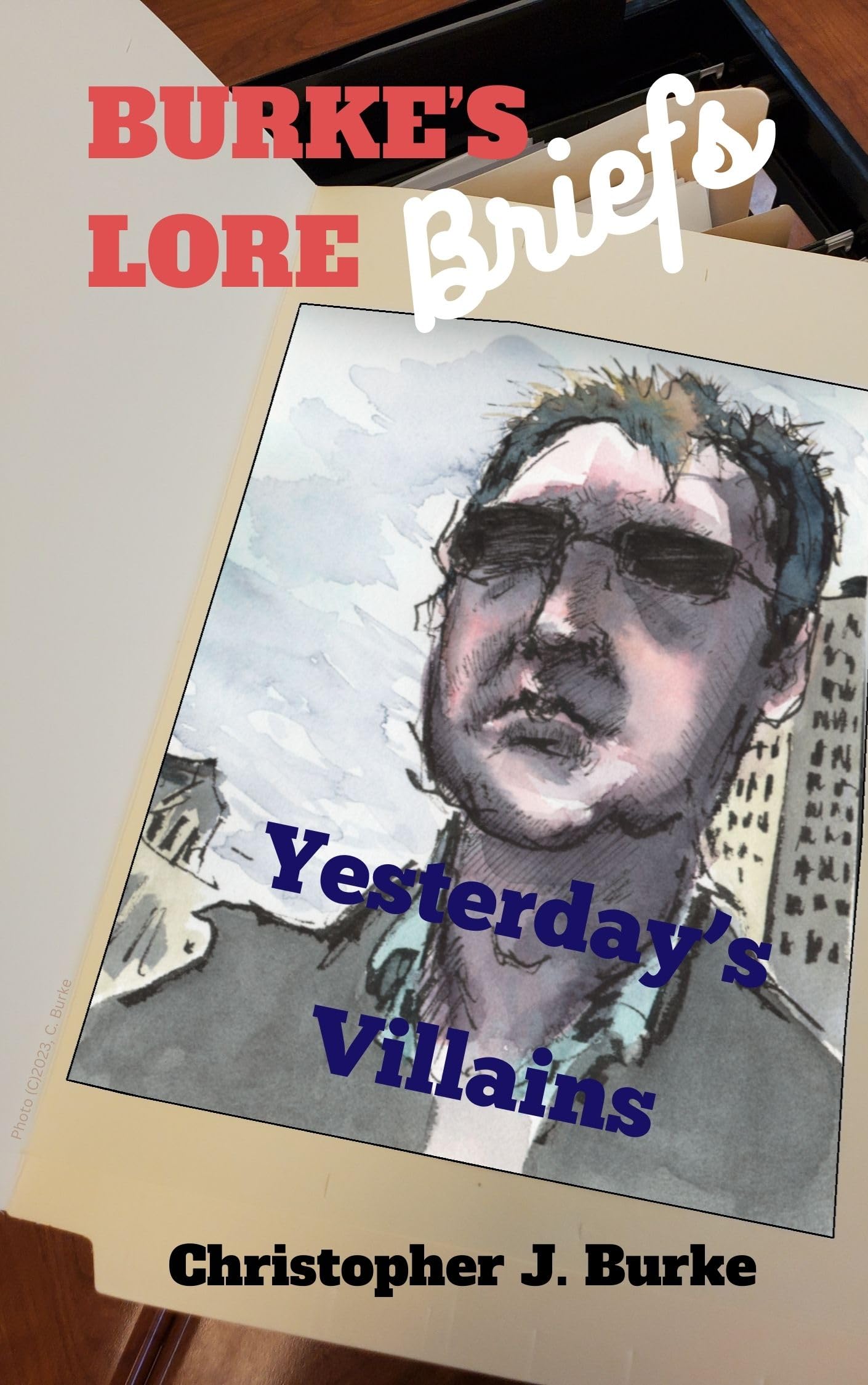
MY NEWEST BOOK IS OUTBurke's Lore Briefs: Yesterday's Villains, the following to Tomorrow's Heroes is now available on Amazon and Kindle Unlimited. If Heroes who don't die live long enough to become the villain, what happens to Villains who live long enough? When do schemes of global conquest become dreams of a quiet place away from all those annoying people you once wanted to subjugate? And does anyone really want to rule over the world's ashes if it means we can't have nice things? |
 |
 |
|
My older books include three more books in my Burke's Lore Briefs series, and the anthologies A Bucket Full of Moonlight and In A Flash 2020. Vampires, werewolves, angels, demons, used-car salesmen, fairies, superheroes, space and time travel, and little gray aliens talking to rock creatures and living plants. Plus pirates, spies, horror, and kindergarten noir! If you enjoy my books, please consider leaving a rating or review on Amazon or on Good Reads. Thank you! |
 |
 |

|
 |
 |