Thursday, July 20, 2023

June 2023 Algebra 1 Regents Part IV


This exam was adminstered in June 2023. These answers were not posted until after the Independence Holiday weekend, well after the school year ednded.

More Regents problems.

June 2023

Part IV: Each correct answer will receive 6 credits. Partial credit can be earned.


37. Dana went shopping for plants to put in her garden. She bought three roses and two daisies for $31.88. Later that day, she went back and bought two roses and one daisy for $18.92.

If r represents the cost of one rose and d represents the cost of one daisy, write a system of equations that models this situation. Use your system of equations to algebraically determine both the cost of one rose and the cost of one daisy.

If Dana had waited until the plants were on sale, she would have paid $4.50 for each rose and $6.50 for each daisy. Determine the total amount of money she would have saved by buying all of her flowers during the sale.


Answer:


Write a system of equations. Remember to use r and d, not x and y. It will be solved the same way.

The second sentence tells us 3r + 2d cost 31.88. The third sentence says that 2r + 1d cost 18.92. So:

3r + 2d = 31.88
2r + d = 18.92

You can use either elimination or substition to solve this. To use substitution, rewrite the second equation as

d = -2r + 18.92
and then substitute it into the first equation.
3r + 2(-2r + 18.92) = 31.88
and solve for r.

Or use elimination, by multiplying the second equation by 2.

3r + 2d = 31.88
2r + d = 18.92

3r + 2d = 31.88
4r + 2d = 37.84

-r= -5.96
r = 5.96

1 rose costs $5.96.

2(5.96) + d = 18.92
11.92 + d = 18.92
d = 7

1 daisy costs $7.00.

The final portion of the question could be answered even if you didn't solve the system of equations. It could be solved even if you didn't WRITE the system of equations.

You already know how much money Dana spent. It's in the problem. Find how much she would have spent with the flowers on sale, and then subtract the two numbers.

(31.88 + 18.92) - (5*(4.50) + 3(6.50)) = $8.80

She would've saved $8.80.

As far as Part IV problems go, this one wasn't particularly difficult. It was basically a Part III question with an additional problem tacked onto the end of it.


End of Exam

How did you do?


More to come. Comments and questions welcome.

More Regents problems.

I also write Fiction!


You can now order Devilish And Divine, edited by John L. French and Danielle Ackley-McPhail, which contains (among many, many others) three stories by me, Christopher J. Burke about those above us and from down below.
Preorder the softcover or ebook at Amazon.

Also, check out In A Flash 2020, by Christopher J. Burke for 20 great flash fiction stories, perfectly sized for your train rides.
Available in softcover or ebook at Amazon.

If you enjoy it, please consider leaving a rating or review on Amazon or on Good Reads.


Tuesday, July 18, 2023

June 2023 Algebra 1 Regents Part III


This exam was adminstered in June 2023. These answers were not posted until after the Independence Holiday weekend, well after the school year ednded.

More Regents problems.

June 2023

Part III: Each correct answer will receive 4 credits. Partial credit can be earned.


33. Graph f(x) = |x| + 1 and g(x) = -x2 + 6x + 1 on the set of axes below.
Based on your graph, determine all values of x for which f(x) = g(x).


Answer:


Put both of these equations into your graphing calculator and check the table of values. Make sure you either draw off the edge of the chart, or include arrows at your endpoints. And draw enough to show all the points of intersection. And remember to label at least one of the lines.

Your graph should look like this:

The values of x where f(x) = g(x) are 0 and 5.

Do NOT write coordinates. They asked for x values.


34. Jean recorded temperatures over a 24-hour period one day in August in Syracuse, NY. Her results are shown in the table below.


Her data are modeled on the graph below.

State the entire interval over which the temperature is increasing.
State the three-hour interval that has the greatest rate of change in temperature.
State the average rate of change from hour 12 to hour 24. Explain what this means in the context of the problem.

Answer:


Increasing means where there's a positive slope on the graph. The graph is increasing between hour 6 and hour 12. You could write it as [6,12] or 6 < x < 12, or just write it in words from 6 to 12. Whether it is an open or closed interval is debatable at this level, so either answer would've been accepted. College professors are free to argue otherwise in the comments, or to write to NY State and tell them that they are big doody heads.

The interval with the greatest rate of change would be the same as the one with the steepest slope. It is obvious from the graph, but you could measure the rise over run, that the hours from 9 to 12 have the greatest change. Note that it doesn't say positive change. However 9 to 12 is steeper in a positive direction than any of the negative slopes in the chart.

The average rate of change from hours 12 to 24 is the slope between (12,92) and (24,74).
(74 - 92) / (24 - 12) = -18/12 = -3/2.
In the context of this problem, the temperature was dropping 3 degrees every 2 hours.


35.Solve the following system of inequalities graphically on the set of axes below.
2x + 3y > -6
x < 3y + 6

Label the solution set S.

Is the point (4,-2) in the solution set?
Explain your answer.


Answer:


If you can graph the first inequality, which is in Standard Form, great! If not, rewrite it along with the second one in slope-intercept form so you can graph it.

2x + 3y > -6
3y > -2x - 6
y > -2/3 x - 2

x < 3y + 6
-3y < -x + 6
y > 1/3 x - 2

Notes: Both lines will have y-intercept at (0,-2). The first inequality has a solid line with a negative slope. The second inequality will have a broken (or dashed) line and a positive slope. Both inequalities will be shaded above their lines.

Your graph will look like this. The S will go in the top section, which is shaded twice with the crisscross pattern. Remember to label at least one of the lines, and use the original inequalities, not the ones you put in your calculator.

No, (4,-2) in not in the solution set. It is not in the section label S. It is in a section that is only a solution to one of the inequalities. (Phrase it however you like.)

NOTE: If you make a graphing error, such as shading below the dashed line, then (4,-2) may be in the solution set of your graph. If so, then your answer will be Yes. You will not be penalized twice. (You will lose a point for the graphing error.)


36. Suzanna collected information about a group of ponies and horses. She made a table showing the height, measured in hands (hh), and the weight, measured in pounds (lbs), of each pony and horse.

Write the linear regression equation for this set of data. Round all values to the nearest hundredth.
State the correlation coefficient for the linear regression. Round your answer to the nearest hundredth.
Explain what the correlation coefficient indicates about the linear fit of the data in the context of the problem.

Answer:


Enter the data into Lists L1 and L2 on your calculator. Run the linear regression. If you didn't get values for r and r2, then you need to run the command DiagonsticsOn from the Catalog. You will need the r value.

When you run the linear regression, you will get a = 184.89 and b = 1706.07, to the nearest hundredth.
So the equation will be y = 184.89x - 1706.07.

The correlation coefficient is 0.99, which is the value of r to two decimal places.

The context is this: As the height of the horse increases, the weight of the horse increases.

If you said that there's a strong positive correlation, that would be true, but it wouldn't state the context of the problem.


End of Part III

How did you do?


More to come. Comments and questions welcome.

More Regents problems.

I also write Fiction!


You can now order Devilish And Divine, edited by John L. French and Danielle Ackley-McPhail, which contains (among many, many others) three stories by me, Christopher J. Burke about those above us and from down below.
Preorder the softcover or ebook at Amazon.

Also, check out In A Flash 2020, by Christopher J. Burke for 20 great flash fiction stories, perfectly sized for your train rides.
Available in softcover or ebook at Amazon.

If you enjoy it, please consider leaving a rating or review on Amazon or on Good Reads.


June 2023 Geometry Regents Part III


This exam was adminstered in January 2023. These answers were not posted until they were unlocked on the NY Regents website or were posted elsewhere on the web.

June 2023 Geometry, Part III

Each correct answer is worth up to 4 credits. Partial credit can be given. Work must be shown or explained.


31. Cape Canaveral, Florida is where NASA launches rockets into space. As modeled in the diagram below, a person views the launch of a rocket from observation area A, 3280 feet away from launch pad B. After launch, the rocket was sighted at C with an angle of elevation of 15o. The rocket was later sighted at D with an angle of elevation of 31o.


Determine and state, to the nearest foot, the distance the rocket traveled between the two sightings, C and D.

Answer:


To find the length of CD, you need to find the length of BD and BC and then subtract BD - BC. In both cases, you have the angle and the adjacent side and you are looking for the opposite side, so you want to use tangent ratios.

tan 15 = x/3280, so x = 3280 * tan 15 = 878.873..

tan 31 = y/3280, so y = 3280 * tan 31 = 1970.822..

CD = 1970.822 - 878.873 = 1091.949 = 1092 feet.


33. TA small can of soup is a right circular cylinder with a base diameter of 7 cm and a height of 9 cm. A large container is also a right circular cylinder with a base diameter of 9 cm and a height of 13 cm. Determine and state the volume of the small can and the volume of the large container to the nearest cubic centimeter.

What is the minimum number of small cans that must be opened to fill the large container? Justify your answer.

Answer:


I can't tell you (because even if I remembered, I couldn't disclose it) the number of students who missed up the second part of the question.

The question gives diameters, but the formula uses radius. Halve each number.

V(sm) = π (3.5)2(9) = 346.36... = 346 cm3

V(lg) = π (4.5)2(13) = 827.024... = 827 cm3

For the second part, divide the volume of the larger can by the volume of the smaller can. And then round UP. If you don't round up, you won't fill the larger can.

827/346 = 2.39..., so you would need to open 3 cans.


34. Parallelogram MATH has vertices M(-7,-2), A(0,4), T(9,2), and H(2,-4).
Prove that parallelogram MATH is a rhombus.
[The use of the set of axes below is optional.]

Determine and state the area of MATH.

Answer:


You probably want to plot the points just to make it easier to visualize, but it isn't necessary.

You must either show that the four sides have the same length, or you must show that the diagonals are perpendicular and bisect each other. It is not enough to show that the diagonals are perpendicular because the diagonals of a kite are perpendicular also.

MA: √( (-7 - 0)2 + (-2 - 4)2 ) = √ (85)

AT: √( (0 - 9)2 + (4 - 2)2 ) = √ (85)

TH: √( (9 - 2)2 + (2 - -4)2 ) = √ (85)

MA: √( (2 - -7)2 + (-4 - -2)2 ) = √ (85)

All four sides are congruent, so MATH is a rhombus. This concluding statment is required.

The easiest way to find the area of the rhombus is to draw a rectangle around it that has points M, A, T, and H on each of its sides. Four triangles will be formed. Find the area of the rectangle and subtract the areas of the four triangles.

You have the numbers that you need -- you found the rise and run when you did the distance formula!

The rectangle has an area of 16 * 8 = 128. The four triangles have areas of 1/2(6)(7) = 21, 1/2(9)(2) = 9, 1/2(6)(7) = 21, and 1/2(9)(2) = 9.

So 128 - (21 + 9 + 21 + 9) = 68

You could also have found the lengths of the two diagonals and multiplied 1/2 d1d2.

End of Part III

How did you do?

Questions, comments and corrections welcome.

I also write Fiction!


You can now order Devilish And Divine, edited by John L. French and Danielle Ackley-McPhail, which contains (among many, many others) three stories by me, Christopher J. Burke about those above us and from down below.
Preorder the softcover or ebook at Amazon.

Also, check out In A Flash 2020, by Christopher J. Burke for 20 great flash fiction stories, perfectly sized for your train rides.
Available in softcover or ebook at Amazon.

If you enjoy it, please consider leaving a rating or review on Amazon or on Good Reads.


Wednesday, July 05, 2023

June 2023 Geometry Regents Part II


This exam was adminstered in January 2023. These answers were not posted until they were unlocked on the NY Regents website or were posted elsewhere on the web.

June 2023 Geometry, Part II

Each correct answer is worth up to 2 credits. Partial credit can be given. Work must be shown or explained.


25. In △ABC below, use a compass and straightedge to construct the altitude from C to AB.
[Leave all construction marks.]

Answer:


An altitude is a perpendicular line, and the way to create one is to make a perpendicular bisector. But first we need a segment with two endpoints to bisect. Do NOT use A and B.

The first step is to put the compass on point C. Open it wide enough to swing past line AB in two places. These two points will be used for your perpendicular bisector.

Since we already have point C, you only have to make arcs below the line to find another point. If you make them above the line, that is okay, because they will line up with point C.

Draw a line from point C to the point below the line you just found. That line will contain the altitude of the triangle.

Look at this image. I didn't use my own because "faking" construction in MS Paint is not an easy task, and it sometimes doesn't come out just right.


26. Triangles ABC and DEF are graphed on the set of axes below.

Describe a sequence of transformations that maps △ABC onto △DEF.

Answer:


This was an odd question because a "sequence" is not needed. It is one simple rotation. No translations, reflections or dilations needed afterward.

A rotation of 90 degrees clockwise about the origin maps △ABC onto △DEF.

You need to say rotation, how much, and about which center to get both credits.

You also could've said, for instance, a rotation of 90 degrees clockwise (or 270 CCW) around point A or point C, and then listed the required translation to move onto DEF.


27. Line segment PQ has endpoints P(–5,1) and Q(5,6), and point R is on PQ. Determine and state the coordinates of R, such that PR:RQ = 2:3.
[The use of the set of axes below is optional.]

Answer:


If the ratio is 2:3 that PR is 2/5 of the length of line segment and RQ is 3/5.

Find the difference between the two x-coordinates. Multiply that number by 2/5. Then add the result to -5. Do the same for the two y-coordinates. Find the differnce. Multiply by 2/5, but add the result to 1, because P is at (-5,1).

5 - -5 = 10; 2/5(10) = 4. -5 + 4 = -1. The x-coordinate of R is -1. (If you plot the line, you can see what the y value will be.)

6 - 1 = 5. 2/5(5) = 2. 1 + 2 = 3. The y-coordinate of R is 3. The location of R is (-1.3)

If you plot P and Q and draw the line with a straightedge, you will see that the line goes through the point (-1,3).


28. A circle has a radius of 6.4 inches. Determine and state, to the nearest square inch, the area of a sector whose arc measures 80°.

Answer:


The area of a circle is πr2. The area of a sector is the area of the full circle times the measure of the central angle divided by 360 degrees.

A = (80/360)π(6.4)2 = 28.5955...

The area is approximately 29 square inches.


29. A large snowman is made of three spherical snowballs with radii of 1 foot, 2 feet, and 3 feet, respectively. Determine and state the amount of snow, in cubic feet, that is used to make the snowman.
[Leave your answer in terms of p.]

Answer:
The formula for the Volume of a sphere is 4/3 π r3. You will need to use the formula 3 times and then add the results together.

Do NOT use the value of pi or press the pi key on your calculator when calculating.

V = 4/3 π (1)3 + 4/3 π (1)3 + 4/3 π (1)3

V = 4/3 π ( (1)3 + (2)3 + (3)3)

V = 4/3 π (1 + 8 + 27)

V = 4/3 π (36)

V = 48 π

Interesting note: 1 + 2 + 3 = 6, and (1)3 + (2)3 + (3)3 = 62


30. In the diagram below of right triangle ACB, altitude CD is drawn to hypotenuse AB, AD = 2 and AC = 6.


Determine and state the length of AB.

Answer:
Some students look at this and see the Right Triangle Altitude Theorem, except we don't immediately know the altitude. You can find it with Pythagorean Theorem, but remember to leave the answer as a radical. Do NOT round it, because an error will creep into your final answer.

The large right triangle is divided into two smaller right triangles. All three triangles are similar, and their corresponding angles are congruent. This means that their corresponding sides are proportional.

In triangle ACD, we know the hypotenuse and the short leg.

In triangle ABC, we know the short leg and we are looking for the hypotenuse.

Set up a proportion:

Short/hyp = short/hyp>
2 / 6 = 6 / AB
2 AB = 36
AB = 18

AB has a length of 18.

If you used the Pythagorean Theorem, you would've found that CD has a length of √(32). Then DB would equal 16. Finally, AB = AD + DB = 2 + 16 = 18. Same result.


31. Triangle RST has vertices with coordinates R(-3,-2), S(3,2) and T(4,-4). Determine and state an equation of the line parallel to RT that passes through point S. [The use of the set of axes below is optional.]

Answer:
You can graph it but it isn't likely to help, except to tell you that between what two numbers the y-intercept is, but you can't read it precisely because it's a fraction.

First, find the slope of RT. Then use that slope and point S to come up with the equation of the line. If you remember Point-Slope Form, it's not to difficult. If you use Slope-Intercept Form, it's a little trickier because of the fractions. Use fractions. Don't round decimals!

The slope of RT = (-4 - -2) / (4 - -3) = -2/7, which isn't a very nice fraction.

Point-Slope Form, using S: y - 2 = -2/7(x - 3)

Slope-Intercept Form:

y = mx + b
2 = (-2/7)(3) + b
2 = -6/7 + b
20/7 = b
y = -2/7 x + 20/7

20/7 could be written as a mixed number, 2 6/7, but not as a decimal because it's infinite.

End of Part II

How did you do?

Questions, comments and corrections welcome.

I also write Fiction!


You can now order Devilish And Divine, edited by John L. French and Danielle Ackley-McPhail, which contains (among many, many others) three stories by me, Christopher J. Burke about those above us and from down below.
Preorder the softcover or ebook at Amazon.

Also, check out In A Flash 2020, by Christopher J. Burke for 20 great flash fiction stories, perfectly sized for your train rides.
Available in softcover or ebook at Amazon.

If you enjoy it, please consider leaving a rating or review on Amazon or on Good Reads.


June 2023 Algebra 1 Regents Part II


This exam was adminstered in June 2023. These answers were not posted until after the Independence Holiday weekend, well after the school year ednded.

More Regents problems.

June 2023

Part II: Each correct answer will receive 2 credits. Partial credit can be earned. One mistake (computational or conceptual) will lose 1 point. A second mistake will lose the other point. It is sometimes possible to get 1 point for a correct answer with no correct work shown.


25. Solve the equation algebraically for x:

-2.4(x + 1.4) = 6.8x - 22.68

Answer:


You have the choice of using the Distributive Property first, or dividing both sides of the equation by -2.4. In this case, dividing by -2.4 will lead to infinite decimals, and you don't want to round in the middle of the problem, so let's use the Distributive Property.

-2.4(x + 1.4) = 6.8x - 22.68
-2.4x - 3.36 = 6.8x - 22.68
19.32 = 9.2x
x = 2.1


26. The function f(x) is graphed on the set of axes below.


State the zeroes of f(x).

Explain your reasoning.

Answer:


The zeroes of the function are the values of x that make f(x) = 0. In other words, it's the values on the x-axis where the graph crossing the x-axis (which is the line y = 0 or f(x) = 0).

The zeroes are -2, 2, and 3.

I gave a reason above, but you could write something like those are the values of the x-intercepts.

Do NOT write points/coordinates, such as (-2,0). That isn't what they asked for.

The number 12 is the y-intercept. It is not a correct answer.


A more interesting question -- and the one that I expected -- was to give a possible equation for this function.

The definition of the function is f(x) = a(x + 2)(x - 2)(x - 3), but what is the value of a?

When x = 0, according to the graph f(0) = 12. And (0 + 2)(0 - 2)(0 - 3) = 12. So a = 1.

So the function is f(x) = (x + 2)(x - 2)(x - 3).


27. Breanna creates the pattern of blocks below in her art class.

A friend tells her that the number of blocks in the pattern is increasing exponentially.
Is her friend correct?

Explain your reasoning


Answer:


The friend is not correct. It is increasing by 2, a constant rate of change, or a common difference, which means it's a linear pattern not and exponential one.


28. The data set 20, 36, 52, 56, 24, 16, 40, 4, 28 represents the number of books purchased by nine book club members in a year.
Construct a box plot for these data on the number line below.

Answer:


You can use the calculator to sort the data, and even have it give you the Five Number Summary that you need to construct the box-and-whisker plot.

If you don't know how to do that, you can do it by hand since there are only 9 data items.

The numbers is order are:

4, 16, 20, 24, 28, 36, 40, 52, 56

The mminimum number is 4 and the maximum number is 56. There are nine numbers, so the fifth number is the one in the center, the median, which is 28.

There are four numbers less than the median. Q1 is halfway between the 2nd and 3rd numbers. Halfway between 16 and 20 is 18. Likewise, Q3 is halfway between the 7th and 8th numbers. Halfway between 40 and 52 is 46.

So the Five-Number Summary, which you should write down, is: Min = 4, Q1 = 18, Med = 28, Q3 = 46 and Max = 56.

Plot points above these positions on the number line. Note that the scale has already been set. Then draw a box that goes through Q1 and Q3 and add a vertical line through the median. Finally, draw the two whiskers from Q1 to the Min and Q3 to the Max.

Your answer should look like this:


29. Given: A = x + 5 and B = x2 - 18

Express A2 + B in standard form.

Answer:


Substitute each expression. Square the binomial (x + 5). Combine like terms. Rewrite in Standard form with the term with the highest exponent going first.

(x + 5)2 + x2 - 18
x2 + 10x + 25 + x2 - 18
2x2 + 10x + 7

That's it.


30. The two relations shown below are not functions.

Explain how you could change each relation so that they each become a function.

Answer:


Important: they don't want you to just tell them why it is not a function. You MUST state something that would fix the relation, making it a function.

In Relation 1: you could make (4,20) an open circle, or you could make (4,30) an open circle, or you could even remove the entire middle segment from 2 < x < 4.

In Relation 2: you CANNOT say "change one of the -4's to another number". That is not specific enough. Plus, it isn't entirely true. There are other numbers that you are not allowed to change it to if you want the result to be a function.

In Relation 2, you could say, remove (-4, 0), or change (-4,4) to (-3,4), or something specific like that. If you change the x value for x = -4, do NOT change it to a number that is already there.


31. Factor completely: 2x2 + 16x - 18

Answer:


"Factor completely" almost always means multiple steps. Remove the Common Factor (2) from each term and then factor the trinomial into two binomials.

2x2 + 16x - 18 = 2(x2 + 8x - 9) = 2(x + 9)(x - 1)

Your final answer will have three terms.


32. Solve 3d2 - 8d + 3 = 0 algebraically for all values of d, rounding to the nearest tenth.

Answer:


The fact that it has to be rounded to the nearest tenth usually means that you want to use the Quadratic Formula because you might not be able to factor it otherwise.

These numbers look like they would work out with the "borrow and payback" method, or the reverse box method, or whatever you may have heard it called. However, they will not. You need to factors of +9 with a sum of -8. You can't do that with integers. So let's use the Quadratic Formula.

Follow along on the image below:

Rounded, the solutions are d = 2.2 and d = 0.5.


End of Part II

How did you do?


More to come. Comments and questions welcome.

More Regents problems.

I also write Fiction!


You can now order Devilish And Divine, edited by John L. French and Danielle Ackley-McPhail, which contains (among many, many others) three stories by me, Christopher J. Burke about those above us and from down below.
Preorder the softcover or ebook at Amazon.

Also, check out In A Flash 2020, by Christopher J. Burke for 20 great flash fiction stories, perfectly sized for your train rides.
Available in softcover or ebook at Amazon.

If you enjoy it, please consider leaving a rating or review on Amazon or on Good Reads.


Tuesday, July 04, 2023

Happy Independence Day 2023

(Click on the comic if you can't see the full image.)
(C)Copyright 2023, C. Burke. "AnthroNumerics" is a trademark of Christopher J. Burke and (x, why?).

You have the freedom to solve this or not to.

The answer is left as an excerise for whatever app you math students use to do your homework for you.


I also write Fiction!


You can now order Devilish And Divine, edited by John L. French and Danielle Ackley-McPhail, which contains (among many, many others) three stories by me, Christopher J. Burke about those above us and from down below.
Order the softcover or ebook at Amazon.

Also, check out In A Flash 2020, by Christopher J. Burke for 20 great flash fiction stories, perfectly sized for your train rides.
Available in softcover or ebook at Amazon.

If you enjoy it, please consider leaving a rating or review on Amazon or on Good Reads.


Come back often for more funny math and geeky comics.


Wednesday, June 28, 2023

Have One

(Click on the comic if you can't see the full image.)
(C)Copyright 2023, C. Burke. "AnthroNumerics" is a trademark of Christopher J. Burke and (x, why?).

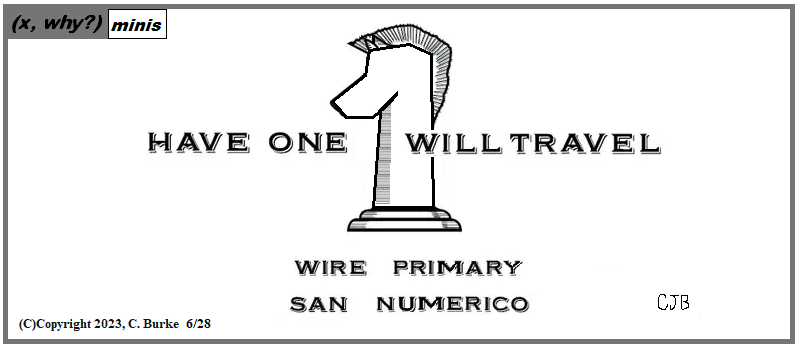
Have One what? I don't know. But have one anyway.

I thought about making this a TV series in the world of the AnthroNumerics(tm), and I even thought about giving this number 1 eyes and labeling it an Anthronumeric(tm). Or maybe it actually exists in that world. Who's to say? Other than me, at some point?

Maybe Ian (1) might sport a new hairdo for a while.

This is "fair use" and satire, to the best of my understanding. No challenge to IP rights is intended.


I also write Fiction!


You can now order Devilish And Divine, edited by John L. French and Danielle Ackley-McPhail, which contains (among many, many others) three stories by me, Christopher J. Burke about those above us and from down below.
Order the softcover or ebook at Amazon.

Also, check out In A Flash 2020, by Christopher J. Burke for 20 great flash fiction stories, perfectly sized for your train rides.
Available in softcover or ebook at Amazon.

If you enjoy it, please consider leaving a rating or review on Amazon or on Good Reads.


Come back often for more funny math and geeky comics.


Saturday, June 24, 2023

Too Fast

(Click on the comic if you can't see the full image.)
(C)Copyright 2023, C. Burke. "AnthroNumerics" is a trademark of Christopher J. Burke and (x, why?).

Watch out. Ken might take that as a challenge.

As we know from Summer 2008, Ken has a heavy foot with driving.

For those who are curious about the math, the speed of light is (in science classes) c = 3 x 10⁸ m/s. I always learned it as 186,000 miles per second. Since there are 3600 seconds in an hour, that would be just shy of 670 million miles per hour (allowing for rounding errors).

So 67 mph is 1/10,000,000th of the speed of light.

The background is from photo I took on an apple-picking trip in upstate New York about a decade or so ago.


I also write Fiction!


You can now order Devilish And Divine, edited by John L. French and Danielle Ackley-McPhail, which contains (among many, many others) three stories by me, Christopher J. Burke about those above us and from down below.
Order the softcover or ebook at Amazon.

Also, check out In A Flash 2020, by Christopher J. Burke for 20 great flash fiction stories, perfectly sized for your train rides.
Available in softcover or ebook at Amazon.

If you enjoy it, please consider leaving a rating or review on Amazon or on Good Reads.


Come back often for more funny math and geeky comics.


Thursday, June 22, 2023

Server Farm

(Click on the comic if you can't see the full image.)
(C)Copyright 2023, C. Burke. "AnthroNumerics" is a trademark of Christopher J. Burke and (x, why?).

You have to grow them somewhere.

Oddly, this comic started as something more absurb that would've left people scratching their heads saying "I don't get it". And then "server" came to mind.

It wasn't until I was almost done (after several days of working on this, and mulling it over) that I remembered that I'd done a Cubicle farm comic a long time ago. Ironically, I didn't fence in the servers like I did in the other comic.


I also write Fiction!


You can now order Devilish And Divine, edited by John L. French and Danielle Ackley-McPhail, which contains (among many, many others) three stories by me, Christopher J. Burke about those above us and from down below.
Order the softcover or ebook at Amazon.

Also, check out In A Flash 2020, by Christopher J. Burke for 20 great flash fiction stories, perfectly sized for your train rides.
Available in softcover or ebook at Amazon.

If you enjoy it, please consider leaving a rating or review on Amazon or on Good Reads.


Come back often for more funny math and geeky comics.


Thursday, June 15, 2023

How Many Desks?

(Click on the comic if you can't see the full image.)
(C)Copyright 2023, C. Burke. "AnthroNumerics" is a trademark of Christopher J. Burke and (x, why?).

When math teachers proctor science exams...

The problems are left as an exercise for the reader ... or the teacher, if one wishes to use them in class. It can be stipulated that there are whole numbers of students and desks.

These are not Calendar Math problems (meaning that they didn't appear on a published calendar), but they would work for a calendar because the answer is not greater than 31. You wouldn't want more than 31 students at the same time anyway! (The maximum number is subject to contract negotiations, of course.)

I also write Fiction!


You can now order Devilish And Divine, edited by John L. French and Danielle Ackley-McPhail, which contains (among many, many others) three stories by me, Christopher J. Burke about those above us and from down below.
Order the softcover or ebook at Amazon.

Also, check out In A Flash 2020, by Christopher J. Burke for 20 great flash fiction stories, perfectly sized for your train rides.
Available in softcover or ebook at Amazon.

If you enjoy it, please consider leaving a rating or review on Amazon or on Good Reads.


Come back often for more funny math and geeky comics.


Wednesday, June 07, 2023

School Life #35: Can't Even

(Click on the comic if you can't see the full image.)
(C)Copyright 2023, C. Burke. "AnthroNumerics" is a trademark of Christopher J. Burke and (x, why?).

It's just an odd day.

I guess it's a good thing that Mark came along. Otherwise, Shaun and Isabel might've had a problem.

Comic note: I was originally going for nine, and then I thought I could add another triple. But then that would've been an even number, and someone would've pointed that out. (Granted, I do like comments.) But I was able to squeeze it Freedom, Serenity (Ningjing) and Bibi, who (I believe) haven't appeared in a School Life comic before. I think it's because I imagine them to be at least a year older than the other students.

And if anyone is wondering, from left to right: Kyung (Ky), Brigid, Katie, Mark, Shaun, Isabel, Vaughn, Hal, Sven, Freedom, Serenity(Ningjing), Bibi, Daisy, Missy, and Vanessa.

According to my Character page, neither Brigid and Katie have actually been named in the comic yet, but at this point, I don't imagine changing those names.


I also write Fiction!


You can now order Devilish And Divine, edited by John L. French and Danielle Ackley-McPhail, which contains (among many, many others) three stories by me, Christopher J. Burke about those above us and from down below.
Order the softcover or ebook at Amazon.

Also, check out In A Flash 2020, by Christopher J. Burke for 20 great flash fiction stories, perfectly sized for your train rides.
Available in softcover or ebook at Amazon.

If you enjoy it, please consider leaving a rating or review on Amazon or on Good Reads.


Come back often for more funny math and geeky comics.